
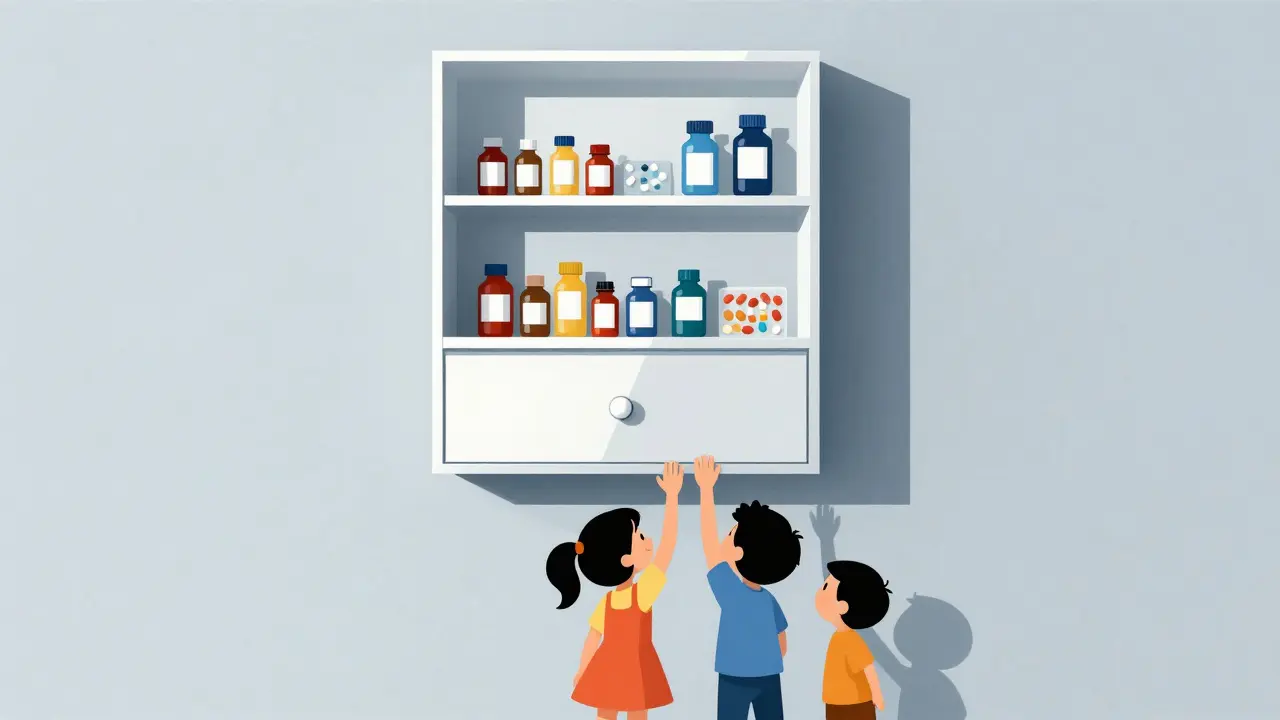
Every family needs a medicine cabinet. But most of them? They’re dangerous. Not because they’re empty - because they’re full of old pills, half-used bottles, and forgotten vitamins that kids can grab in seconds. In 2024, over 458,000 emergency room visits in the U.S. involved children under 19 who got into medications. Most of those happened at home. And it’s not just kids. Teens are taking pills from the cabinet, sometimes without asking. Even vitamins can be toxic in the wrong dose. The good news? You can fix this - fast. And you don’t need to spend a fortune.
Stop Storing Medicines in the Bathroom
The bathroom is the worst place for medicine. It’s humid. It’s warm. Moisture from showers and baths makes pills crumble, liquids grow mold, and creams turn watery. A 2025 study from Cone Health found that humidity can reduce the strength of common painkillers and allergy meds by up to 40% after just six months. That means your ibuprofen might not work when you need it. And if it’s expired? It could make you sick. Move your cabinet. Find a dry, cool spot - like a high shelf in a linen closet, a bedroom drawer, or even a closet in the hallway. The key is: no steam, no sunlight, no easy access. ADT’s 2023 safety guidelines say keep it at least four feet off the ground. That’s not a suggestion. It’s the minimum.Lock It - Even If You Think Your Kids Can’t Open It
Childproof caps? They’re not childproof. A 2021 Johns Hopkins study showed that 42% of kids aged 4 to 5 can open standard medicine bottles in under 10 minutes. That’s faster than you can say “I’ll just be a minute.” And if you think your kids aren’t curious? They are. Kids don’t care if it’s a vitamin or a painkiller. If it looks like candy, they’ll try it. If your cabinet doesn’t lock, get a childproof lock. They cost less than $15. Stick it on the door. Or better yet - put your meds in a locked drawer. Even a small lockbox from the hardware store works. For prescription painkillers or ADHD meds? Use a double lock: locked drawer inside a locked cabinet. The Hanley Foundation says 54% of teens who misuse prescription drugs get them from home. Locking it isn’t about distrust. It’s about safety.Empty It Out. Start Fresh.
Take everything out. Every pill, every bottle, every tube. Lay it all on the table. Now sort it into three piles: Keep, Toss, and Questionable. Toss anything expired. That includes vitamins, cough syrup, and antacids. The FDA says if it’s more than 12 months past the expiration date, it’s not just useless - it can be harmful. Expired antibiotics, for example, can cause dangerous reactions. Melonie Crews-Foye, a pharmacy supervisor, says it plainly: “If they are expired, get rid of them. They can do more harm than good.” Questionable? That’s anything you don’t recognize. A bottle with no label. A pill you can’t name. A cream with a weird smell. If you can’t tell what it is, throw it out. Don’t guess. Don’t hope. Don’t keep it “just in case.” Only keep what you use regularly - and make sure it’s in its original container. No more dumping pills into Ziploc bags. Labels have dosage info, expiration dates, and warnings. Without them, you’re playing Russian roulette.
Organize Like a Pro
Once you’ve cleaned it out, organize for speed and safety. Group by use: pain relief, allergies, cold/flu, first aid. Keep daily meds together. Put morning pills on one side, nighttime ones on the other. Cone Health recommends using free adherence packaging - small blister packs labeled by day and time. Many pharmacies offer this at no extra cost. Keep a written list. Write down every medicine you keep: name, dose, why you take it. Include vitamins, supplements, and eye drops. Keep a copy in your wallet and on your phone. If your child gets sick or you end up in the ER, this list saves minutes - and maybe lives.Dispose of Old Meds the Right Way
Never flush pills. Never toss them in the trash without mixing them up. The DEA says that’s how drugs end up in water supplies - and in the hands of people who shouldn’t have them. Use a take-back program. CVS, Walgreens, and most major pharmacies have free disposal kiosks. In 2023, the DEA’s National Prescription Drug Take Back Day collected over a million pounds of unused meds. That’s real impact. If there’s no drop-off nearby, use DisposeRX powder. It’s free. You get it from your pharmacy when you pick up an opioid prescription - but you can ask for it anytime. Just pour the powder into the bottle with your old meds, add water, shake, and throw it in the trash. The powder turns the pills into a gel that can’t be reused. Safe. Simple. Effective.Teach Your Family - Without Scaring Them
Kids need to know medicine isn’t candy. But you don’t need to make it scary. Say this: “These are tools for when you’re sick. Only grown-ups give them out.” Teens? Talk to them honestly. Tell them: “Taking someone else’s pill can hurt you. Even if it’s just a sleeping pill or a painkiller.” The data shows teens who misuse meds often think they’re safe because they’re “just OTC.” They’re not. A single extra dose of acetaminophen can cause liver failure. Post the Poison Help number - 800-222-1222 - on your fridge, your phone, and your bathroom mirror. Save it in your contacts as “Poison Help.” It’s free. It’s 24/7. And it’s staffed by real nurses and pharmacists who know exactly what to do.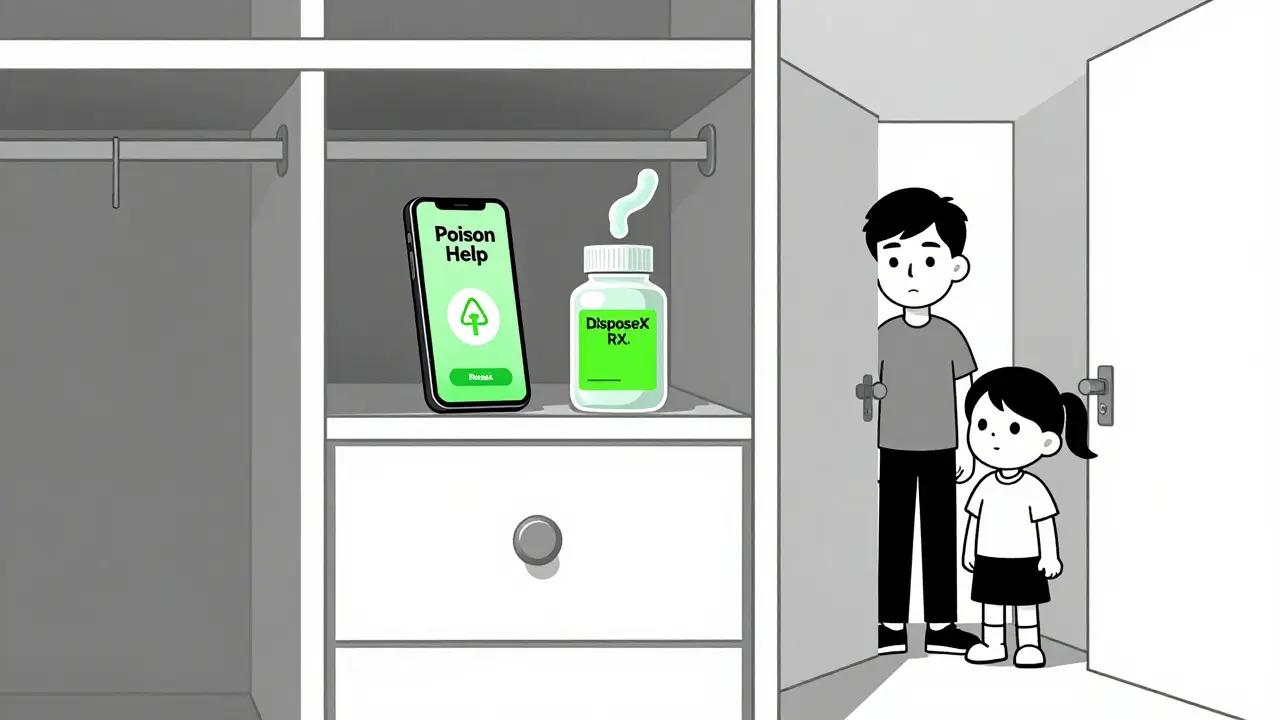
Check It Twice a Year
Set a reminder. Every April and October, do a quick cabinet check. Ask yourself:- Are any bottles expired?
- Is anything missing?
- Are the locks still working?
- Did we add anything new?
What About Smart Cabinets?
Some families are using smart locks that send alerts to your phone if someone opens the cabinet. ADT says adoption has grown 300% since 2020. These aren’t necessary for everyone - but if you have a teen with a history of substance use, or if you keep strong pain meds at home, it’s worth considering. They’re not magic, but they add a layer of awareness.Final Thought: Safety Isn’t Perfect - But It’s Possible
You can’t control everything. Kids are curious. Teens are testing boundaries. People come into your home - friends, relatives, delivery drivers. But you can control the cabinet. You can lock it. You can clean it. You can teach your family. And you can make sure the only thing that gets taken from it is healing - not harm.The goal isn’t a perfect cabinet. It’s a safe one. And that starts with one simple step: take everything out. Then build it back right.
Kristin Dailey
January 18, 2026 AT 12:59Just threw out three bottles of expired Tylenol this morning. Done. Next.
Robert Cassidy
January 18, 2026 AT 18:16You think this is about medicine? Nah. This is about control. They want you to lock everything up because they don’t trust Americans to make their own choices. The government’s been pushing this ‘safe cabinet’ nonsense since 2018. It’s not safety-it’s surveillance dressed up as parenting. And don’t get me started on those DisposeRX powders. Who’s really behind that? Big Pharma’s got its fingers in every pill bottle now.
I’ve got four kids. I keep meds in the kitchen cabinet. They know the rule: ask first. If they don’t, they get grounded. No locks needed. No apps. No weird gel magic. Just discipline. But sure, let’s spend $15 on a lock because the media says so. Classic fear-mongering.
And don’t even mention ‘smart cabinets.’ Next they’ll be putting trackers in Advil. The second you install one of those, you’re signing up for data mining. ADT? They’re owned by a private equity firm that also owns three private prisons. Coincidence? I think not.
Tyler Myers
January 19, 2026 AT 20:29Let’s be clear: if your kid can open a childproof cap, you’ve failed as a parent. Not the cap. YOU. The Johns Hopkins study? It’s not a surprise. Kids today are raised by TikTok and smartphones-they don’t know what ‘discipline’ means. And now you want to blame the medicine cabinet? No. Blame the mom who left the bottle on the counter while she scrolled Instagram. Blame the dad who thinks ‘just this once’ is okay.
And let’s talk about expiration dates. The FDA says 12 months? That’s a lie. Most pills are good for 5+ years. The expiration date is a corporate scam to make you buy new bottles. I’ve got ibuprofen from 2019. Still works. Still safe. The government doesn’t want you to know that. Why? Because they profit from your fear.
DisposeRX? That’s not for safety. That’s for cover-up. They don’t want you flushing pills because they’re worried about the water supply? Bullshit. They want to track what you’re throwing away. Every time you use that powder, you’re giving them a digital footprint. Don’t be fooled.
And smart cabinets? Please. That’s not security. That’s a backdoor for the state. Next thing you know, your cabinet logs will be subpoenaed because your teen took one aspirin. Welcome to the police state, folks.
Pat Dean
January 20, 2026 AT 16:33I’ve been a nurse for 22 years. I’ve seen kids collapse from acetaminophen overdoses. I’ve seen grandparents take expired antibiotics and end up in septic shock. This isn’t ‘fear-mongering.’ This is trauma. You think locking a cabinet is extreme? Try watching a 7-year-old code blue because you thought ‘it’s just a vitamin.’
I don’t care if you think the FDA is lying. I care that your kid is alive. I care that your 16-year-old isn’t addicted to Adderall because you left the bottle in the bathroom. You don’t need a PhD to understand this: out of sight, out of reach. Lock it. Clean it. Teach it. No drama. No conspiracy. Just do the right thing.
And if you think ‘discipline’ solves everything? Congrats. Your kid’s still alive. But what about the next family? The one that doesn’t have your ‘strength’? You’re not protecting your home-you’re ignoring the epidemic.
Jay Clarke
January 21, 2026 AT 02:33Look, I get it. You want to feel like a good parent. You want to check boxes. Lock the cabinet. Write a list. Buy the gel. But here’s the truth: kids are gonna find stuff. Always have. Always will.
I had a cousin who took my dad’s Xanax in 1998. He was 14. Didn’t die. Got grounded. Learned his lesson. That’s it. No lockbox. No app. No powder. Just consequences.
Now we’re turning medicine cabinets into Fort Knox because someone wrote a blog post? Come on. We’re not raising robots. We’re raising humans. Curiosity isn’t a crime. Overreaction is.
And don’t get me started on ‘teach them without scaring them.’ How? By pretending pills are ‘tools’? That’s not parenting. That’s therapy-speak. Say it straight: ‘If you take this without asking, you’ll lose your phone for a month.’ Works every time.
Stop buying into the fear industrial complex. Your kid isn’t going to die because you didn’t buy a $15 lock. They’re gonna die because you didn’t talk to them. That’s the real problem.
Emma #########
January 22, 2026 AT 14:13I really appreciate this post. My 5-year-old found my migraine pills last year-thankfully, they were just expired. But it scared me so bad. I didn’t realize how many things in our house were dangerous until I emptied the cabinet.
I started using the blister packs from my pharmacy. It’s free, and now I know exactly what I’m taking each day. I also wrote down everything on my phone and printed a copy for my mom’s house. She’s 72 and forgets what’s what.
And I found a take-back bin at my local CVS last week. It was so easy. I dropped off 12 bottles. Felt good. Like I was helping, not just protecting my family.
Also, I put the Poison Help number on my fridge next to the microwave. My daughter asked me what it was, and I told her it’s for when someone feels sick from medicine. She said, ‘Oh, like when I took the gummy vitamins too fast?’ And I said yes. Simple. No fear. Just facts.
Thank you for reminding us that safety doesn’t have to be complicated.
Andrew McLarren
January 22, 2026 AT 22:28While the practical advice presented herein is both methodical and empirically grounded, I must respectfully submit that the underlying paradigm assumes a static, nuclear-family model of domestic life. In contemporary households-particularly those with non-traditional caregivers, shared custody arrangements, or multi-generational cohabitation-the concept of a singular ‘medicine cabinet’ is increasingly anachronistic.
Furthermore, the emphasis on physical locking mechanisms may inadvertently reinforce a culture of surveillance rather than education. A more holistic approach would integrate pharmacological literacy into primary education, beginning at the elementary level, thereby cultivating intrinsic responsibility rather than external control.
Additionally, the reliance on proprietary disposal technologies such as DisposeRX introduces a dependency on corporate supply chains, which may not be universally accessible. Community-based pharmaceutical stewardship programs, funded by municipal health departments, would represent a more equitable and sustainable solution.
While I commend the intent of this guidance, I urge a re-examination of its sociopolitical underpinnings to ensure equitable implementation across diverse domestic ecologies.
Andrew Short
January 24, 2026 AT 08:12You’re all missing the point. This isn’t about kids. It’s about control. The real danger isn’t your 4-year-old grabbing a pill-it’s the fact that the government, pharmacies, and big pharma are using this ‘safety’ narrative to track your medication use. Every time you use a take-back bin, they log it. Every time you buy a lockbox, they sell you a product that connects to their cloud.
And who benefits? The same companies that make the pills. They want you to keep buying new ones. They want you to think your old meds are ‘dangerous’ so you don’t use them. That’s why expiration dates are fake. That’s why they push ‘disposal’ instead of reuse.
I’ve been using my 2018 blood pressure meds for 6 years. They’re fine. My doctor even said so. But now I’m supposed to throw them away because some bureaucrat in D.C. says so? No thanks. I’ll take my chances with the pills, not the system.
Locking your cabinet? Fine. But don’t pretend it’s about safety. It’s about compliance.
christian Espinola
January 25, 2026 AT 03:59Correction: The FDA does NOT say expired meds are ‘harmful’ after 12 months. That’s a myth. The FDA states that most medications retain potency well beyond expiration-often for years. The 12-month rule is a marketing tactic by manufacturers to drive repeat sales. You’re being misled.
Also: ‘DisposeRX’ is not free. It’s bundled into the cost of opioid prescriptions to create the illusion of corporate responsibility. You’re paying for it-just not directly.
And ‘smart cabinets’? They’re not ‘awareness tools.’ They’re IoT surveillance devices. ADT doesn’t care about your kids. They care about your data. Your cabinet’s open/close logs are sold to insurers. Don’t believe me? Check their privacy policy. It’s buried in paragraph 14.
Stop consuming fear. Start reading primary sources.
Chuck Dickson
January 26, 2026 AT 22:48Hey-this is actually awesome. I did this last month and it changed everything. Took me 45 minutes. Got rid of 27 bottles. Bought a $12 lockbox from Home Depot. Put it on the top shelf of my closet. No one touches it. Not even my wife.
My 12-year-old asked why the meds were locked. I said, ‘Because they’re powerful. Like a knife. You don’t play with knives unless someone shows you how.’ He got it. No lecture. Just truth.
Also, I asked my pharmacist for the blister packs. She gave them to me for free. Now I don’t miss a pill. My anxiety’s down. My sleep’s better. I feel like I’ve got my life back.
If you’re reading this and thinking ‘I don’t have time’-you do. 15 minutes. That’s all it takes. Do it for your kid. Do it for your future self.
You got this.
Naomi Keyes
January 27, 2026 AT 20:18Let’s be precise: the FDA’s official guidance on expired medications states that ‘there is no evidence that taking expired medications is harmful’-except for specific classes like tetracycline, nitroglycerin, and insulin. You’re conflating potency loss with toxicity. This is inaccurate. And dangerous misinformation.
Additionally, ‘DisposeRX’ is not universally available-it’s only distributed with opioid prescriptions in certain states. You’re implying it’s a public health resource when it’s a corporate liability shield.
And ‘smart cabinets’? The ADT product referenced is the ‘ADT Smart Home Medication Dispenser’-which requires a subscription. You didn’t mention that. That’s misleading.
Also: ‘Keep a written list’-but you didn’t specify format. Is it handwritten? Digital? Encrypted? HIPAA-compliant? If not, you’re risking PHI exposure. This is sloppy advice.
And ‘childproof caps’? They’re not ‘childproof’-they’re ‘child-resistant’ per ASTM standards. Terminology matters. You’re perpetuating a false sense of security.
And one last thing: you said ‘458,000 ER visits.’ That’s correct-but 70% of those were due to accidental ingestion in children under 6. Not teens. Not misuse. Accidents. So your entire ‘teens stealing pills’ section is statistically misleading.
Fix your facts. Your credibility depends on it.
Dayanara Villafuerte
January 28, 2026 AT 18:40OMG YES 🙌 I did this last weekend and it felt like a detox for my whole house 😭 I threw out so much junk-expired cough syrup from 2020, a tube of ‘antibiotic cream’ that smelled like old socks 🤢, and a bottle of ‘vitamins’ that had my ex’s name on it 💀
Got the free blister packs from CVS-my grandma cried when she saw them. Said it was the first time she’d ever taken her meds on time. 😭
Also, I put the Poison Help number on my fridge with a little heart emoji ❤️ and now my 8-year-old says ‘I’ll call Poison Help if I feel weird’ and I’m like… okay, that’s my baby. 💕
Also-why is everyone so mad? It’s just a cabinet. Lock it. Clean it. Breathe. We got this. 🌈
Andrew Qu
January 30, 2026 AT 10:17One thing I didn’t see mentioned: what about pets? My dog ate a bottle of my fish oil capsules last year. Didn’t kill him-but he was sick for days. Same rules apply: lock it, keep it high, clean it out. Pets are just as curious as kids.
Also, if you’re using supplements, check the label for third-party testing (USP, NSF, or ConsumerLab). A lot of ‘natural’ vitamins have heavy metals or hidden drugs. I’ve seen cases where ‘turmeric’ had ibuprofen in it. Crazy, right?
Don’t just clean the cabinet-clean your assumptions too. Your ‘harmless’ supplement might be the most dangerous thing in there.
You’re doing great. Keep going.
rachel bellet
January 30, 2026 AT 12:32Let’s deconstruct the epistemological framework of pharmaceutical safety as presented here. The normalization of institutionalized containment-via lockboxes, smart cabinets, and disposal protocols-reinforces a biopolitical regime wherein bodily autonomy is subordinated to administrative risk mitigation. The individual is rendered a passive node within a surveillance-capitalist pharmacopoeia.
The reliance on ‘childproof’ containers, while ostensibly protective, functions as a symbolic gesture of paternalism, displacing the necessity for developmental education with mechanical deterrence. This is not safety-it is institutionalized infantilization.
Furthermore, the valorization of ‘original containers’ as epistemic authority privileges pharmaceutical packaging as a site of truth-production, ignoring the historical commodification of medical knowledge by corporate entities. The label is not neutral-it is a marketing artifact.
The ‘written list’ is a performative act of compliance with HIPAA-adjacent bureaucracy, not a tool of empowerment. It reduces pharmacological agency to a spreadsheet.
And DisposeRX? A neoliberal solution to a structural problem. The state outsources responsibility to the consumer while the pharmaceutical industry profits from both the sale and the disposal.
True safety lies in dismantling the system, not optimizing its containers.
Kristin Dailey
January 31, 2026 AT 18:30Update: I locked my cabinet. My 10-year-old asked why. I said, ‘Because I love you.’ He hugged me. Done.
Chuck Dickson
February 1, 2026 AT 05:22That’s the best thing I’ve read all week. Thank you. 💙