
Many people assume that because generic medications are cheaper, they don’t need financial help. But that’s not true. Even though generics cost 80-85% less than brand-name drugs, they still add up-especially if you’re taking three or four every month. For someone on a fixed income, paying $10 for levothyroxine, $12 for metformin, and $8 for lisinopril every 30 days can mean skipping meals or choosing between meds and rent. The good news? There are ways to cut those costs, even if you don’t qualify for Medicaid or can’t get a manufacturer coupon. The key is knowing where to look-and what’s changed in 2025.
Why Generics Still Need Help
Generic drugs aren’t cheap because they’re low quality. They’re cheap because they don’t have to pay for research, marketing, or patents. But that also means drugmakers can’t afford to offer copay cards like big pharma does. A Gilead copay card might bring a $1,200 brand-name pill down to $0. But for a $15 generic? There’s no card. No discount. No help. That leaves patients stuck with whatever their insurance says. The problem isn’t just the price-it’s how insurance works. Most plans put generics in Tier 1, with a $5-$10 copay. Sounds fine, right? But if you’re on Medicare Part D, every dollar you pay for those generics counts toward your out-of-pocket limit. In 2024, that limit was $8,300. Once you hit it, your costs drop to 5% of the drug price. But reaching that limit takes time-especially if you’re only paying $5 per pill. That’s why many people don’t realize they’re building toward a cap that could save them thousands later.Extra Help: The Best Option for Medicare Beneficiaries
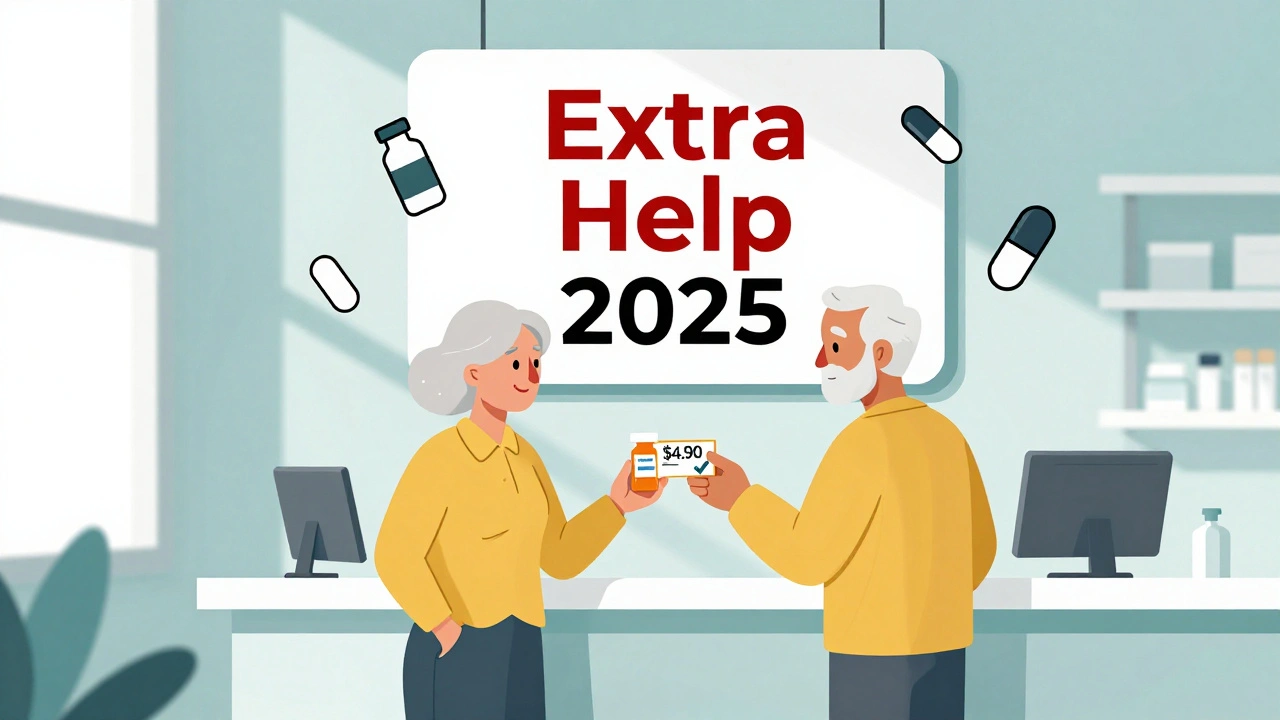
If you’re on Medicare and have a low income, Extra Help (also called the Low-Income Subsidy) is the most powerful tool available. Starting January 1, 2025, it will cut your generic copay to exactly $4.90 per prescription-and $12.15 for brand-name drugs. No deductible. No coverage gap. No surprises. You automatically qualify if you get Medicaid, Supplemental Security Income (SSI), or a Medicare Savings Program. But even if you don’t, you might still qualify based on income. For 2025, individuals earning up to $21,870 annually and couples up to $29,580 can apply. That’s higher than you might think. Many people who work part-time or live on Social Security don’t realize they’re eligible. Applying takes 15-20 minutes online at SSA.gov or through your local State Health Insurance Assistance Program (SHIP). You’ll need your most recent tax return, bank statements, and proof of any other income. SHIP counselors helped over 1.2 million people with generic drug costs in 2023-and 68% of those cases were about confusion over why their $5 generics still counted toward their $8,300 cap. Extra Help fixes that.Pharmacy Discount Programs: No Application Needed
If you’re not on Medicare or don’t qualify for Extra Help, don’t give up. Your local pharmacy might have a discount list. Walmart, Kroger, Target, and many independent pharmacies offer generic medication lists for as low as $4 or $10 per 30-day supply. These aren’t insurance plans-they’re cash prices. And you can use them even if you have insurance. Here’s how it works: Ask the pharmacist, “Do you have a $4 generic list?” Then ask which drugs are included. Common ones: lisinopril, metformin, levothyroxine, atorvastatin, amoxicillin. The list changes, but most cover 150+ medications. The catch? You can’t combine it with your insurance copay. If your insurance charges $10 and the cash price is $4, pay cash. You’ll save money. A 2024 American Pharmacists Association study found that 62% of patients don’t even ask about these programs. They assume insurance is their only option. That’s a mistake. One woman in Ohio was paying $28 for her generic metformin through her plan. She switched to the Walmart $4 list and saved $24 every month. That’s $288 a year-on a drug she takes every day.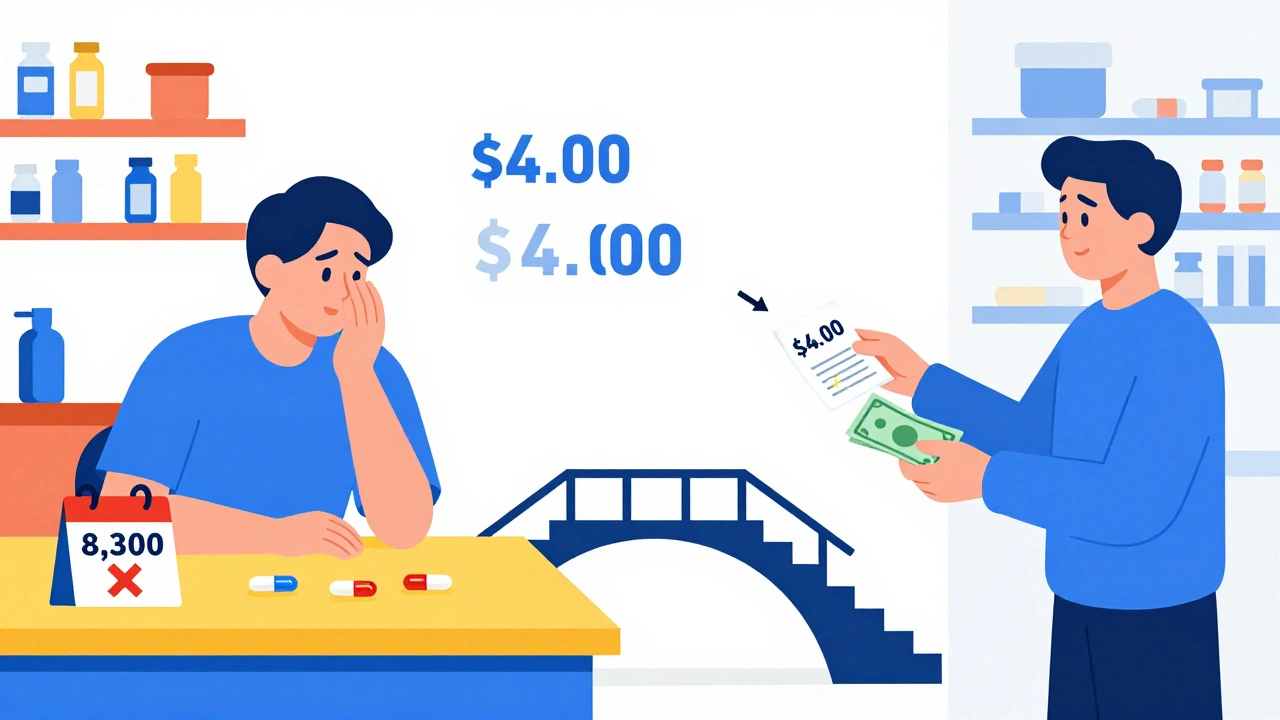
Nonprofit Assistance: For Those Who Fall Through the Cracks
There’s a gap in the system. People who earn too much for Medicaid but too little to afford $30 a month in generics. They don’t qualify for Extra Help. They don’t get manufacturer cards. And they’re not poor enough for most nonprofit aid. Organizations like the PAN Foundation and NeedyMeds help here. PAN covers 72 diseases, but only 17 of those programs are for conditions that use mostly generics-like high blood pressure, diabetes, and thyroid disease. To qualify, your income must be under 400% of the federal poverty level ($56,120 for an individual in 2025). Approval takes about 3 weeks. You’ll need your doctor to confirm your diagnosis and your insurance details. NeedyMeds is free to use. Just search your drug, and it shows every available discount, coupon, or patient assistance program. In 2023, they processed 417,000 applications. The approval rate was 78% for those under 250% FPL-but only 12% for those between 250-400% FPL. That’s the ‘assistance cliff.’ You make just enough to be denied help, but not enough to pay.What Changed in 2025
The Inflation Reduction Act didn’t just tweak the system-it rewrote it. Starting January 1, 2025, Medicare Part D beneficiaries will have a hard cap of $2,000 per year on out-of-pocket drug costs. That’s down from $8,300. For people on generics, this is huge. Most will reach that cap faster because they’re taking more refills. Once you hit $2,000, your generics cost $0 for the rest of the year. Also gone: the deductible for Extra Help recipients. And insulin-generic or brand-will now cost no more than $2 per month. That’s a game-changer for millions. Pfizer also announced it’s expanding its patient assistance program in 2025 to include more generic medications. It’s not a copay card, but it’s a step toward closing the gap.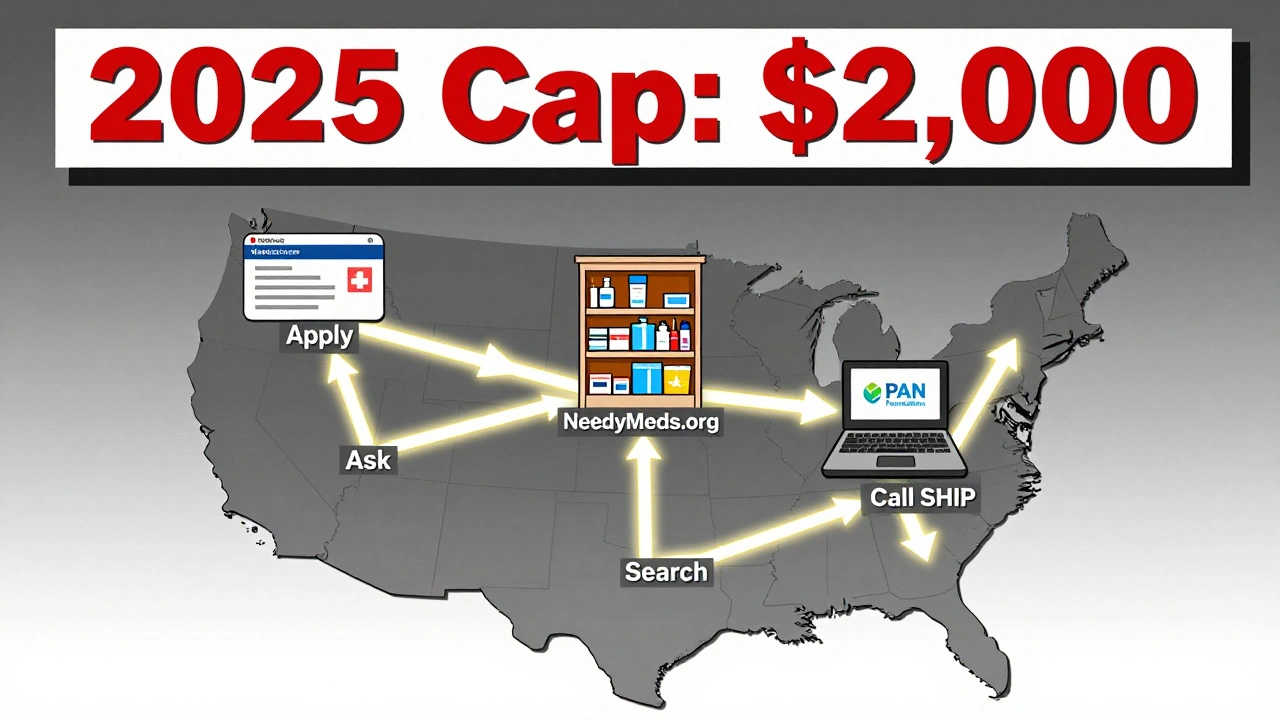
How to Get Help: A Simple Plan
Here’s what to do, step by step:- Check if you qualify for Extra Help at SSA.gov or call 1-800-MEDICARE. Use your 2024 income to apply.
- Ask your pharmacist for the $4 or $10 generic list. Compare it to your insurance copay. Pay cash if it’s cheaper.
- Search NeedyMeds.org for your exact drug names. Bookmark the page.
- Apply to PAN Foundation if you have a chronic condition treated with generics (diabetes, hypertension, etc.).
- Call SHIP in your state. They’ll walk you through every option-free of charge.
What Not to Do
Don’t skip your meds because you can’t afford them. A 2023 study in the Annals of Internal Medicine found that 38% of people who couldn’t pay for their generics stopped taking them. That led to more ER visits, hospital stays, and higher long-term costs. Don’t assume your insurance is the only option. Pharmacy discount programs work even if you have Medicare Part D. You just can’t use both at the same time. Don’t wait until you’re in crisis. Extra Help applications take 45-90 days to process. Apply now, even if you’re not sure you qualify. You might be surprised.Final Thought
Generic drugs are supposed to be the answer to high drug prices. But without support, they’re just a slightly cheaper burden. The system is changing-and fast. In 2025, more people than ever will pay less. But you have to act. Don’t wait for help to come to you. Find it. Ask for it. Use it. Your health depends on it.Can I use a pharmacy discount program if I have Medicare?
Yes. Pharmacy discount programs like Walmart’s $4 list are cash prices and can be used instead of your Medicare copay. You can’t combine them with insurance, but if the cash price is lower than your copay, paying cash saves you money. Many Medicare beneficiaries don’t know this and overpay every month.
Why don’t generic drug companies offer copay cards like brand-name makers?
Generic manufacturers make very thin profits-often just pennies per pill. Brand-name companies charge hundreds or thousands of dollars per dose and can afford to subsidize copays. Generic makers can’t. If they offered discounts, they’d lose money. That’s why help comes from pharmacies, nonprofits, and government programs instead.
What if I make too much for Extra Help but still can’t afford my meds?
You’re not alone. Many people earn just above the income limit and fall into what’s called the ‘assistance gap.’ Your best options are pharmacy discount programs (Walmart, Kroger, SingleCare), NeedyMeds for coupons, and PAN Foundation if you have a qualifying chronic condition. Apply to multiple programs at once-most successful applicants use two or more.
Does the $2,000 out-of-pocket cap in 2025 include generic medications?
Yes. All prescription drug costs you pay out of pocket-whether for generics or brand-name drugs-count toward the $2,000 cap under Medicare Part D in 2025. That means if you take multiple generics every month, you’ll hit the cap faster than someone taking expensive brand-name drugs. Once you hit $2,000, your generics will cost $0 for the rest of the year.
Can I get help for insulin if I’m on a generic version?
Yes. Starting January 1, 2025, all insulin-including generic versions like insulin glargine-will cost no more than $2 per month for Medicare Part D beneficiaries. This applies regardless of your income. It’s one of the most significant changes in decades and will help millions.
How do I know if my generic drug is on a pharmacy discount list?
Ask your pharmacist directly. Most pharmacies publish their lists online. Walmart’s list includes over 150 generics and updates quarterly. You can also search NeedyMeds.org, which tracks discount programs by drug name and pharmacy. If your drug isn’t listed, ask if they can price-match a competitor’s discount.

Ben Greening
December 11, 2025 AT 09:17Interesting breakdown. I’ve been using the Walmart $4 list for my metformin for over a year now-never even knew I could bypass my Medicare copay until a pharmacist mentioned it. Saved me $180 a year on just one drug. Simple stuff, really. Why don’t more people ask?
Neelam Kumari
December 12, 2025 AT 06:13Oh please. You people act like $4 is a miracle. In India, we get generics for 20 rupees-like, $0.24. You’re all crying over a coffee’s worth of cash while your government lets Big Pharma laugh all the way to the bank. At least here, we don’t need a 15-step application just to afford insulin.
David Palmer
December 13, 2025 AT 12:54Wait so you’re telling me I can just walk into Walmart and pay less than my insurance? No cap? No forms? No waiting? That’s wild. I’ve been paying $12 a month for lisinopril through my plan. I’m gonna go right now. If this is real, I’m never using insurance for meds again. Like, ever. This feels like a loophole.
Doris Lee
December 14, 2025 AT 10:52This is exactly the kind of info people need to hear. You’re not broken if you can’t afford meds-you just haven’t found the right tools yet. Try the $4 list. Talk to your pharmacist. Apply for Extra Help even if you think you don’t qualify. You’ve got this. And if you’re reading this and feeling overwhelmed? Breathe. Help is out there. You’re not alone.
Michaux Hyatt
December 14, 2025 AT 22:43Just to add-NeedyMeds is your best friend. I used to think it was just a directory, but it links to actual applications for PAN, state programs, even local food banks that help with med costs. I helped my neighbor apply last month-she got approved for both Extra Help and PAN for her diabetes meds. Took her 3 weeks. She’s now paying $0 for three drugs. Life-changing.
Raj Rsvpraj
December 15, 2025 AT 13:06...And yet, you Americans still rely on charity. In my country, we have universal healthcare-meds are covered. You have a system that treats medicine like a luxury commodity. You’re not victims-you’re enablers. You vote for people who let this happen. And now you’re celebrating $4 pills like it’s a revolution? Pathetic.
Frank Nouwens
December 15, 2025 AT 16:06It is indeed noteworthy that the Inflation Reduction Act has precipitated a significant recalibration of out-of-pocket expenditure ceilings for Medicare Part D beneficiaries, particularly with regard to the implementation of a $2,000 annual cap effective January 1, 2025. This development, while long overdue, represents a meaningful stride toward equitable access to essential pharmaceuticals for elderly and fixed-income populations.
Aileen Ferris
December 16, 2025 AT 13:55wait so generic insulin is $2 now?? but like… what if your pharmacy doesnt have it?? and what if your doc wont prescribe the generic?? and what if your insurance still charges you $15?? this feels like a trap
Rebecca Dong
December 17, 2025 AT 22:38THEY’RE LYING. This is all a distraction. The real cost? Your data. Every time you apply for Extra Help, they track your meds. Every time you use a discount card, your name goes into a database. Next thing you know, your insurance rates go up because ‘you’re high risk.’ And don’t get me started on the 2025 cap-it’s just a bait-and-switch. They’ll raise premiums next year. You think they want you healthy? No. They want you compliant. Watch.
Nikki Smellie
December 18, 2025 AT 06:14Did you know that the $2 insulin cap only applies to Medicare? What about the 15 million non-Medicare Americans who still pay $100+? And what about the pharmacies that quietly refuse to honor the $4 list unless you ask three times? And what about the 40% of seniors who can’t use the internet to apply? This isn’t help-it’s a rigged game with glitter on top.
Queenie Chan
December 19, 2025 AT 20:13Okay, but what about the people who take 8 generics? Like, my aunt has diabetes, hypertension, thyroid, arthritis, depression, and cholesterol-all on generics. She’s paying $110/month. Even with Extra Help and Walmart, she’s still at $45. Is there a program for the ‘super-polypharmacy’ crowd? I feel like the system was designed for people taking one or two meds. Anyone else feel like we’re all just glitching through the cracks?