
When you pick up a prescription at the pharmacy, you probably don’t think about why your insurer covers one generic drug but not another-even if both seem identical. The truth is, insurers don’t just pick generics at random. There’s a detailed, often invisible process behind every drug on your plan’s formulary. And it’s not about saving a few dollars-it’s about balancing safety, effectiveness, and cost across millions of people.
How Formularies Work
Every health plan, whether it’s Medicare, Medicaid, or a private insurer like UnitedHealthcare or Cigna, has a list called a formulary. This is the official roster of drugs the plan agrees to pay for. Generics make up the backbone of this list. In fact, 87% of all prescriptions filled in the U.S. are for generic drugs, according to the American Pharmacists Association. That’s not an accident. It’s the result of a deliberate strategy by insurers to cut costs without sacrificing care. Formularies are organized into tiers. Think of them like pricing levels. Tier 1 is the cheapest. That’s where nearly all generic drugs land. A 30-day supply of a Tier 1 generic typically costs you $0 to $15. Compare that to a brand-name drug in Tier 3 or 4, which might set you back $40 to $100 or more. Medicare Part D plans, which cover over 50 million people, have made this structure standard: 92% of them use a 3-tier system where Tier 1 is exclusively for generics. Blue Shield of California, Humana, and CVS Health all follow the same pattern. The goal? Make the cheapest, safest option the easiest one to get.The Pharmacy & Therapeutics Committee
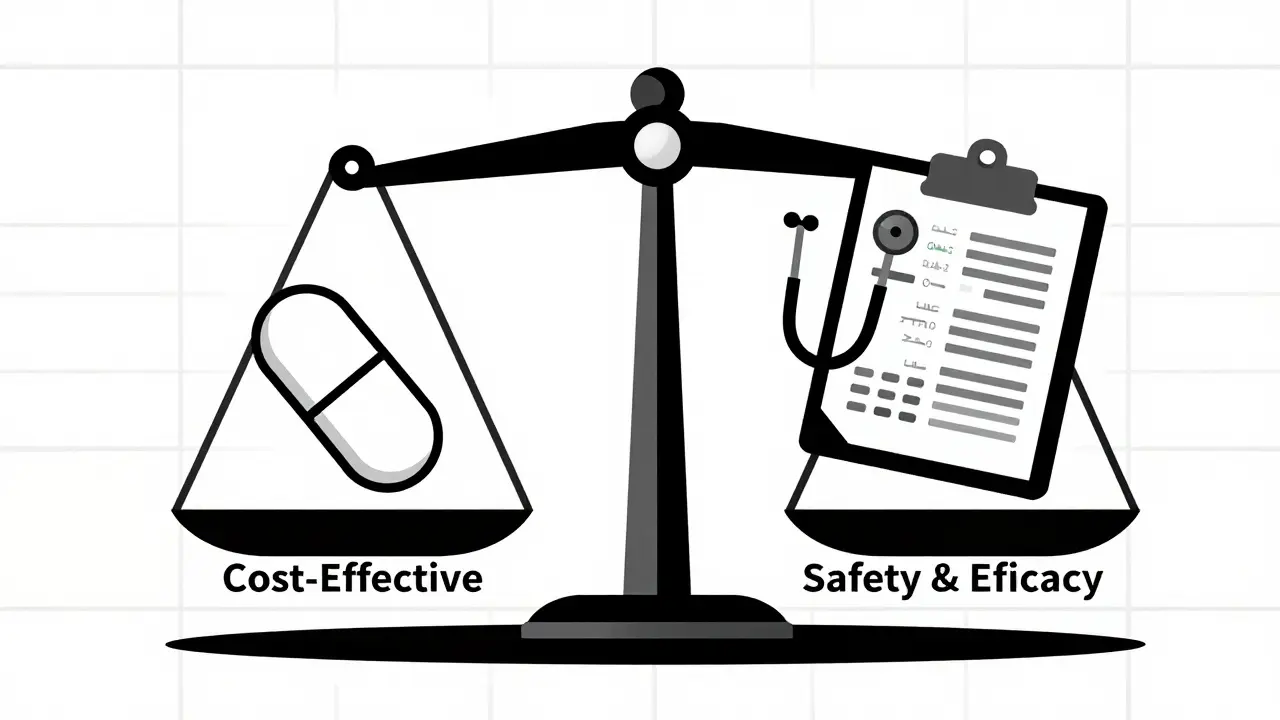
Who decides which generics make the cut? It’s not a single person. It’s a committee-usually called the Pharmacy & Therapeutics (P&T) committee. These groups are made up of doctors, pharmacists, and sometimes even patient advocates. They meet regularly, review data, and vote on which drugs get added or removed. Their decisions aren’t based on guesswork. They look at three things:- Clinical effectiveness: Does the drug actually work? The committee reviews clinical trials, real-world outcomes, and studies from journals. If two generics treat high blood pressure equally well, they’ll pick the one with the strongest evidence.
- Safety: Even if a drug works, does it cause more side effects? A generic that leads to more hospital visits or allergic reactions won’t make the list, no matter how cheap it is.
- Cost-effectiveness: This is where insurers really focus. If Drug A and Drug B do the same thing, but Drug B costs 40% less, Drug B wins. That’s not just about the drug’s price-it’s about total cost to the system. A $5 generic that prevents a $10,000 hospital stay is a no-brainer.
Why Some Generics Get Rejected
Not every generic that’s FDA-approved gets covered. Why? Because approval and coverage aren’t the same thing. The FDA says a generic is “therapeutically equivalent” if it has the same active ingredient, strength, dosage form, and route of administration as the brand-name drug. That’s the legal baseline. But insurers go further. They look at whether the generic is manufactured by a company with a reliable track record. If a manufacturer has had recalls, quality issues, or supply chain problems, the P&T committee may skip their product-even if it’s technically approved. Some generics are also excluded because they’re too new. Insurers wait to see how they perform in real use. A 2023 study in the Journal of Managed Care & Specialty Pharmacy found that many insurers delay coverage for generics until they’ve been on the market for at least six months. This isn’t about distrust-it’s about avoiding surprises. If a new generic causes unexpected side effects in thousands of patients, the plan wants to know before it’s widely prescribed.
Therapeutic Substitution and Patient Impact
Here’s where things get tricky for patients. Many insurers don’t just cover generics-they require you to use them. This is called therapeutic substitution. If your doctor prescribes a brand-name drug, your pharmacy might automatically switch you to a generic version at the counter. In 78% of commercial insurance plans, this happens without asking you first. For most people, this works fine. But not always. A 2023 survey by Drug Topics found that 31% of patients reported side effects after switching to a generic they hadn’t experienced before. Maybe the inactive ingredients (like fillers or dyes) differ slightly. Or maybe the absorption rate varies just enough to cause problems for someone with a sensitive condition. That’s why exception requests exist. If a generic doesn’t work for you-or makes you sick-you can ask your doctor to file an appeal. The insurer must respond within three business days. In urgent cases, they have just one day. If they don’t respond? The drug gets approved automatically. The Patient Advocate Foundation found that 78% of patients who appeal get coverage eventually. But the system still puts a heavy burden on doctors. One 2022 AMA survey found that physicians spend over 13 hours a week just dealing with prior authorizations and formulary exceptions.Transparency Issues
Here’s the uncomfortable truth: most people don’t know how these decisions are made. Only 37% of insurers publicly share their full P&T committee criteria. You won’t find a detailed list on your plan’s website. You won’t get a report explaining why one generic was chosen over another. That lack of transparency frustrates patients and providers alike. Some insurers, like UnitedHealthcare, score well on transparency-rated 4.2 out of 5 in a 2023 CAQH Index. Others? Below 2.5. That inconsistency makes it harder for doctors to know what to prescribe. It also means patients can be caught off guard when a drug they’ve been taking suddenly gets dropped from coverage.
The Bigger Picture: Cost, Supply, and the Future
The economic impact is huge. From 2007 to 2019, Medicare Part D saved $1.67 trillion by using generics. In 2019 alone, that totaled $141 billion in savings. The U.S. generic drug market is worth $81.8 billion and is expected to hit $112.6 billion by 2027. That growth is fueled by insurer policies that push generics as the default option. But challenges are emerging. The FDA reported 372 active drug shortages in late 2023, and 78% of them were generics. When a key generic runs out, insurers scramble. They might switch to a more expensive alternative-or delay coverage until supply returns. The Inflation Reduction Act of 2022, which caps out-of-pocket drug costs at $2,000 per year for Medicare beneficiaries starting in 2025, is changing the game. With patients paying less out of pocket, insurers are shifting focus. Instead of just pushing the cheapest generic, they’re now looking at volume. High-use generics that prevent hospitalizations are becoming top priorities. And then there’s the future. AI-driven personalized generics are on the horizon. These aren’t your typical pills-they’re custom-formulated drugs based on a patient’s genetics. Right now, 62% of P&T committee leaders say they’re unsure how to evaluate these new products. The rules haven’t caught up.What You Can Do
If you’re on a plan that doesn’t cover your generic:- Ask your doctor to file an exception request. They’ll need to show that the covered alternative caused side effects, didn’t work, or required a higher dose than allowed.
- Check if your pharmacy offers a cash price. Sometimes paying out of pocket is cheaper than your copay.
- Review your plan’s formulary every year during open enrollment. Insurers change their lists-and they don’t always tell you.


Levi Viloria
February 28, 2026 AT 12:26John Cyrus
February 28, 2026 AT 16:47John Smith
February 28, 2026 AT 20:48Richard Elric5111
March 2, 2026 AT 07:59Dean Jones
March 2, 2026 AT 09:05Betsy Silverman
March 4, 2026 AT 08:08Ivan Viktor
March 4, 2026 AT 15:35Sharon Lammas
March 6, 2026 AT 00:56Zacharia Reda
March 6, 2026 AT 23:42