
Every year, thousands of people end up in the hospital-not because they got sick, but because they took the wrong pill. Sometimes it’s the wrong dose. Sometimes it’s the wrong drug entirely. And in most cases, it happens because someone didn’t stop to check the label. Not once. Not even twice. Just assumed they knew what was in their hand. That’s how dangerous this habit is.
You’ve probably heard the advice: "Always check your labels." But if you’ve tried it before and gave up, you’re not alone. Most people forget. Or they think, "I’ve taken this for months, I know what it is." But memory is unreliable. And when it comes to your health, you can’t afford to guess.
Why Checking Labels Saves Lives
In the U.S., medication errors cause between 7,000 and 9,000 deaths every year. That’s more than car accidents or gun violence. The biggest cause? Confusing one pill for another. A 2023 study by SmithRx found that people who checked their labels before every dose cut their risk of making a mistake by 76%. That’s not a small improvement. That’s life or death.
Why does this happen so often? Because labels are messy. Pills look alike. Names sound similar. A bottle labeled "Lisinopril 10 mg" might sit next to "Lisinopril-HCTZ 20 mg"-and if you’re rushing in the morning, you might grab the wrong one. Or worse, you might grab last week’s bottle because it’s still on the counter.
The FDA updated labeling rules in January 2025 to make this easier. New labels must use at least 6-point sans-serif font for key info and 8-point or larger for warnings. Colors are chosen for high contrast. But none of that matters if you don’t actually look at it.
The 10 Things You Must Check Every Time
Don’t just glance. Scan. Verify. There are 10 specific things you need to confirm before you swallow anything:
- Your full name - Is it spelled right? Does it match your ID?
- Drug name - Both brand and generic. "Advil" is ibuprofen. "Lipitor" is atorvastatin. Know both.
- Prescriber’s name - Did your doctor actually order this? Sometimes, a refill gets mixed up.
- Dosage and strength - 10 mg? 50 mg? Big difference. Look for "mg," "mcg," or "units." Never assume.
- Quantity and refills - Did you get the right number of pills? Are there refills left?
- Warnings - "Avoid alcohol." "Take with food." "May cause dizziness." These aren’t suggestions. They’re safety rules.
- Date filled - If it’s older than 30 days, ask your pharmacist. Some meds lose potency fast.
- Expiration date - Never take expired pills. They don’t just stop working-they can become harmful.
- Pharmacy name and number - If something looks off, call them. Pharmacists are trained to catch mistakes.
- Administration instructions - "Take once daily"? "Take at bedtime"? "Take with water only"? Get this right.
That’s not a lot to remember. But if you do it every time, you’ll be in the top 1% of medication safety.
The Three-Touch Method: How to Make It Stick
Trying to remember to check labels is like trying to remember to brush your teeth without a routine. You need a habit. Not a reminder. A habit.
The American Society of Health-System Pharmacists (ASHP) recommends the Three-Touch Method. Here’s how it works:
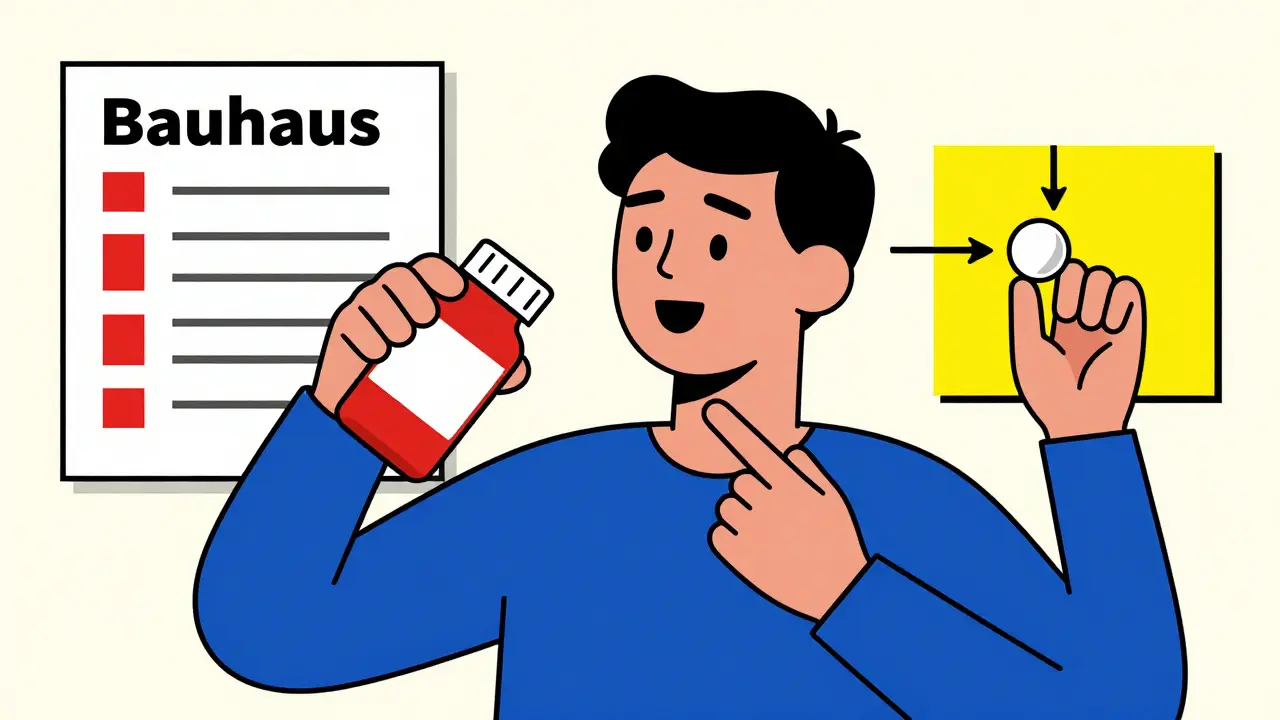
- Hold the bottle in your hand.
- Touch the label with your finger and say aloud: "This is [your name], for [condition], [dose] [times per day]."
- Touch the cap, then the pill, then say: "I am taking this now."
It sounds silly. But here’s the science: physical touch + verbal repetition = memory reinforcement. SmithRx’s clinical trial showed that people using this method had 92% adherence after 30 days. Silent checking? Only 64%.
Try it for 21 days. That’s how long it takes for most people to turn a conscious action into an automatic habit. Don’t skip a day. Even if you’re tired. Even if you’re alone. Say it out loud. It’s not about being weird-it’s about being safe.
What If You Can’t Read the Label?
If you’re over 65, or if you have trouble seeing, you’re not alone. One in five adults in the U.S. has vision problems that make small print hard to read. That’s not a personal failing. It’s a design flaw.
Here’s what to do:
- Ask your pharmacist for a magnified label. Many pharmacies offer this for free. It’s a sticker with larger text you can stick on the bottle.
- Use a handheld magnifier or phone camera zoom. Turn on the flashlight.
- Ask a family member to read the label aloud while you listen. Then repeat it back. This "teach-back" method improves retention by 57%.
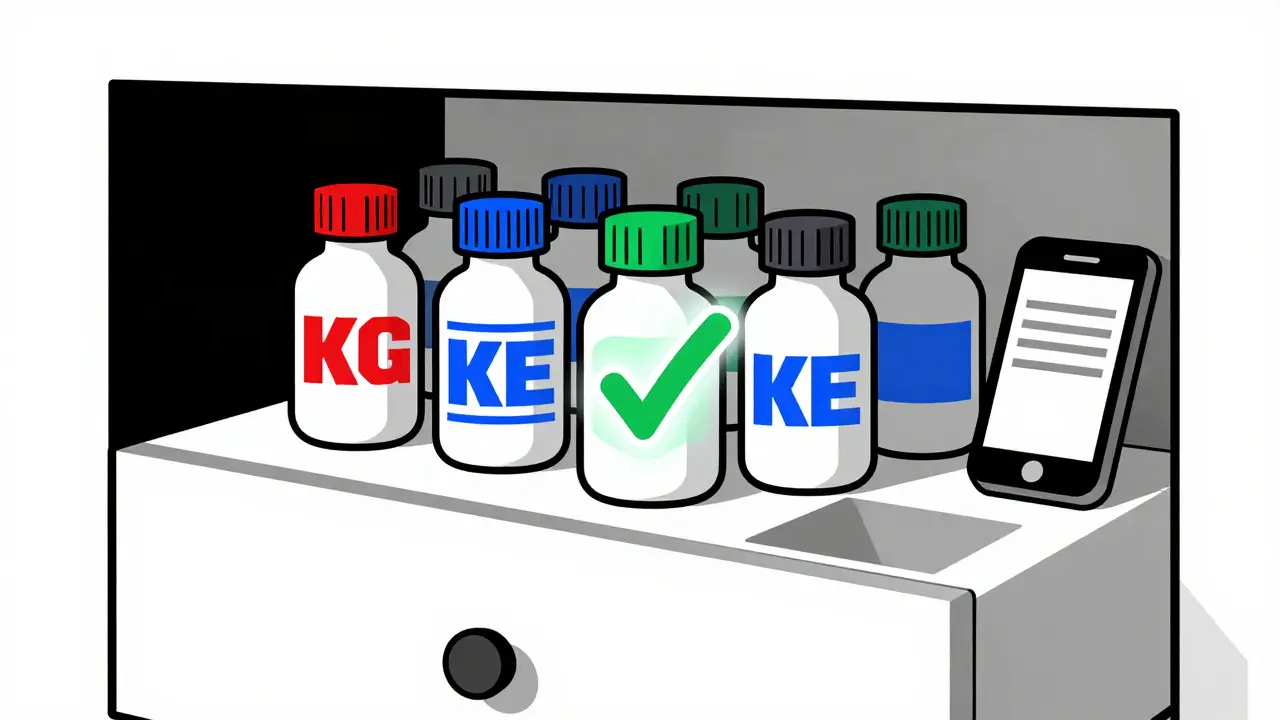
- Use color-coded caps. Ask your pharmacist to put a red cap on blood pressure meds, blue on insulin, green on antibiotics. Visual cues beat text when reading is hard.
One woman in Belfast, 78, started confusing her insulin with saline solution. She’d been using the same bottle for months. Then her daughter helped her switch to a red cap and wrote "INSULIN" in big letters on masking tape. She hasn’t made a mistake since.
Why Pill Organizers and Apps Alone Don’t Work
You’ve probably seen those little plastic boxes with days of the week. Or apps that buzz to remind you to take your meds. They sound great. But they don’t stop you from grabbing the wrong pill.
Outsource Pharma’s 2023 study showed:
- Pill organizers reduce errors by 42% - but only if you fill them correctly. And if you mix up pills while filling them? You’ve just created a new risk.
- Medication apps without label verification? Only 29% reduction in errors.
- Apps that require you to photograph the label before logging a dose? 63% higher user retention at 90 days.
The problem with tech is it removes the human check. You tap "taken" without looking. And if the app says "Lisinopril" but the bottle says "Lisinopril-HCTZ"? You’re still in danger.
Use tech as a helper, not a replacement. Take a picture of the label. Then look at it. Then take the pill.
Where to Place Your Meds to Avoid Mistakes
Most people take meds in the morning. Right after they wake up. Right before they drink coffee. That’s the perfect time to rush. And rushing = mistakes.
Here’s a simple trick: Put your meds where you already go every day.
- Next to your coffee maker.
- On your toothbrush holder.
- On the kitchen counter where you eat breakfast.
MedPak’s behavioral research found this cuts missed checks by 53%. Why? Because you’re not going to your medicine cabinet. You’re seeing your pills as part of your routine. You can’t skip coffee. So you can’t skip checking.
Don’t store all your meds in one drawer. Keep daily pills where you’ll see them. Keep backups elsewhere. Less clutter = fewer mistakes.
What to Do When You’re Overwhelmed
If you’re on five or more medications, you’re not just at risk-you’re in the high-risk group. 45% of adults over 65 take five or more drugs. That’s called polypharmacy. And it’s the #1 reason for medication errors.
Here’s how to manage it:
- Make a simple checklist on a sticky note: Drug | Dose | Time | Purpose. Tape it to your fridge.
- Ask your pharmacist for a medication review every 6 months. They can spot duplicates, interactions, or unnecessary pills.
- Use one pharmacy for all your prescriptions. They track everything in one system.
- Never refill a prescription without checking the label again. Even if it’s the same drug.
One man in Belfast took 8 pills a day. He thought he knew them all. Then he accidentally took his blood thinner twice in one day. He ended up in the ER. After that, he started using the Three-Touch Method and a checklist. He hasn’t had a problem since.
When Label Checking Doesn’t Work
There are times when this habit alone isn’t enough:
- If you have severe dementia or memory loss, you need someone else to help.
- If you can’t read at all, you need someone to read labels to you.
- If you’re in a hurry every morning, you need to change your routine-not your habit.
But here’s the truth: most people don’t fail because they’re incapable. They fail because they never learned how to make it automatic.
Dr. Angela Smith from Carolinas HealthCare System says: "Over-reliance on memory fails 83% of patients within two weeks." That’s not a failure of willpower. It’s a failure of design. You need a system. Not a reminder.
The Future Is Here
Pharmacies are starting to use smart packaging. Some containers now require you to scan the label with your phone before they open. Others beep if you try to take a pill too soon after the last one. These aren’t sci-fi. They’re real. And they’re coming to your pharmacy.
But even with all this tech, the most effective tool is still you-pausing, looking, and saying: "This is my medicine. I know what it is. I’m taking it right."
That’s not just a habit. It’s your last line of defense.
What if I take my pill without checking the label once? Am I in danger?
One mistake doesn’t mean disaster-but it increases your risk. Medication errors are usually caused by a pattern of small lapses. Skipping label checks even once a week can double your chance of a harmful error over time. The goal isn’t perfection-it’s consistency. Make it a ritual, not a chore.
Can I just rely on my pharmacist to catch mistakes?
Pharmacists do their best, but they can’t monitor every refill or every patient. In 2023, only 28% of U.S. pharmacies offered formal label-checking training. You’re the only person who will be there when you take the pill. Your eyes and your mind are the final safety check.
What should I do if the label looks different from last time?
Stop. Don’t take it. Call your pharmacy immediately. Labels change for good reasons-new manufacturer, different strength, or a refill error. If it looks off, it probably is. Always verify. Even if you’ve taken it before.
Is it okay to use a pill organizer with pre-filled doses?
Yes-but only if you fill it yourself after checking each label. Never let someone else fill it without you verifying the pills first. Even a nurse or family member can make a mistake. Always confirm the name, dose, and color of each pill before putting it in the box.
How long does it take to build this habit?
Most people need 18 to 22 repetitions to make label checking automatic. That’s about 3 to 4 weeks. Use the Three-Touch Method every single time. Don’t skip days. After that, it’ll feel normal-even if you forget why you started.



Marie Crick
February 20, 2026 AT 23:32Just took my pill without checking. Again. And I’m fine. Why are we turning this into a religious ritual?
Jonathan Rutter
February 21, 2026 AT 02:35You know what’s worse than forgetting to check a label? Letting corporations and bureaucrats design your health routine for you. This whole "Three-Touch Method" is just another way to make you feel guilty for being human. I’ve been on 7 meds for 12 years. I know what each pill looks like. I know what they do. You don’t need to say it out loud-you need to stop treating patients like toddlers. The real problem? Pharmacies that change pill colors every six months. That’s not patient error-that’s systemic chaos. And now we’re blaming the person who’s trying to survive?
Scott Dunne
February 21, 2026 AT 04:38As an Irishman, I find this entire post deeply American. We don’t need 10 checkpoints to take a pill. We just take it. If you’re confused, ask your GP. Simple. This over-engineering of basic behavior is why your healthcare system is collapsing under its own weight. I’ve been on blood thinners for five years. Never checked a label. Still alive. Coincidence? Maybe. But I’ll take my odds over your checklist any day.
Jana Eiffel
February 22, 2026 AT 07:57The epistemological foundations of medication adherence are profoundly underexamined in contemporary public health discourse. One must interrogate not merely the act of label-checking, but the ontological assumptions embedded within the notion of "self" as an autonomous agent capable of consistent volitional behavior. The imposition of ritualized physical touch and verbal affirmation-however empirically supported-presupposes a Cartesian dualism between cognition and corporeality that may not hold in populations exhibiting neurodivergent or trauma-informed somatic responses. Perhaps a phenomenological approach, grounded in embodied cognition and environmental affordances, would yield more sustainable outcomes than behavioral checklists rooted in behaviorist paradigms.
aine power
February 23, 2026 AT 04:18Wow. So now we’re doing theater to take pills? How quaint.
Tommy Chapman
February 25, 2026 AT 01:00Y’all are out here treating medicine like a TSA checkpoint. I’ve been taking the same pills for 15 years. I don’t need to touch the bottle and say my name like I’m in a cult. You think your grandma’s gonna do this? Nah. She’s gonna grab the bottle, shake it, and take it. That’s how real people live. This whole post reads like a corporate wellness brochure written by someone who’s never missed a meal, let alone a pill. Stop scaring people into obedience.
Amrit N
February 26, 2026 AT 13:09i love this post but honestly i forget sometimes too. i take 4 pills a day and my brain just blanks. i started putting them next to my phone charger and now i check them while i’m scrolling. not perfect but better than nothing. also i use the three touch thing but whisper it cause my roomie thinks im crazy. lol
Chris Beeley
February 26, 2026 AT 20:51This is not a solution. This is a Band-Aid on a hemorrhage. The real issue is that pharmaceutical companies are allowed to make pills look identical while changing formulations without notification. The FDA’s "improved" labeling rules? A joke. They still use 6-point font for "active ingredient" but 8-point for "WARNING: MAY CAUSE SUICIDAL THOUGHTS." That’s not safety-that’s psychological manipulation. And don’t get me started on how generics are repackaged in identical bottles by third-party distributors. You think you’re checking a label? You’re checking a lie. The only way to be safe is to know your pharmacist personally, get all meds from one source, and refuse anything that doesn’t come in a sealed, uniquely coded container with a QR code linking to your EHR. Anything less is gambling with your life.
Arshdeep Singh
February 27, 2026 AT 00:33Let’s be real-this whole "label-checking" thing is just a symptom of America’s obsession with control. In India, we take pills based on color, shape, and intuition. No one says their name out loud. No one touches the cap. And yet, we don’t have 9,000 deaths a year from meds. Why? Because we don’t treat every patient like a liability. You overcomplicate everything. The real problem? People don’t trust their doctors. So they Google every pill and panic. If you want to reduce errors, fix the system-not the patient.
Maddi Barnes
February 28, 2026 AT 13:41Okay, but can we just acknowledge how exhausting it is to be a woman managing 8 meds while also being the family caregiver, the emotional support, the grocery shopper, the scheduler, and now the label-checking compliance officer? 🙄 I’ve done the three-touch method. I’ve taken photos. I’ve used apps. I’ve screamed at my pharmacist. And guess what? I still forgot my blood pressure med last Tuesday because my toddler threw the bottle across the room. So yeah, this is great advice… for people who have 47 hours in a day. For the rest of us? We need systemic support-not another checklist. And if you’re gonna tell me to "say it out loud," at least give me a damn sticker that says "I AM NOT A ROBOT." 🖐️
Robin bremer
February 28, 2026 AT 20:40bro i just take my pills and go. i dont even look at the label. i know what they look like. i mean come on. i took the same blue pill for 3 years. it was always blue. then one day it was white. i was like "wtf" but i took it anyway. turns out it was a generic. i was fine. maybe the system is broken not me? 🤷♂️💊
Courtney Hain
March 2, 2026 AT 07:30Have you considered that the entire "label-checking" movement is a distraction? The real danger isn’t misreading a pill-it’s that your meds are being manufactured in unregulated overseas labs with trace amounts of fentanyl or heavy metals. The FDA doesn’t test 80% of imported pills. The labels? They’re printed on paper that’s been exposed to radiation. The "Three-Touch Method"? A placebo designed to make you feel safe while your blood turns to sludge. If you really want to survive, stop trusting labels. Start testing your pills with a home spectrometer. Or better yet-move to a country with real pharmaceutical oversight. Canada. Switzerland. Germany. Not here. This isn’t healthcare. It’s a lottery.
Greg Scott
March 2, 2026 AT 14:24I appreciate the effort here. Honestly. I’ve been on meds for 10 years. I used to forget. Then I started putting them next to my coffee. Now I never miss. The label thing? I do it without thinking. No need for theatrics. Just consistency. Keep it simple.
Caleb Sciannella
March 3, 2026 AT 19:34While the empirical data presented in this article is compelling-particularly the 76% reduction in medication errors associated with label verification-the underlying sociological implications warrant deeper consideration. The normalization of ritualistic verification practices may inadvertently reinforce a medicalized model of selfhood wherein the individual is perpetually positioned as an object of surveillance, rather than an agent of autonomy. Furthermore, the privileging of visual and tactile cues may exclude neurodivergent populations for whom sensory overload constitutes a significant barrier. A more equitable approach would integrate universal design principles, automated verification technologies, and patient-centered counseling-not behavioral conditioning.
James Roberts
March 4, 2026 AT 10:42Let’s be honest-the real hero here isn’t the label. It’s the pharmacist who stayed late to explain your meds. The daughter who taped the red cap. The nurse who called to confirm the dosage. The fact that we’re even having this conversation means the system failed. So yes, check the label. But also: ask questions. Demand better packaging. Push for one pharmacy. Call your pharmacist by name. And if you’re feeling overwhelmed? You’re not weak. You’re in a system that doesn’t care enough to make it easy. So do what you can. And don’t let anyone make you feel guilty for being human.