

Ever feel like your symptoms come out of nowhere? One day you’re fine, the next you’re hit with a migraine, a panic attack, or a wave of fatigue with no clear reason. You’re not alone. Many people struggle to connect the dots between what they do, eat, or experience-and how their body responds. The key isn’t guessing. It’s documenting side effects-systematically tracking patterns and triggers so you can finally understand what’s really going on.
Why Tracking Works When Guessing Doesn’t
Your body doesn’t communicate in vague feelings. It sends signals. But without a record, those signals get lost in the noise. That’s why just saying “I feel bad after eating dairy” isn’t enough. Maybe it was the cheese, or the stress from the meeting that same day, or the lack of sleep the night before. Without data, you’re flying blind. Research shows that people who track their symptoms consistently are 40-60% more likely to reduce their frequency and severity. A 2023 study of 12,500 migraine sufferers found that those who logged their days saw a dramatic drop in attacks once they identified even one major trigger-like aged cheese, bright lights, or skipped meals. The same pattern holds for anxiety, fibromyalgia, and chronic pain. The data doesn’t lie. But only if you collect it right.The ABC Model: Your Simplest Starting Point
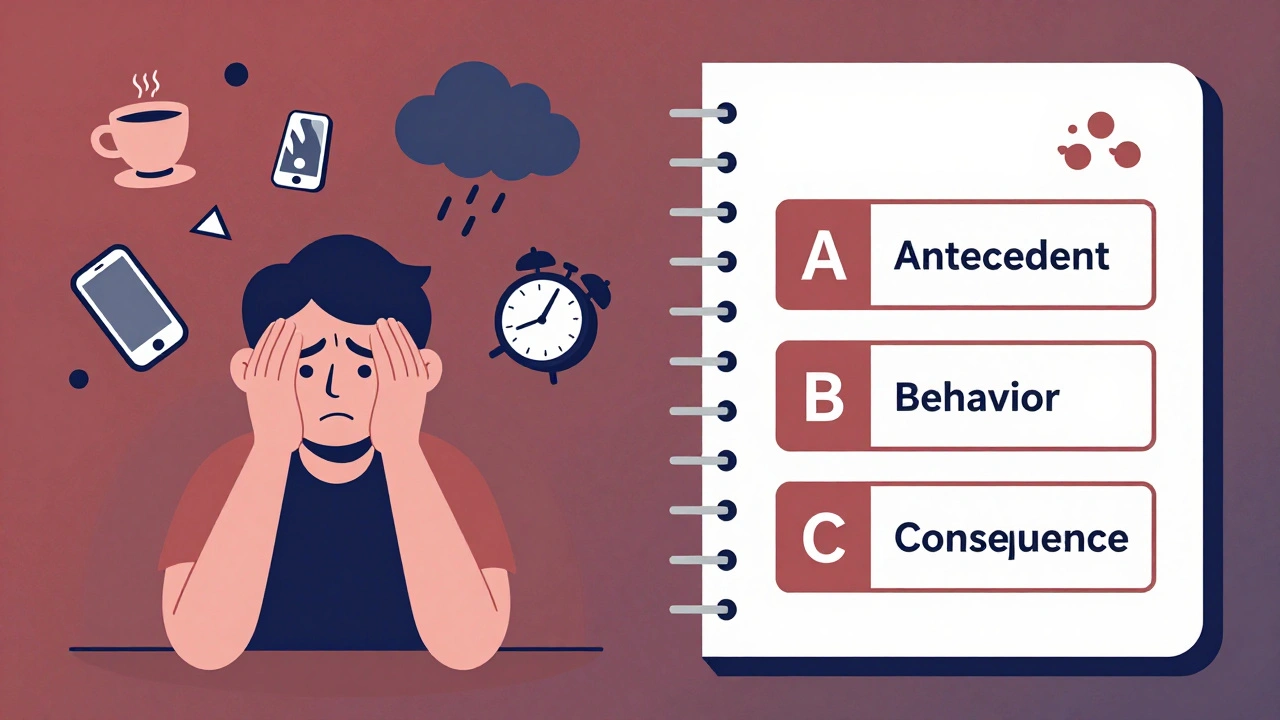
You don’t need fancy apps or complex charts. The most effective method used by behavior analysts and clinicians is the ABC model: Antecedent, Behavior, Consequence.- A (Antecedent): What happened right before the symptom? (e.g., walked into a noisy office, ate pizza, argued with a coworker, woke up late)
- B (Behavior): What exactly happened? Rate the intensity on a scale of 0-10. (e.g., “headache: 8/10,” “anxiety: 7/10,” “fatigue so bad I couldn’t stand”)
- C (Consequence): What happened right after? (e.g., took ibuprofen, lay down for an hour, called in sick, felt better after coffee)
What to Track: The Essentials
You don’t need to record everything. Focus on these six core elements:- Date and time (exact to the hour, if possible)
- Symptom (what it is and how bad-use the 0-10 scale)
- Triggers (food, stress, weather, sleep, screen time, meds)
- Sleep (how many hours, how restful-within 15 minutes of accuracy)
- Medications and supplements (name, dose, time taken)
- Environment (noise, lighting, temperature, location)
Paper vs. Apps: Which One Actually Works?
There’s no one-size-fits-all. What works for one person fails for another.Paper journals are simple. No battery, no updates, no distractions. MedShadow’s 2024 report found 91% of users kept up with paper trackers for longer than six months-especially people over 65. They’re ideal if you’re not tech-savvy or just want to avoid screen fatigue.
Digital apps like MigraineBuddy, Wave, or Twofold offer automation. They can sync with your Apple Watch to track heart rate, sleep, and even skin temperature changes-useful for catching early migraine signs. MigraineBuddy’s algorithm spots patterns users miss, and 82% of users say it helped them identify triggers they never noticed. But here’s the catch: 43% quit after two months because the interface is too complex. If you’re not into tech, an app can feel like another chore.
Try this: Start with paper for 14 days. If you’re hooked, switch to an app. If not, stick with the notebook. The goal isn’t to use the fanciest tool-it’s to keep recording.
Real Results: What People Actually Achieve
People aren’t just tracking for fun. They’re changing their lives.- On Reddit’s r/Migraine, 68% of users who tracked for 90+ days found at least one major trigger. Aged cheeses, processed meats, and alcohol topped the list.
- 74% of chronic illness patients using trackers reduced their medication use by 25% or more by avoiding triggers.
- Patients with detailed migraine diaries cut emergency room visits by 37%, according to Mayo Clinic neurologists.
- One woman in Belfast tracked her anxiety for six weeks and realized it spiked every time she checked work emails after 7 PM. She started turning off notifications after dinner-and her panic attacks dropped by 70%.
These aren’t outliers. They’re people who stopped guessing and started observing.

The Dark Side: When Tracking Backfires
Tracking isn’t magic. For some, it becomes obsession.Dr. Lisa Rodriguez from Harvard Medical School warns that 12-15% of people with anxiety disorders start fixating on every tiny sensation. They begin to fear triggers instead of managing them. One user told me she stopped eating out because she was terrified of “hidden triggers.” She lost weight, but gained a new kind of stress.
That’s why tracking needs balance. It’s a tool-not a rulebook. If you’re spending hours analyzing every bite of food or stressing over a 1-point spike in pain, you’re doing it wrong. Step back. Ask: Is this helping me live better, or just making me more anxious?
How to Get Started (No Fluff, Just Steps)
1. Choose your tool: Grab a notebook or download a simple app like MigraineBuddy or Twofold. Don’t overthink it. 2. Start with ABC: For the next 14 days, write down the antecedent, behavior, and consequence for every symptom you notice. Even small ones. 3. Track the basics: Time, symptom intensity (0-10), sleep, food, meds. That’s it. 4. Review every Sunday: Look for repeats. Did headaches always follow cheese? Did fatigue spike after 4 hours of sleep? Highlight patterns. 5. Test one change: If you see a pattern, try removing it for a week. Did symptoms improve? That’s your answer. 6. Share with your doctor: Bring your journal. It’s the most valuable thing you can bring to an appointment.What Comes Next
Once you’ve got 30 days of data, you’re not done-you’re just getting started. New tools are emerging. The FDA just cleared Twofold’s template for use in clinical trials. Apple Watch now tracks skin temperature to predict migraines before they hit. AI is learning to predict flares 48 hours in advance. But none of that matters if you don’t start with the basics. You don’t need AI to find your triggers. You just need to write them down.Side effects aren’t random. They’re signals. And the only way to hear them clearly is to keep a record. Start today. Not tomorrow. Not next week. Today. Your body is trying to tell you something. Are you listening?
How long does it take to see patterns in symptom tracking?
Most people start seeing clear patterns after 14 to 30 days of consistent tracking. Research shows that 87% of successful trigger identifications require at least 14 days of daily entries. For complex conditions like migraines or anxiety, 30 days gives you enough data to spot subtle links between sleep, diet, stress, and symptoms.
Can I track side effects without using an app?
Absolutely. Paper journals are still the most reliable method for many people. MedShadow’s 2024 report found 91% of users kept up with paper trackers longer than six months, especially those over 65 or who prefer low-tech solutions. All you need is a notebook and 5-7 minutes a day to write down your symptoms, triggers, and context. Simplicity often wins over complexity.
What’s the most common trigger people miss?
Sleep. Many people track food, stress, or weather-but overlook how much sleep affects their symptoms. A 2023 study showed that skipping just 1.5 hours of sleep increased migraine frequency by 39%. Even small changes in sleep timing-like going to bed 30 minutes later than usual-can trigger flares. Tracking sleep duration and quality is one of the most powerful steps you can take.
Why do some people stop tracking after a few weeks?
The main reason is complexity. Digital apps with too many fields, notifications, or setup steps lead to 43% abandonment after 60 days. Others get discouraged when they don’t see immediate results. Tracking isn’t a quick fix-it’s a discovery process. If you’re overwhelmed, simplify. Use just the ABC model and a notebook. Progress, not perfection, is the goal.
Can tracking reduce my medication use?
Yes. A MedShadow survey of 3,200 chronic illness patients found that 74% who tracked their symptoms reduced medication use by at least 25% by avoiding identified triggers. For example, someone with tension headaches might realize caffeine after noon causes flare-ups and cut it out-reducing their need for painkillers. Always consult your doctor before changing medication, but tracking gives you the data to have smarter conversations.
Is there a risk of becoming too focused on tracking?
Yes. For 12-15% of people, especially those with anxiety disorders, tracking can turn into hypervigilance. They start fearing every sensation or food item, which can increase stress and worsen symptoms. If you notice yourself obsessing over minor changes or avoiding normal activities out of fear, take a break. Tracking should empower you-not imprison you. It’s a tool, not a cage.
What’s the best time of day to log symptoms?
Evening is ideal. Logging right before bed lets you reflect on the whole day while events are still fresh. Trying to record symptoms hours later leads to recall bias-people often overestimate pain or forget key details. Set a daily reminder for 8-9 PM. Even five minutes is enough to capture the day’s key moments.


Rashi Taliyan
December 3, 2025 AT 12:31I used to think my migraines were just bad luck-until I started scribbling ABCs in my notebook like a madwoman. One day I noticed: every time I ate paneer tikka after 8 PM, boom-headache. I cut it out. No meds. No drama. Just peace. My mom still thinks I’m weird for writing stuff down, but I’m the one who’s not in bed screaming at 3 AM anymore. 🙌
Kara Bysterbusch
December 4, 2025 AT 16:29While the utility of systematic symptom documentation is unequivocally supported by empirical research, one must not overlook the epistemological implications of reducing somatic experience to quantifiable variables. The ABC model, though elegant in its simplicity, risks reifying subjective phenomenology into a mechanistic framework that may inadvertently pathologize natural human variability. That said, the 40-60% reduction in symptom severity cited is statistically compelling-and I commend the author for advocating accessibility over technological overcomplication. A truly nuanced approach to health literacy.
Rashmin Patel
December 5, 2025 AT 12:31OMG YES. I’ve been tracking for 90 days now and I finally figured out my anxiety spikes every time I drink chai after 4 PM-yes, the caffeine, but also the ritual of it. I thought I was just stressed at work, but nope. It’s the chai + scrolling Instagram in the dark. I switched to herbal tea and now I sleep like a baby. Also, sleep is THE trigger. Everyone ignores it. I lost 2 hours of sleep one night and my fibro flared like a volcano. 🌋 Sleep > everything. Even your ‘important’ emails. Stop lying to yourself. Start logging. You won’t regret it. And if you think paper is ‘too basic’-you’re just scared of facing your own patterns. I’m not mad, I’m just disappointed. 😤
sagar bhute
December 5, 2025 AT 14:17This whole ‘track your symptoms’ thing is just another wellness cult scam. People don’t have migraines because of cheese-they have them because they’re weak, lazy, and refuse to take real medicine. You think writing ‘cheese → headache’ fixes anything? Go to a doctor. Get a scan. Stop playing detective with your life. And don’t act like your notebook is some sacred scripture. It’s not. It’s a crutch for people who don’t want to deal with reality.
Cindy Lopez
December 5, 2025 AT 15:02There’s a grammatical error in the third paragraph: ‘That’s why just saying “I feel bad after eating dairy” isn’t enough. Maybe it was the cheese, or the stress from the meeting that same day, or the lack of sleep the night before. Without data, you’re flying blind.’ The second sentence is a fragment. It should be: ‘Maybe it was the cheese, the stress from the meeting that same day, or the lack of sleep the night before.’ Also, ‘MigraineBuddy’s algorithm spots patterns users miss’-missing comma before ‘users.’ Minor, but it matters.
James Kerr
December 6, 2025 AT 05:14Just started tracking with a notebook last week. Honestly? I thought I’d quit by day 3. But now I look forward to it. It’s like journaling, but for my body. Found out my headaches always hit after 3 hours of screen time and no water. Duh. Now I drink water and take breaks. No more ibuprofen. 😎 Also, sleep is everything. I used to think ‘I can sleep when I’m dead.’ Nope. Dead people don’t get migraines. I’m alive. I’m logging. I’m better.
shalini vaishnav
December 7, 2025 AT 18:58How can you trust Western medical frameworks like ABC tracking in a country like India, where traditional Ayurvedic wisdom has understood mind-body connections for millennia? You don’t need a notebook-you need a panchakarma cleanse and a proper dosha diagnosis. This is just another colonial imposition disguised as ‘science.’ The fact that you’re proud of writing ‘blue cheese → headache’ while ignoring centuries of holistic knowledge is embarrassing. We don’t need apps. We need to reclaim our roots.
vinoth kumar
December 8, 2025 AT 06:30Hey, I’m the guy who used to think tracking was dumb. But I tried it for 14 days after my buddy nagged me. Found out my back pain only happened when I slept on my left side. Changed position. No more pain. Didn’t even need a doctor. I told my mom, she cried. She said, ‘You finally listened to your body.’ I’m not a genius. I just wrote stuff down. If you’re scared to start, just write one line a day. That’s all. You got this.