
Serious Adverse Event Checker
Is This Reportable?
This tool helps you determine if your experience meets FDA criteria for reporting serious adverse events through MedWatch. The FDA considers a serious adverse event to be one that:
- Caused death
- Was life-threatening
- Required hospitalization
- Resulted in permanent disability
- Caused a birth defect
- Needed medical intervention to prevent permanent harm
If you're unsure, it's better to report. The FDA says it's better to have too many reports than too few.
When a medication or medical device causes an unexpected reaction, it’s not just your problem-it’s a public health issue. The FDA relies on people like you to spot these dangers before they become widespread. That’s where FDA MedWatch comes in. It’s the official system for reporting side effects, injuries, and product failures tied to drugs, medical devices, and even cosmetics. You don’t need to be a doctor. You don’t need to be an expert. If you or someone you know had a serious reaction, your report could help save lives.
What Exactly Is MedWatch?
MedWatch, short for the FDA Safety Information and Adverse Event Reporting Program, is the FDA’s main tool for tracking problems after a product hits the market. Clinical trials test drugs on thousands of people, but real-world use involves millions. That’s where hidden risks show up-like a rare heart rhythm problem with a new painkiller, or a glucose monitor that gives false readings in cold weather. MedWatch collects these reports from doctors, pharmacists, patients, and manufacturers. Without them, the FDA wouldn’t know what to investigate.
The system covers way more than just prescription pills. It includes over-the-counter meds, biologics like gene therapies, insulin pumps, CBD products, and even hair dye that causes severe burns. The only things it doesn’t cover are vaccines (those go to VAERS) and animal drugs (those go to CVM). Tobacco is also excluded. But for nearly every other FDA-regulated product, MedWatch is the only official way to report a problem.
Who Can Report and How?
Anyone can report. You don’t need permission. You don’t need a doctor’s note. If you think something went wrong, you can file a report. But there are two main paths, depending on who you are.
If you’re a healthcare professional-doctor, nurse, pharmacist, or EMT-you use Form FDA 3500. It asks for your contact info, your specialty, and details about the patient, the product, and what happened. Most professionals finish it in 10 to 15 minutes. It’s designed to be quick if you already know the medical facts.
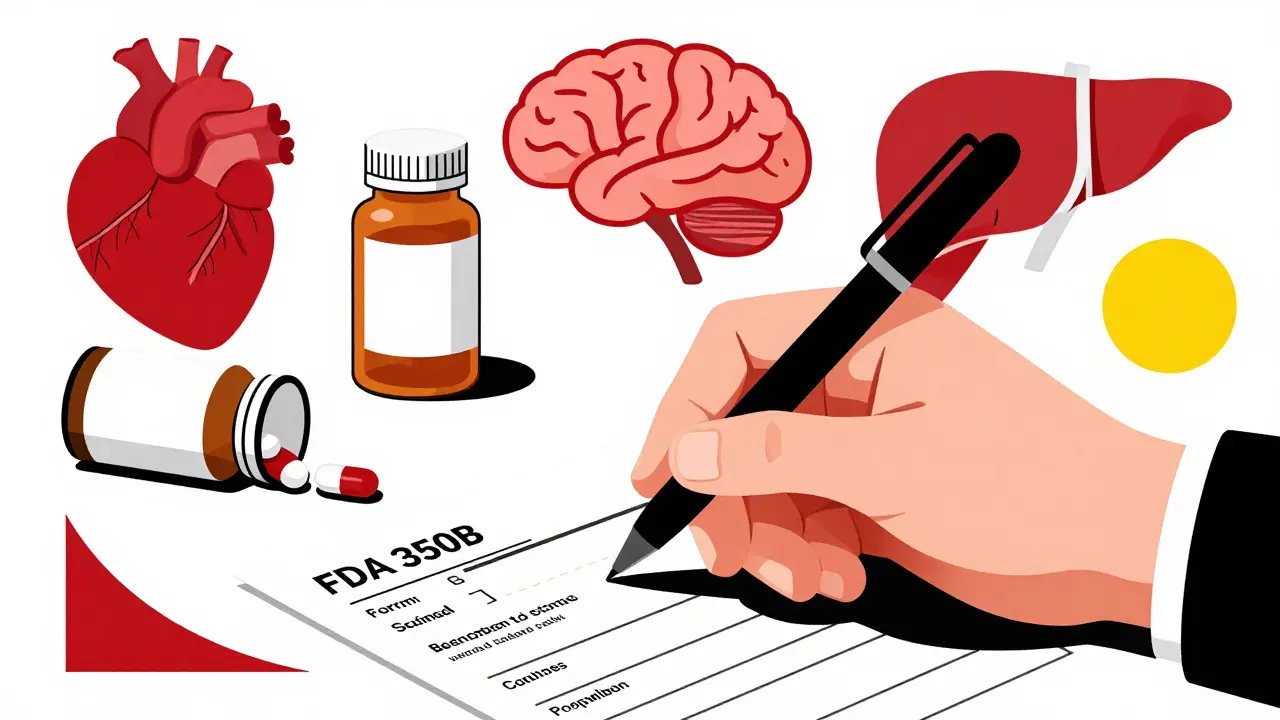
If you’re a patient or a family member, you use Form FDA 3500B. This one is simpler. It skips the medical jargon and asks things like: What medicine or device were you using? When did the problem start? What happened? Did you go to the hospital? Did it get better? It’s available in English and Spanish, and you can fill it out online or print and mail it.
Manufacturers, hospitals, and importers have to report by law. They use Form FDA 3500A and must submit it within 30 days (or 10 days for deaths). These reports make up about 80% of all submissions. But your report matters too. The FDA says 1 to 10% of adverse events ever get reported-and most of those come from professionals. That means your voice could be one of the few that triggers a safety warning.
What Counts as a Reportable Event?
Not every side effect needs reporting. The FDA defines a serious adverse event as one that:
- Caused death
- Was life-threatening
- Required hospitalization
- Resulted in permanent disability
- Caused a birth defect
- Needed medical intervention to prevent permanent harm
Examples: A diabetic using a new glucose meter that gave a dangerously low reading, leading to a seizure. A woman taking a new antidepressant who developed liver failure. A child with a hearing aid that stopped working mid-school day. These are all reportable.
But what about a mild rash? A headache? A stomach ache? Those usually don’t qualify unless they’re part of a bigger pattern. If it’s minor and went away on its own, you probably don’t need to report it. But if you’re unsure, report it anyway. The FDA says it’s better to have too many reports than too few.
Why Do Reports Matter?
One report might seem small. But when 50 people report the same issue with the same device? That’s a signal. That’s when the FDA starts digging. Maybe they review lab data. Maybe they inspect the factory. Maybe they update the warning label. Or maybe they pull the product off the market.
Dr. Janet Woodcock, former head of FDA’s drug division, said MedWatch reports are “essential for identifying safety signals that may not have been evident during clinical trials.” Think about Vioxx. It was a popular painkiller until thousands of reports of heart attacks poured in. The FDA pulled it in 2004. That happened because people reported.
Same with the recent recall of certain cough syrups linked to kidney failure in children. It started with a handful of reports from parents. Without those, the FDA might not have acted in time.
Your report doesn’t just help others. It can change the product itself. A patient once reported that a certain insulin pen was too hard to use for people with arthritis. The manufacturer redesigned the cap. That change is now in every new pen sold.
What’s Hard About Reporting?
It’s not perfect. Many patients say the consumer form uses confusing terms like “event abated,” “dose frequency,” and “medical pathway.” One Reddit user wrote: “I had to Google half the words on the form.” The FDA admits this. In a 2019 study, 62% of consumers said they needed help understanding at least three terms.
That’s why the FDA says: “Take the form to your doctor.” You don’t need them to report for you. But they can help you fill it out. Your medical records have the details they need. A nurse in Iowa told me she helps her older patients fill out the form every week. “I explain what ‘abated’ means,” she said. “It just means ‘got better.’”
Another issue: incomplete reports. About 15% of consumer submissions lack key info-like the product name, the date, or the outcome. That slows things down. The FDA might call you back. Or they might just file it away. To avoid that, have your medicine bottle, device manual, or doctor’s note handy before you start.
How to Report: Step by Step
Here’s how to do it right:
- Get the right form. Go to FDA.gov/MedWatch. Click “Report a Problem.” Choose Form FDA 3500B if you’re a patient, or 3500 if you’re a professional.
- Have your info ready. Name, phone, email. Product name, lot number (if you have it), date you started using it. What happened? When? Did you go to the hospital? Did it improve? Write it down.
- Fill it out honestly. Don’t guess. If you don’t know the exact dose, say “I’m not sure.” If you’re not sure if it was serious, report it anyway.
- Submit. You can do it online. Or print, sign, and mail it. Online is fastest. You’ll get an email confirmation.
- Keep a copy. Save the form, the confirmation email, or the receipt. You might need it later.
It takes 10 to 20 minutes. That’s less time than it takes to wait in line at the pharmacy. But that 20 minutes could mean the difference between a quiet recall and a nationwide warning.
What Happens After You Report?
You’ll get an email saying your report was received. That’s it. No follow-up call. No investigation update. That’s normal. The FDA gets over a million reports a year. They don’t have staff to call everyone back.
But your report goes into a database. Analysts look for patterns. If five people report the same issue with the same drug? That’s flagged. If 50? That’s a priority. The FDA might issue a safety alert. Update the label. Or require the company to do more testing.
Some reports lead to changes within months. Others take years. But if no one reports, nothing changes.
What Else Should You Know?
- You can report even if you’re not sure it was the product’s fault. The FDA wants to hear everything.
- You don’t have to give your name. But if you do, you’ll get a confirmation. And if more info is needed, they might contact you.
- You can report for someone else. A child, an elderly parent, a friend.
- You can report multiple events at once. One form can cover several problems.
- There’s no deadline. Report it today, next week, or six months later. Better late than never.
And here’s the most important thing: your report is not a complaint. It’s not a lawsuit. It’s not a way to get money. It’s a safety tool. The FDA uses it to protect people. And it only works if people use it.
Where to Find Help
If you’re stuck:
- Visit FDA.gov/MedWatch for forms, FAQs, and examples.
- Call the FDA at 1-800-FDA-1088. They’ll walk you through it.
- Ask your pharmacist. They’ve seen this before.
- Check the Drug Labeling Changes page to see if your medicine has been updated.
There’s no other system like this in the U.S. No private company can replace it. No app can do what MedWatch does. It’s the only official channel. And it only works because regular people care enough to speak up.




Diana Phe
February 4, 2026 AT 00:25This whole MedWatch thing is a trap. The FDA lets Big Pharma write the rules, then they pretend to listen to us. I reported my cousin's stroke after that new blood pressure pill-and guess what? Nothing happened. They buried it. They always bury it. You think they care about you? They care about lawsuits and stock prices. Don't waste your time. They're not fixing anything-they're just collecting data to make the next drug look safer.
Carl Crista
February 4, 2026 AT 22:42Andre Shaw
February 5, 2026 AT 04:44Oh wow look at this-another government pamphlet dressed up like a public service. Newsflash: MedWatch is a glorified suggestion box for corporate cover-ups. The real problem? The FDA gets 1.2 million reports a year and acts on maybe 0.003%. That’s not oversight, that’s theater. And don’t get me started on how they let the same companies that make the drugs *also* submit the initial reports. It’s like letting the fox file the complaint about the chicken coop. If you really want change? Start a class action. Or burn your pill bottle on camera. That’s the only language they understand.
Dr. Sara Harowitz
February 6, 2026 AT 14:28Joyce cuypers
February 8, 2026 AT 08:13i just reported my mom’s reaction to her new arthritis med-she got dizzy and fell and broke her hip. i was so scared and didnt know what to do. i found the form online and filled it out with my sister help. it took like 25 min but i felt like i did something. i dont know if it matters but i hope it does. if anyone else is scared to do it-just go for it. you’re not wasting your time. even if the FDA doesn’t reply, you’re helping someone down the line. love you all. 💙
Georgeana Chantie
February 9, 2026 AT 07:11Carol Woulfe
February 10, 2026 AT 07:37It is my professional opinion that the current MedWatch framework exhibits a profound structural deficit in terms of data integrity and response latency. The reliance on laypersons to accurately classify pharmacovigilance events is not merely suboptimal-it is epistemologically unsound. The absence of standardized ontologies, coupled with the non-uniform application of ICD-11 coding, renders the dataset statistically unreliable. Furthermore, the exclusion of tobacco products from the purview of MedWatch, while including CBD, represents a regulatory inconsistency that undermines the entire system’s credibility. I urge the FDA to implement mandatory AI-assisted triage protocols and to publish real-time analytics dashboards to restore public trust.
Kieran Griffiths
February 11, 2026 AT 14:18Hey, I get that reporting feels pointless sometimes. I’ve been a nurse for 18 years and I’ve submitted dozens of reports. Most go nowhere. But I still do it-because one time, a report I filed about a faulty insulin pump led to a recall that saved three kids. You don’t report because you’ll get a thank-you note. You report because someone’s life might depend on it next time. It’s not about the system being perfect. It’s about being part of the solution, even when it’s messy. Keep going. Your voice matters more than you think.
Lisa Scott
February 12, 2026 AT 05:19