

Why doctors get paid to prescribe generic drugs
You might think prescribing a generic drug is just a routine choice - cheaper, same active ingredient, same effect. But behind that decision is a system of rewards, rules, and sometimes pressure. In 2026, healthcare systems across the U.S. are using financial and non-financial incentives to push providers toward generics. And it’s working - but not without friction.
Generic drugs make up 90.5% of all prescriptions filled in the U.S., yet they account for just 23% of total drug spending. That’s because generics cost 80-85% less than brand-name versions. The savings aren’t just theoretical. Over the past decade, generics saved the U.S. healthcare system over $1.7 trillion. That’s why insurers, Medicare, and large health systems are now actively rewarding providers who choose them.
How the rewards actually work
It’s not just about telling doctors to pick generics. Real incentives are built into how they get paid.
- Direct bonuses: Blue Cross Blue Shield plans pay physicians $5 to $15 per generic prescription in targeted drug classes. Some providers earn up to $5,000 a year just for sticking to generics.
- Reduced paperwork: Providers who consistently prescribe generics get faster prior authorization approvals. No more calling insurers for approval - it’s automatic.
- Priority scheduling: Some health networks give top generic prescribers earlier appointment slots or shorter wait times for their own patients.
- EHR defaults: Electronic health records now often set generic drugs as the default option. One study found this alone boosted generic prescribing by over 22 percentage points.
It’s not all cash. Recognition matters too. Hospitals and health plans now highlight top performers in newsletters or internal dashboards. For many providers, being labeled a "cost-conscious prescriber" carries professional weight.
What’s working - and what’s not
Not all incentive programs deliver the same results.
Formulary tiering - where generics are listed as Tier 1 and brands as Tier 3 - only increases generic use by 8-12%. Why? Because patients pay more out-of-pocket for brands, not providers. The financial pressure doesn’t hit the doctor.
But when incentives go straight to the provider? The impact jumps. UnitedHealthcare’s "Value-Based Prescribing Program" boosted generic use by 24.7% in primary care clinics. That’s because the reward is tied directly to the person making the decision.
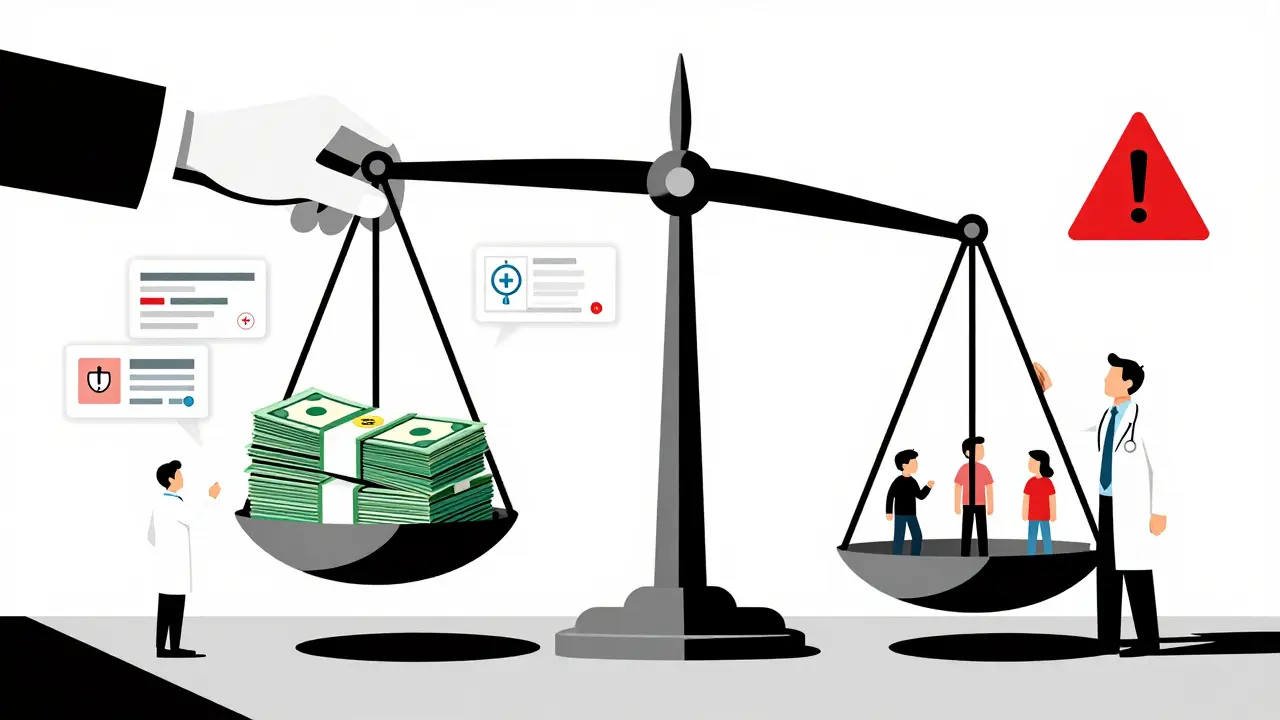
Still, there are loopholes. A 2023 study found that providers enrolled in the 340B drug discount program - which gives them deep discounts on brand-name drugs - actually prescribed generics 6.8% less than others. Why? Because they profit more from using expensive drugs. It’s a perverse incentive: the system rewards them for choosing the more costly option.
Even more troubling: research shows physicians who receive gifts, meals, or sponsored trips from drug companies are 37% less likely to prescribe generics - especially in the first year after a new generic hits the market. That’s not just about money. It’s about relationships.
What providers really think
On forums like Sermo and Reddit, doctors are split.
Dr. Michael Chen, an internist in California, says: "The UnitedHealthcare bonus added $2,800 to my income last year. I didn’t have to change anything. It felt fair."
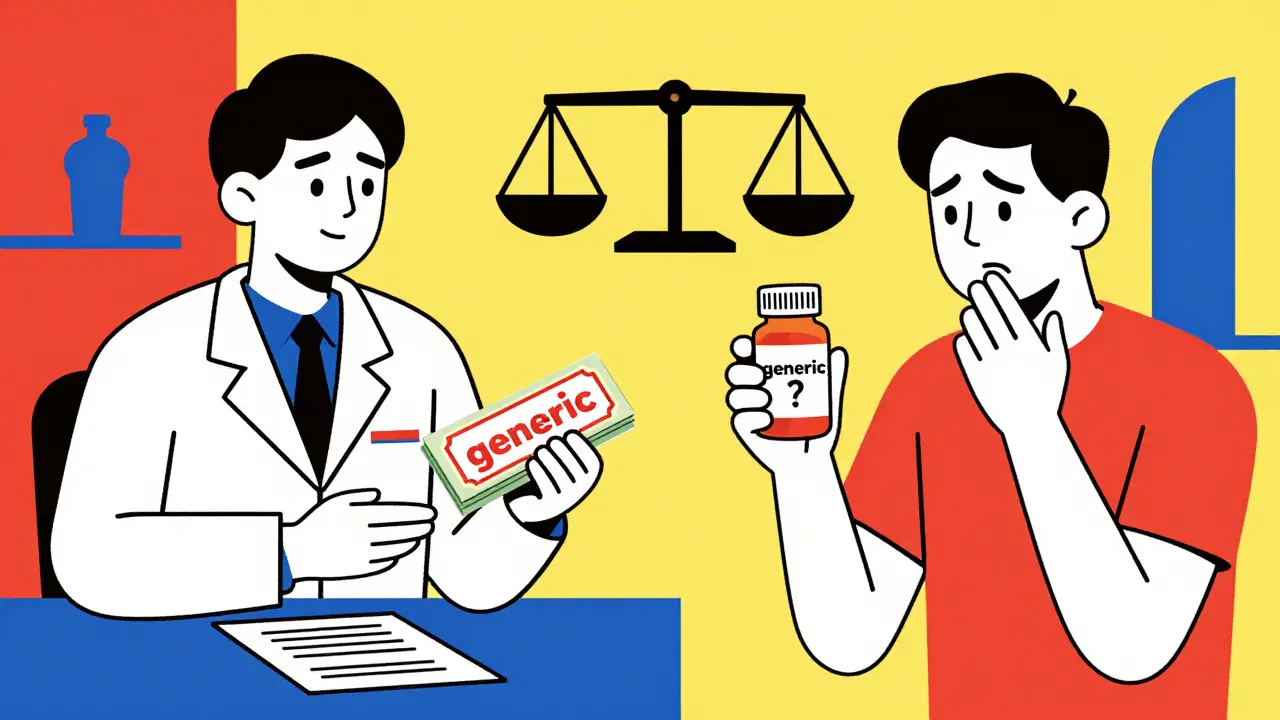
But Dr. Sarah Williams in Texas disagrees: "Some programs feel like coercion. What if my patient needs the brand because of an allergy? What if the generic doesn’t dissolve right for them? I can’t just pick the cheapest option."
A 2021 survey of 1,200 providers found that 63% liked incentives when they were voluntary and tied to quality - not just cost. But 78% worried that if patients found out their doctor was being paid to choose generics, trust would erode.
And then there’s the "cookie-cutter medicine" complaint. One Reddit user, "MedDoc2020," wrote: "Generic incentives work for hypertension or diabetes. But when someone’s on five meds, with liver issues and allergies? You can’t just pick the lowest bid. That’s not medicine - that’s assembly line care."
The hidden costs of the system
There’s a real risk here. When incentives are poorly designed, they can lead to mistakes.
Imagine a patient with epilepsy. Their doctor switches them to a generic seizure drug because it’s cheaper. But the generic has a different filler. The patient has a seizure. Now the doctor’s bonus is gone - and the patient’s life is at risk.
That’s not hypothetical. Studies show that therapeutic substitution errors - where a generic is swapped in without clinical justification - increase when financial pressure is high. The American College of Physicians warns: "Don’t confuse cost savings with clinical safety."
Another problem: burnout. Tracking performance metrics, dealing with EHR alerts, and justifying every prescription takes time. A 2023 AMA survey found 61% of physicians felt "overwhelmed" by the number of metrics they had to report just to qualify for incentives.
What’s next?
The system is evolving.
CMS is testing a "$2 Drug List" - where essential generics like metformin or lisinopril cost $2 or less for patients. Early results show 22.7% better adherence for chronic conditions. That’s not just a discount - it’s a behavioral nudge.
UnitedHealthcare’s 2024 rollout of "value-based prescribing contracts" ties payments to both cost and clinical outcomes. So now, it’s not just about prescribing generics - it’s about prescribing the right generic, and keeping patients healthy.
Meanwhile, Germany’s "reference pricing" system - which sets one reimbursement rate for all drugs in a class - has pushed generic use to 93%. The U.S. is at 85%. The gap isn’t about availability. It’s about incentives.
What you need to know
If you’re a provider:
- Incentives can boost your income - if you’re in a program that pays you directly.
- Don’t assume all generics are interchangeable. Check for therapeutic equivalence, especially in narrow-index drugs like thyroid meds or seizure drugs.
- Use EHR alerts wisely. If your system flags "generic alternative available," verify it’s clinically appropriate - don’t just click "accept."
- Know your patient’s history. A generic might be cheaper, but if it’s caused side effects before, stick with the brand.
If you’re a patient:
- Ask your doctor: "Is this generic right for me?"
- Don’t assume cheaper means better. Some generics have different fillers or absorption rates.
- If you notice a change in how you feel after switching - speak up.
The bottom line: generic prescribing incentives are here to stay. They’re saving billions. But they’re not perfect. The goal shouldn’t be to prescribe the cheapest drug - it should be to prescribe the right drug, at the right price. And that takes judgment, not just a bonus check.
Do generic prescribing incentives affect patient care?
Yes - but not always in the way you’d expect. When incentives are well-designed, they reduce costs without harming outcomes. Studies show patients on generics have similar effectiveness and safety profiles. But when incentives are too aggressive or ignore clinical nuance, they can lead to medication errors, especially in patients with complex conditions like epilepsy, thyroid disease, or mental health disorders. The key is balancing cost savings with clinical judgment.
Are doctors being bribed to prescribe generics?
No - not in the traditional sense. Unlike brand-name drug companies that offer meals, trips, or gifts to influence prescribing, generic incentives are usually transparent, structured, and tied to performance metrics. They’re often built into contracts with insurers or health systems, not direct payments from drugmakers. But there’s a gray area: if a provider receives bonuses based on volume alone - without clinical oversight - it can feel coercive. The real issue isn’t bribery - it’s misaligned incentives.
Why don’t all doctors use generics if they’re cheaper?
Several reasons. First, some patients respond differently to generics due to inactive ingredients, absorption rates, or allergies. Second, some doctors don’t trust newer generics, especially within the first year after launch. Third, in practices that receive discounts on brand-name drugs (like 340B clinics), prescribing generics means less profit. And finally, some providers feel pressured by systems that don’t allow exceptions - even when clinically necessary.
Can I ask my doctor to prescribe a brand-name drug even if a generic is available?
Absolutely. You have the right to request a brand-name drug. Your doctor may need to submit a prior authorization explaining why the generic won’t work for you - but they can’t refuse your request. In fact, most incentive programs allow exceptions for medical necessity. If you’ve had a bad reaction to a generic before, or if your condition is unstable, your doctor should honor your preference.
Do these incentives work better in certain specialties?
Yes. Primary care doctors prescribe generics at an 89.2% rate - far higher than specialists, who average 76.4%. Why? Primary care deals with common, stable conditions like high blood pressure or diabetes, where generics are nearly always appropriate. Specialists often treat complex cases - cancer, autoimmune diseases, neurological disorders - where even small differences in formulation matter. Incentives work best where clinical equivalence is clear.
What’s the difference between formulary tiering and direct provider incentives?
Formulary tiering shifts the cost burden to the patient - if a brand-name drug is Tier 3, the patient pays more. It doesn’t directly reward the doctor. Direct provider incentives, on the other hand, pay the clinician for choosing generics. Studies show tiering increases generic use by 8-12%. Direct incentives - like bonuses or reduced paperwork - boost it by over 20%. The latter works because it changes the provider’s behavior, not just the patient’s.



phyllis bourassa
March 7, 2026 AT 13:25Doctors aren't robots. You can't just click 'accept' in the EHR and call it a day. Real medicine is messy. And now we're being punished if we don't go along with the algorithm?
Aaron Pace
March 8, 2026 AT 16:21Joey Pearson
March 8, 2026 AT 23:10Roland Silber
March 9, 2026 AT 09:56Think of it like speed limits. You don’t ban driving because someone sped. You build in ambulance exemptions. Same logic.
Patrick Jackson
March 10, 2026 AT 09:34We’re reducing medicine to a spreadsheet. And that’s not just inefficient - it’s dehumanizing.
Weston Potgieter
March 11, 2026 AT 23:45Vikas Verma
March 13, 2026 AT 17:30Sean Callahan
March 14, 2026 AT 17:20Ferdinand Aton
March 16, 2026 AT 06:54William Minks
March 17, 2026 AT 23:20Jeff Mirisola
March 18, 2026 AT 23:53Susan Purney Mark
March 20, 2026 AT 09:06Ian Kiplagat
March 21, 2026 AT 00:01Amina Aminkhuslen
March 22, 2026 AT 06:01amber carrillo
March 23, 2026 AT 03:18