
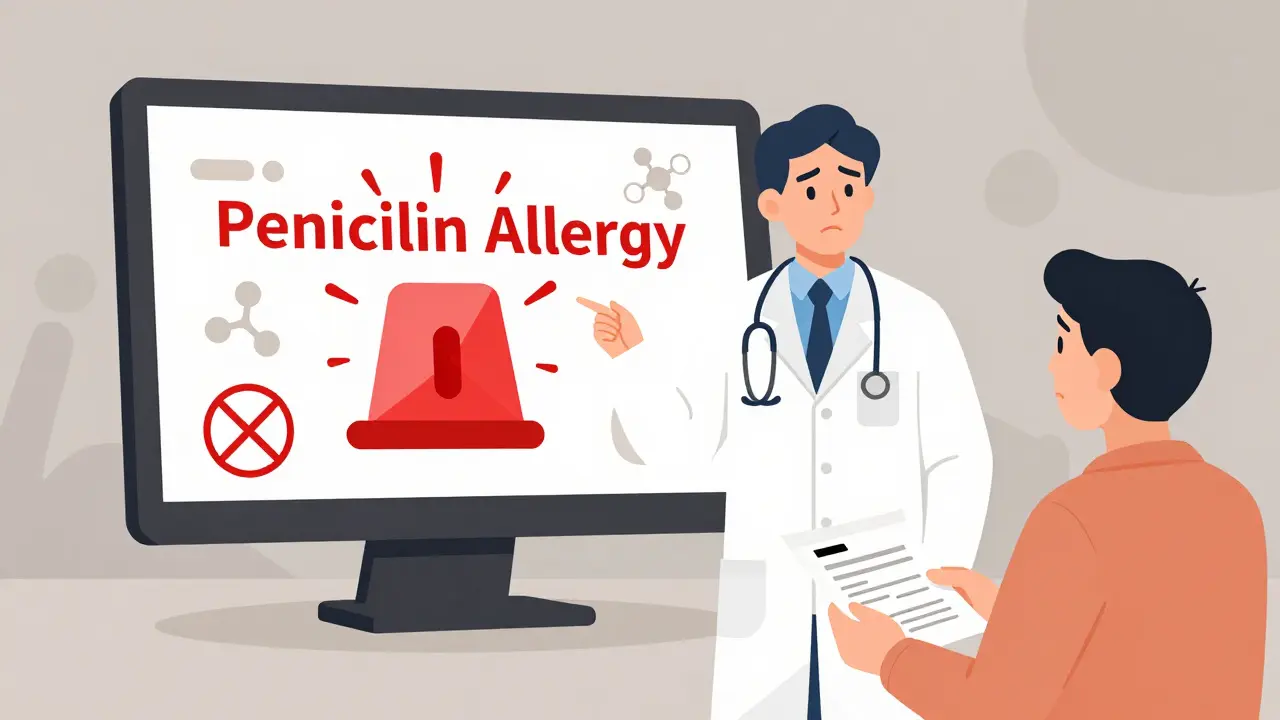
When you pick up a prescription, you might see a pop-up on the pharmacist’s screen: "Penicillin allergy detected. Avoid amoxicillin." It feels like a safety net-until you realize you’ve seen the same warning five times this month, even though you’ve taken amoxicillin without issue since you were 8. What’s going on? Pharmacy allergy alerts aren’t just simple warnings. They’re complex, often flawed, digital signals that can save your life-or make you ignore real dangers.
What Exactly Is a Pharmacy Allergy Alert?
A pharmacy allergy alert is a computer-generated warning inside electronic health record systems like Epic or Cerner. It pops up when a provider tries to prescribe or dispense a medication that matches something listed in your allergy history. These systems don’t just check for exact drug names. They look at drug classes, chemical similarities, and cross-reactivity patterns. For example, if you’re labeled as allergic to penicillin, the system might block amoxicillin, cephalexin, and even some NSAIDs-even if you’ve taken them safely for years. The goal? Prevent life-threatening reactions like anaphylaxis. And it works-sometimes. Studies show properly functioning systems reduce serious drug reactions by nearly 18%. But here’s the problem: 90% of these alerts are false alarms. They trigger because of outdated labels, vague documentation, or overly broad rules built into the software.Definite vs. Possible Allergy Alerts: The Key Difference
Not all alerts are created equal. There are two main types:- Definite allergy alerts happen when the drug you’re being prescribed is in the same class as something you’ve clearly reacted to. For example, if your chart says "penicillin allergy: rash," and the system sees amoxicillin (a penicillin), it flags it.
- Possible allergy alerts are the troublemakers. They’re based on cross-reactivity assumptions. Like saying, "If you’re allergic to penicillin, you might react to cephalosporins." But the truth? The actual cross-reactivity rate between penicillins and newer cephalosporins is less than 2%. Yet most systems treat it like a 50-50 risk.
Why So Many Alerts Are Wrong (And Why You Keep Seeing Them)
You’ve probably heard someone say, "I’m allergic to penicillin." But what did they mean? Did they get a rash? Throw up? Break out in hives? Or did they just feel sick after taking it as a kid and assume it was an allergy? Most allergy alerts rely on what’s typed into the EHR-and too often, it’s just "penicillin allergy" with no details. A 2021 NIH study found that 47% of EHR systems don’t even record the type of reaction. So if someone wrote "stomachache after penicillin" decades ago, the system still treats it like a life-threatening allergy. Worse, many systems use blanket rules. If you’re allergic to one NSAID, they’ll block all of them-even though only 12% of those alerts are clinically meaningful. A 2019 study in Annals of Allergy, Asthma & Immunology showed that 88% of NSAID allergy alerts are false. Yet they still pop up every time. And then there’s alert fatigue. A 2022 survey found that 78% of physicians override allergy alerts several times a week. One doctor on Reddit described getting 17 alerts for a single vancomycin order because of a childhood stomachache labeled as a "penicillin allergy." That’s not safety. That’s noise.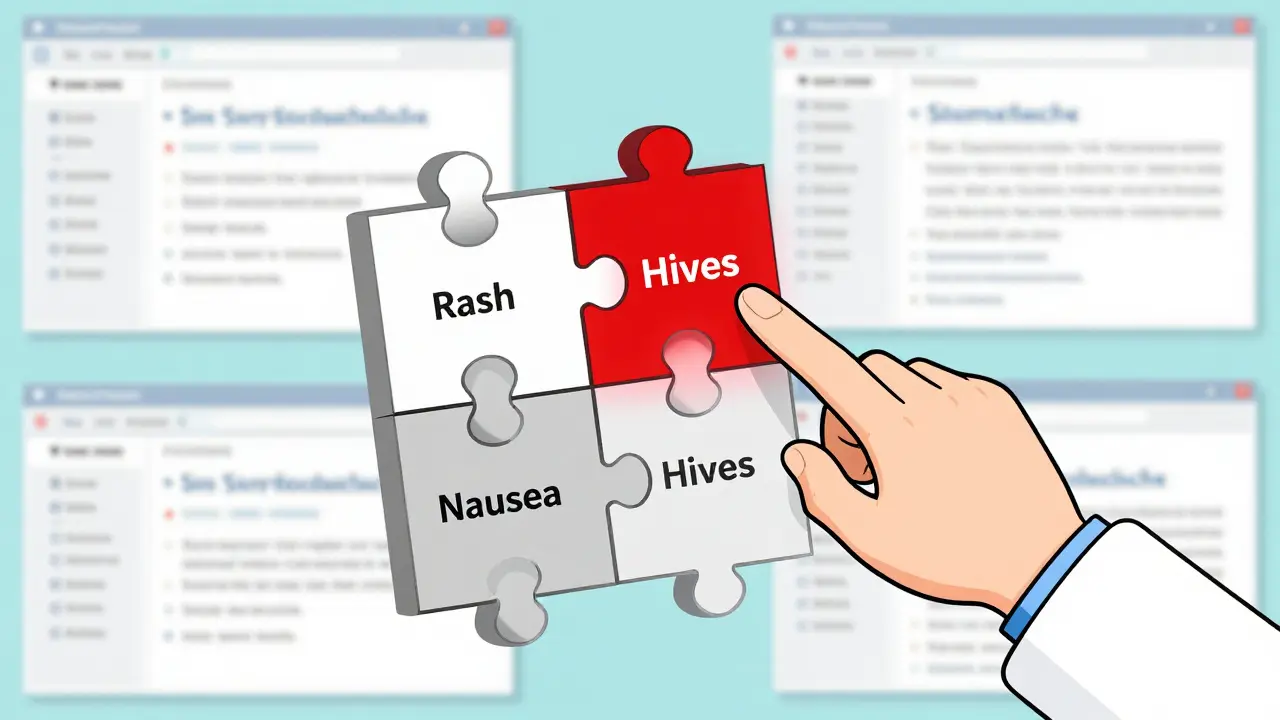
What the Alert Is Really Saying: Decoding the Message
When you see an alert, look for three things:- The reaction type: Was it hives? Swelling? Trouble breathing? Or nausea, diarrhea, headache? Only the first three suggest a true immune-mediated allergy. The rest are side effects.
- The severity: Epic systems use color codes: yellow (mild), orange (moderate), red (severe), black (life-threatening). Cerner uses similar tiers. A yellow alert for a rash is very different from a black alert for anaphylaxis.
- The drug relationship: Is it the exact same drug? Or a different one in the same class? If it’s a different drug, ask: "Is this cross-reactivity real?" For example, a penicillin allergy doesn’t mean you can’t take azithromycin, doxycycline, or even most cephalosporins.
What You Can Do: Take Control of Your Allergy Info
You’re not powerless here. You can fix this.- Ask yourself: "What actually happened when I had that reaction?" Write it down. "My face swelled up after penicillin" is useful. "I felt sick" is not.
- Update your records: At every doctor’s visit, ask: "Is my allergy list accurate?" Many people carry old, incorrect labels for decades.
- Get tested: If you think you’re allergic to penicillin, ask for a skin test or oral challenge. Studies show over 90% of people who think they’re allergic aren’t. That’s not a myth-it’s science.
- Use patient portals: Many hospitals now let you edit your own allergy list. Don’t just accept what’s there. Correct it.
The Future: Smarter Alerts Are Coming
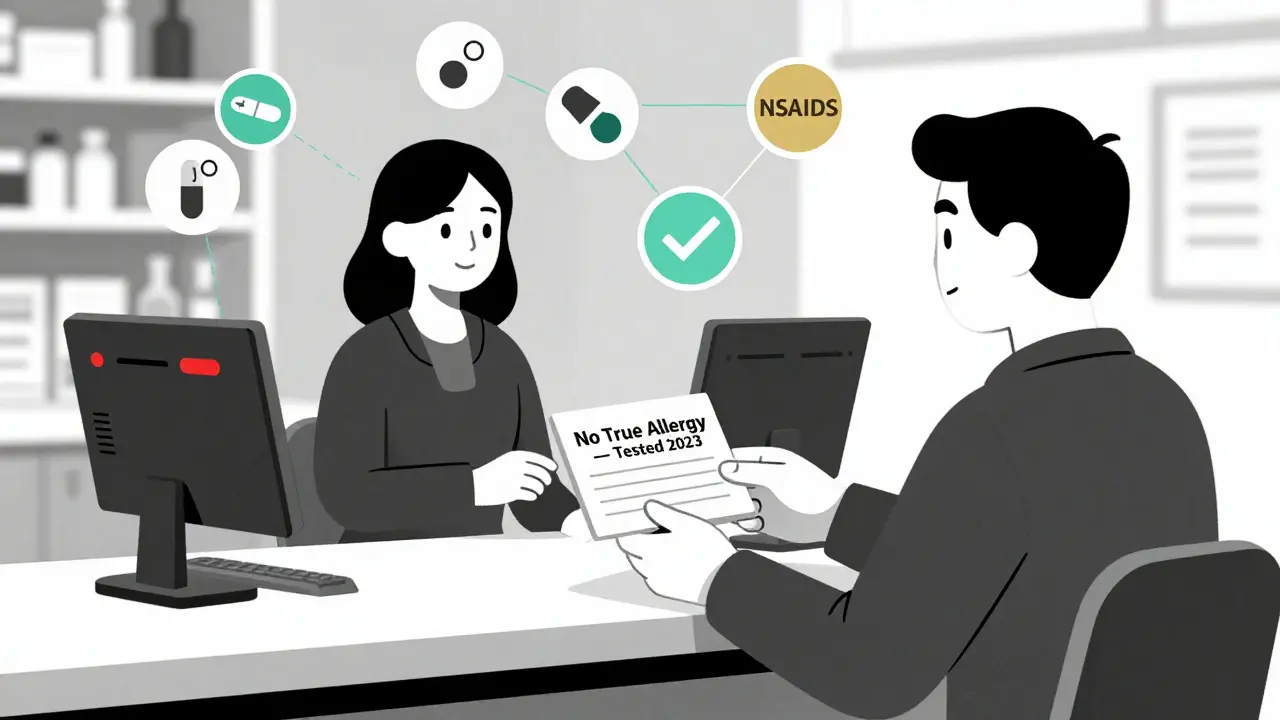
The system is broken-but it’s being fixed. Epic’s 2023.2 update introduced "Allergy Relevance Scoring," using machine learning to predict which alerts are actually dangerous based on your history and how often similar alerts were ignored. Early results show a 37% drop in low-value alerts. Cerner (now Oracle Health) launched "Precision Allergy," which pulls in data from allergist visits. If you’ve had a drug challenge and proved you’re not allergic, the system auto-removes the alert. The NIH’s ALERT-ASAP study showed that requiring clinicians to document reaction severity and type cut unnecessary alerts by over half-without increasing harm. By 2026, 70% of major EHR systems will use risk-stratified alerting: high-risk reactions (anaphylaxis) get loud, mandatory warnings. Low-risk reactions (nausea, mild rash) get quiet, non-blocking notes. This isn’t science fiction. It’s happening now.What This Means for You
Pharmacy allergy alerts are tools-not rules. They’re meant to help, not scare. But if you don’t understand them, you’ll either panic over every warning… or ignore them all. The truth? Most people don’t need to avoid penicillin. Most people don’t need to avoid all NSAIDs. Most people don’t need to avoid cephalosporins just because they once felt queasy after a shot. But if you’ve had a real allergic reaction-swelling, trouble breathing, anaphylaxis-then these alerts are your lifeline. The system fails when it treats every "allergy" the same. The fix is simple: be specific. Update your records. Ask questions. Your next prescription shouldn’t come with a 17-alert warning because of a childhood stomachache. It should come with confidence-because your data is accurate, clear, and trusted.What’s the difference between a drug allergy and a side effect?
A drug allergy involves your immune system reacting to a medication, often causing hives, swelling, trouble breathing, or anaphylaxis. Side effects-like nausea, dizziness, or headaches-are predictable, non-immune reactions. Most "allergies" in medical records are actually side effects. Only 5-10% of adverse drug reactions are true allergies.
If I’m allergic to penicillin, does that mean I can’t take any antibiotics?
No. Penicillin allergies are often misdiagnosed. Studies show over 90% of people who think they’re allergic to penicillin can safely take it after testing. Even if you are allergic, you can still take many other antibiotics like azithromycin, doxycycline, or ciprofloxacin. Cross-reactivity with cephalosporins is extremely low-less than 2% for newer ones. Most EHR systems overestimate this risk.
Why do I get allergy alerts for drugs I’ve taken before without problems?
Because your allergy list probably hasn’t been updated. Many people label a bad reaction as an "allergy" without knowing what it was. A stomachache, headache, or rash from childhood might still be in your record. Systems don’t know you’ve taken the drug safely since then-they just see a label. Always review and correct your allergy list at every visit.
Can I ignore an allergy alert if I’ve taken the drug before?
You can, but don’t do it blindly. If you’ve taken the drug before without issue, it’s likely safe. But make sure your provider knows. Ask them to verify your history and update your record. Never override an alert for a drug you’ve never taken before, even if you think it’s fine. Always confirm with your doctor or pharmacist.
How can I make sure my allergy info is accurate in my medical records?
At every appointment, ask: "Is my allergy list correct?" Write down exactly what happened: "Hives and swelling after penicillin at age 7," not just "penicillin allergy." Use your patient portal to edit your list if you can. Consider seeing an allergist for testing if you’re unsure. Accurate records mean fewer false alerts-and safer care.




Jocelyn Lachapelle
December 15, 2025 AT 21:10Been there. Got the rash at 8, thought I was allergic for 20 years. Got tested last year. Turns out I’m not. Now I take amoxicillin like it’s candy. Why did no one tell me this sooner?
Lisa Davies
December 17, 2025 AT 15:35Yessss this!! 🙌 I used to panic every time I got a script. Now I just open my portal and edit my allergies before the dr even walks in. Life changed. ✨
Nupur Vimal
December 18, 2025 AT 11:42Most people don't understand immune response vs GI upset. You say 'allergy' but mean 'felt weird.' That's not an allergy. That's just your stomach being dramatic. Fix your terminology.
Cassie Henriques
December 20, 2025 AT 02:02The cross-reactivity metrics in Epic are based on outdated pharmacokinetic models from the 90s. The system doesn't account for IgE epitope mapping or HLA haplotype risk stratification. We're running on legacy heuristics with zero machine learning calibration. It's a statistical minefield.
Jake Sinatra
December 21, 2025 AT 10:43This is exactly why standardized documentation protocols are non-negotiable in clinical practice. Vague entries in EHRs create systemic risk. Every provider must be trained to capture reaction type, severity, and timing with precision.
Melissa Taylor
December 21, 2025 AT 15:56My mom was told she was allergic to penicillin because she threw up once as a kid. She’s 72 now. Took amoxicillin last year for a UTI. Felt fine. Why did we waste 60 years believing a lie?
John Brown
December 23, 2025 AT 13:34Real talk: if you’ve taken the drug before and didn’t die, it’s probably fine. But don’t just override the alert. Tell your doc. Make them update it. We’re all tired of being scared by ghost warnings.
Christina Bischof
December 24, 2025 AT 00:01i just learned that hives = real allergy. stomachache = side effect. that’s it. why did no one ever explain that to me before?
John Samuel
December 25, 2025 AT 16:18The evolution of clinical decision support systems toward risk-stratified alerting represents a paradigm shift in pharmacovigilance. The integration of longitudinal patient data with dynamic Bayesian inference models will soon render static, binary allergy flags obsolete. This is not merely an improvement-it is an epistemic correction.
Michelle M
December 27, 2025 AT 12:40It’s funny how we trust machines to keep us safe but never question why they’re so bad at understanding human stories. That rash you got at 8? That wasn’t an allergy. That was your body saying, ‘Hey, I’m not feeling this.’ We need to teach tech to listen better.
RONALD Randolph
December 28, 2025 AT 19:46THIS IS WHY AMERICA’S HEALTHCARE IS BROKEN! PEOPLE DON’T KNOW THE DIFFERENCE BETWEEN A RASH AND ANAPHYLAXIS! THEY JUST TYPE ‘ALLERGY’ AND LET THE COMPUTER DO THE WORK! NO WONDER WE HAVE 90% FALSE ALERTS! FIX YOURSELF BEFORE YOU FIX THE SYSTEM!
Benjamin Glover
December 30, 2025 AT 08:46It’s amusing how Americans treat medical records like social media profiles. Update your allergies? How quaint. In the UK, we just trust our GPs to know what’s what.
Raj Kumar
December 31, 2025 AT 11:59bro i had the same thing. thought i was allergic to ibuprofen because i got a headache once. got tested. zero allergy. now i take it like water. why did no one tell me this before?
Mike Nordby
January 1, 2026 AT 05:16As a clinical informaticist, I can confirm that the ALERT-ASAP protocol has demonstrated statistically significant reductions in alert fatigue without compromising patient safety. The key lies in tiered, context-aware notification systems grounded in evidence-based thresholds. Institutions that have implemented these changes report improved clinician compliance and reduced adverse drug events.