
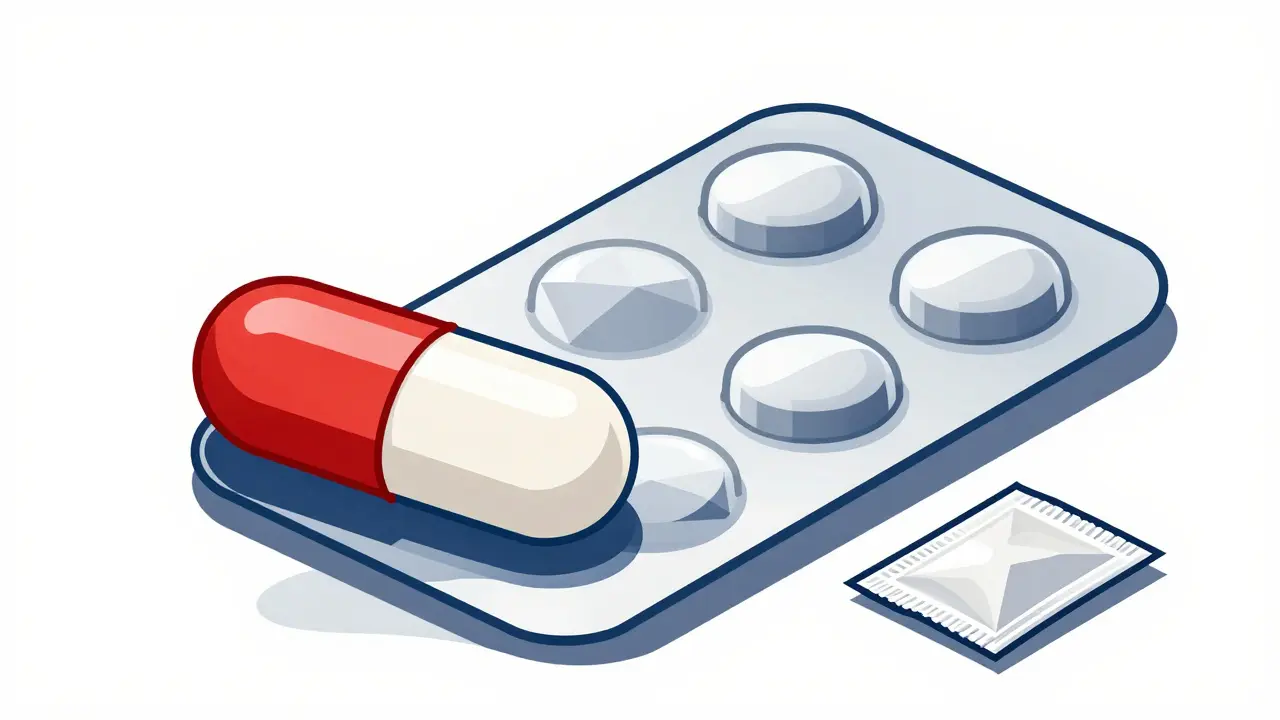
If you’ve ever opened a bottle of pills and found them sticky, discolored, or smelling weird, you’re not alone. Moisture doesn’t just make pills look bad-it can make them useless or even dangerous. In humid climates like Belfast, where damp air seeps into homes year-round, even a few weeks of poor storage can wreck your medication. The good news? Preventing this is simple if you know how.
Why Moisture Destroys Pills and Capsules
Pills and capsules aren’t just sugar and powder. They contain active ingredients designed to work in your body under very specific conditions. When moisture gets in, it triggers chemical reactions called hydrolysis and oxidation. These break down the drug molecules. Aspirin, for example, turns into salicylic acid and vinegar when wet-both can irritate your stomach. Vitamin C degrades fast in humidity, losing its potency. Antibiotics like amoxicillin can lose up to 100% of their effectiveness in just 10 days if exposed to damp air.It’s not just about strength. Broken-down chemicals can form toxic byproducts. The FDA has issued multiple recalls in recent years because moisture-damaged meds tested positive for harmful impurities. A 2022 industry report found that 67% of U.S. medication shortages were tied to quality issues caused by moisture. That’s not a small number-it’s a system-wide problem.
The Three-Layer Defense System
Pharmaceutical manufacturers don’t leave your meds to chance. They use three proven layers to keep moisture out:- Film coating-a thin, invisible shield around each pill
- Packaging-the bottle or blister pack you see
- Desiccants-those little packets you throw away without thinking
Here’s the key: none of these work alone. You need all three.
Film Coating: The First Line of Defense
Most pills you buy today have a coating. But not all are equal. Older pills use HPMC (hydroxypropyl methylcellulose), which lets in some moisture. Newer, better coatings use PVA (polyvinyl alcohol), like Opadry® amb II. Studies show PVA coatings block moisture 30-40% better than HPMC. In one test, uncoated and HPMC-coated amoxicillin tablets lost all their active ingredient after 10 days outside packaging. PVA-coated ones? Still fully effective.When you pick up a prescription, look for brand-name medications-they’re more likely to use advanced coatings. Generic versions sometimes cut corners. If your pills feel unusually soft or crumbly, that’s a red flag.
Packaging: Don’t Trust the Bottle
HDPE plastic bottles (the common white ones) are great for keeping liquid out. But they’re terrible at blocking water vapor. A bottle sitting on your bathroom counter? It’s basically a steam chamber. Even if it has a tight cap, every time you open it, moist air rushes in. In a 500-pill bottle taken twice daily, you’re letting in new air 250 times. That’s 250 chances for moisture to sneak in.Aluminum blister packs are better-they seal each pill individually. But once you pop a pill out, it’s exposed. That’s why you can’t rely on packaging alone. You need the third layer.
Desiccants: The Silent Heroes
Those little packets labeled “Do Not Eat”? They’re silica gel. And they’re lifesavers. Silica gel can absorb up to 40% of its own weight in moisture. In long-term tests, a properly sized desiccant kept moisture levels in a pill bottle rising by less than 1% over two years-even in 40°C heat.But here’s the catch: most bottles come with undersized desiccants. Manufacturers use the smallest packet possible to save money. A 2021 FDA warning letter cited a company for exactly this-desiccants too small to handle the headspace in a 500-pill bottle. The result? Recalls.
What should you do? If your bottle came with a desiccant, leave it in. Don’t toss it. If it’s missing, buy silica gel packs separately. Look for packs labeled for pharmaceutical use. Put one in every pill container you store long-term-even small ones.
Where to Store Pills (And Where Not To)
Your bathroom cabinet is the worst place. Showers create steam. Sink condensation builds up. The humidity there can hit 80%-perfect for wrecking pills.Your kitchen? Also bad. Near the stove or dishwasher? Even worse.
The best spot? A cool, dry drawer in your bedroom. Or a closet shelf away from windows. Temperature should stay below 25°C. Humidity? Below 60%. A simple digital hygrometer (under £10 online) can tell you if your storage spot is safe.
Don’t transfer pills to random containers-like a pill organizer left on the counter. Those are for daily use, not long-term storage. Once you put pills in a plastic organizer, they lose all protection. Use them only for the day’s dose.
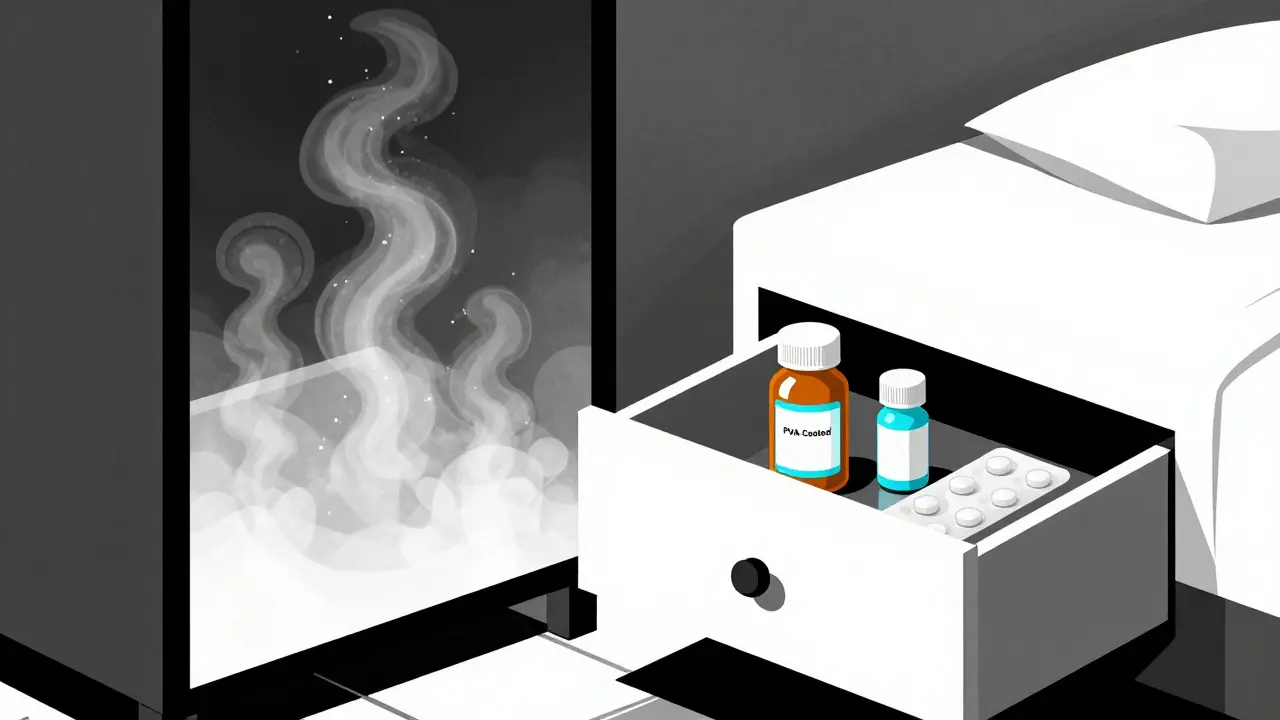
What to Do If Your Pills Are Already Damaged
If you spot any of these signs, throw them out:- Sticky or tacky surface
- Discoloration (yellow, brown, or faded spots)
- Cracking or crumbling when touched
- Unusual smell (vinegar, mildew, or chemical odor)
- Capsules that are swollen, leaking, or misshapen
Don’t take them. Even if they look “mostly okay.” You can’t see chemical breakdown. A pill that’s lost 20% potency might not kill you-but it won’t help either. In antibiotics, that’s how resistant bacteria start.
What Pharmacists Wish You Knew
Pharmacists see this every day. One pharmacist on Reddit said after switching to PVA-coated antibiotics, customer complaints about bad pills dropped from five per month to zero.Another point: if you live in a humid area (like Northern Ireland), ask your pharmacist if your meds are moisture-sensitive. Ask specifically: “Is this coated with PVA?” or “Does it come with a proper desiccant?”
Many generic brands skip the better coating to save money. You pay less upfront-but risk your health later.
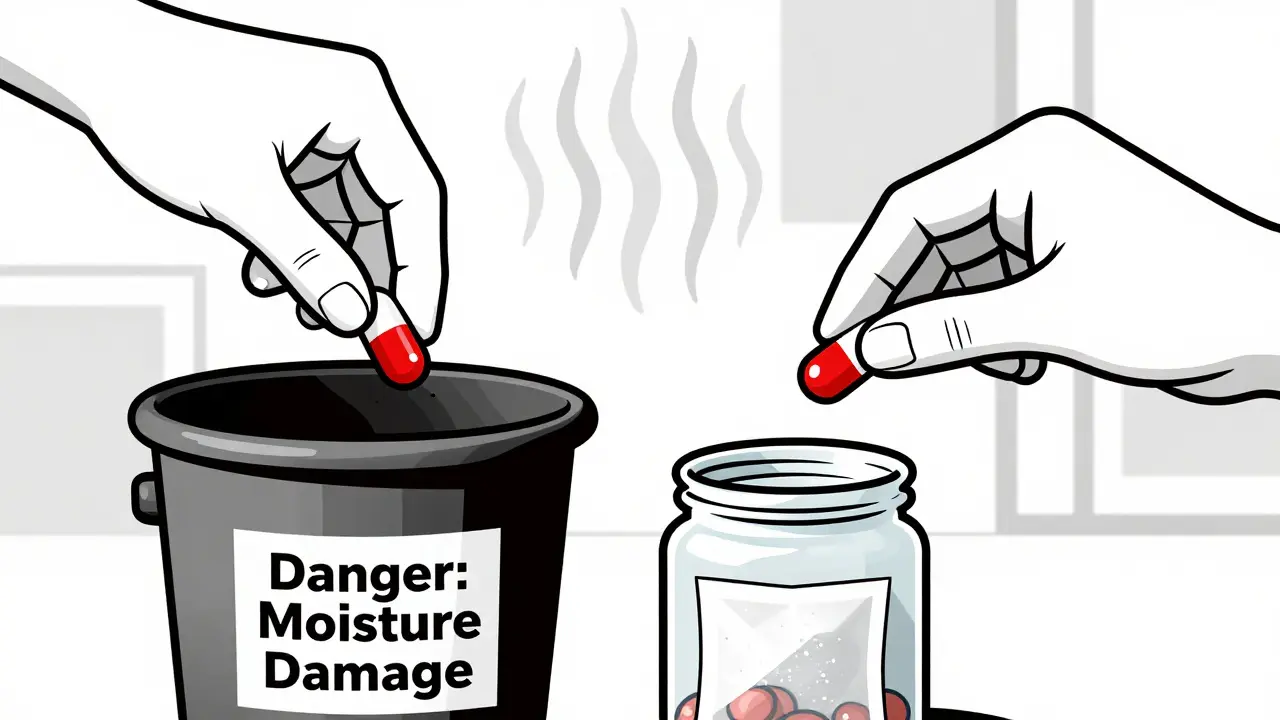
What You Can Do Today
You don’t need to overhaul your medicine cabinet. Start here:- Check all your pill bottles. Is there a desiccant? If yes, leave it in. If no, add one.
- Move all meds out of the bathroom and kitchen.
- Use a small, sealed container (like a glass jar with a tight lid) to store extra pills. Put a silica gel pack inside.
- Don’t refill pill organizers more than 3 days ahead.
- When buying new meds, ask if they’re PVA-coated. If the pharmacist doesn’t know, request a brand-name version.
These steps cost nothing. But they can save your health.
What’s Next for Medication Protection
The industry is moving toward smarter solutions: packaging that changes color if moisture gets in, biodegradable desiccants, and even moisture-absorbing ingredients mixed directly into pills. But for now, the old-school combo-coating + packaging + desiccant-still works best.And if you’re ever unsure? When in doubt, throw it out. Your body doesn’t need weak or broken meds. It needs ones that work.
Can I reuse desiccant packets from old pill bottles?
No. Once a silica gel packet has absorbed moisture, it’s near full capacity. Even if it doesn’t look wet, it can’t absorb much more. Reusing it gives false security. Always use fresh, unopened desiccant packs.
Do all pills need moisture protection?
Not all, but many do. Antibiotics, vitamins (especially C and B12), thyroid meds, and heart medications are highly sensitive. If your pill is white, powdery, or dissolves easily in water, it’s likely moisture-sensitive. When in doubt, assume it needs protection.
Is it safe to store pills in the fridge?
Only if the label says so. Fridges are humid environments, especially near the door. Condensation can form on bottles, making moisture damage worse. Most pills are fine at room temperature. Always check the package insert.
How long do silica gel desiccants last in a pill bottle?
A properly sized silica gel pack in a sealed bottle can last 2-3 years. But once you open the bottle regularly, it works harder. Replace the desiccant every 6-12 months if you’re using the bottle daily. If the pack turns from blue to pink (in indicator packs), it’s full and needs replacing.
Can I use rice instead of silica gel to absorb moisture?
No. Rice doesn’t absorb moisture effectively in this context and can introduce mold or dust. It’s not sterile and isn’t designed for pharmaceutical use. Silica gel is the only safe, tested option.
What if my medication doesn’t come with a desiccant?
Add one yourself. Buy pharmaceutical-grade silica gel packs online or from a pharmacy. Put one in the bottle before sealing it. Even a small 1-gram pack helps. Don’t wait for damage to happen-prevent it.
If you follow these steps, your pills will stay strong, safe, and effective. Moisture damage isn’t inevitable-it’s preventable. You just need to know how.



Payton Daily
December 29, 2025 AT 11:42So let me get this straight-we’re supposed to trust Big Pharma’s ‘three-layer defense’ when they’re the ones who’ve been quietly poisoning us with glyphosate-laced vitamins for decades? This isn’t storage advice, it’s a distraction. They want you paranoid about silica gel so you don’t ask why your insulin costs $300 a vial.
Debra Cagwin
December 31, 2025 AT 05:43This is actually one of the most practical, life-saving pieces of health advice I’ve read in years. Thank you for breaking it down so clearly. Leaving the desiccant in? Moving meds out of the bathroom? I’m doing both starting today. Your post just prevented someone from taking ineffective antibiotics-and that’s huge.
Nicole Beasley
January 1, 2026 AT 14:56Wait so… silica gel = good, rice = bad 😮 I always thought rice was magic for moisture… guess I’m learning something new today 🤯
Sydney Lee
January 3, 2026 AT 04:47Let’s be honest: the pharmaceutical industry is a grotesque oligopoly that prioritizes profit margins over patient safety. The fact that manufacturers use undersized desiccants to save pennies while people suffer from degraded meds is not negligence-it’s malice disguised as capitalism. And yet, we’re told to ‘just leave the packet in’ like it’s a moral choice. No. It’s a band-aid on a bullet wound.
Who approved these standards? Who’s auditing the ‘properly sized’ desiccant claims? The FDA? The same agency that greenlit OxyContin? We are not consumers-we are test subjects in a system designed to extract, not heal.
And don’t get me started on the PVA vs HPMC coating. If you’re paying for generics, you’re funding the slow death of your own immune system. This isn’t science. It’s corporate warfare-and your medicine cabinet is the battlefield.
Vu L
January 4, 2026 AT 00:31Bro, I’ve been storing my Adderall in a Ziploc in my glovebox for 3 years. It’s fine. You’re all overreacting. If it didn’t kill me yet, it’s probably fine.
Ryan Touhill
January 4, 2026 AT 05:03While I appreciate the effort to educate, I must point out that your reliance on industry jargon like ‘hydrolysis’ and ‘oxidation’ without defining them for the layperson is exclusionary. This isn’t a pharmacology lecture-it’s a public health guide. If you truly care about accessibility, you’d avoid terms like ‘PVA-coated’ without context. Most people don’t know what polyvinyl alcohol is, and that’s not their fault. It’s yours for assuming they should.
Also, why is the FDA cited as a source of authority when they’ve failed catastrophically on opioid regulation, lead in toys, and now, apparently, desiccant sizing? Your tone suggests blind trust in institutions that have repeatedly betrayed public trust. That’s not wisdom. It’s naivety wrapped in a lab coat.
sonam gupta
January 5, 2026 AT 08:11Why are you Americans so obsessed with pills? In India we use herbs, yoga, and sunlight. If your body can’t handle humidity, maybe your lifestyle is the problem. Stop blaming silica gel and start living right.
Julius Hader
January 6, 2026 AT 16:36I used to toss those little packets. Now I keep them. I even bought extra ones for my vitamins. It’s cheap. It’s easy. And honestly? I sleep better knowing my meds aren’t turning into vinegar. Small habits save lives.
Teresa Marzo Lostalé
January 6, 2026 AT 21:29Wow. I just checked my medicine cabinet. Two bottles with no desiccant. One in the bathroom. I’m crying a little. But also… thank you. I’m moving everything tonight. 🌿💧