

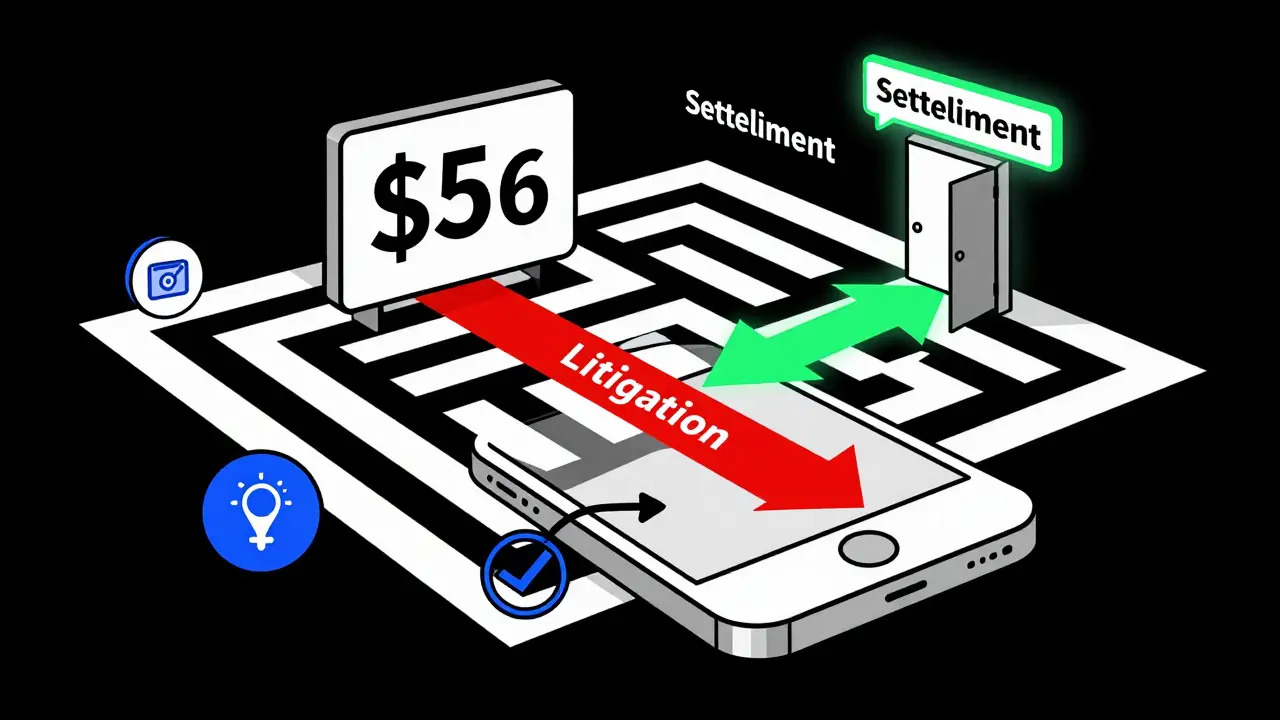
When two big companies are fighting over a patent, it’s not usually about who’s right. It’s about who can afford to wait. Most patent disputes never go to trial. In fact, patent settlement happens in over 85% of cases before a judge ever hears arguments. Why? Because litigation is expensive, slow, and risky. A single patent lawsuit can cost $3 million to $5 million just to get to trial. For companies that make products - not lawsuits - that’s money better spent on R&D, not courtrooms.
Why Companies Choose Settlement Over Court
Imagine you’re a phone maker. You’ve spent years building a new model. Your engineers worked overtime. Your supply chain is locked in. Then, out of nowhere, a competitor sues you, claiming you stole their patent on a charging port design. You don’t even know if the patent is valid. But if you fight, your product launch gets delayed. Your retailers cancel orders. Your stock drops. You’re not just fighting a legal case - you’re fighting your own business timeline. That’s why companies settle. Not because they’re weak. Because they’re smart. They calculate the cost of delay. They look at how many units they’ll lose. They weigh the chance that a jury might side with the plaintiff, even if the patent is shaky. Sometimes, paying a few million dollars to make the problem disappear is cheaper than risking $50 million in lost sales.The Anatomy of a Patent Settlement
A good patent settlement isn’t just a check written and signed. It’s a carefully constructed deal with multiple moving parts. The most successful ones include four key pieces:- Patent portfolio assessment - Companies don’t fight over every patent. They pick 3 to 15 that matter most. These are usually the ones with broad claims or that cover core features of a product.
- Claim chart analysis - Lawyers map exactly which parts of your product match the patent claims. This isn’t guesswork. It’s line-by-line technical comparison.
- Validity check - Before offering money, smart companies spend $150,000 to $300,000 to find prior art that could kill the patent. If the patent was granted based on old tech no one noticed, it’s not worth fighting over.
- Settlement structure - This is where creativity kicks in. Is it a one-time payment? Royalties? Cross-licensing? Or a high-low deal?
High-low settlements are becoming popular. Here’s how they work: both sides agree on two numbers - a minimum payment if the patent is upheld, and a maximum if it’s thrown out. They pick 2 to 5 key patent claims as proxies. If those claims survive review, the defendant pays the higher amount. If they’re invalidated, the payment drops. It’s a way to hedge risk without going to trial.
When Settlements Work - And When They Don’t
Not all settlement strategies are created equal. The success rate depends on who you’re dealing with.If you’re negotiating with another tech giant - say, Samsung and Ericsson - settlement works well. Both sides have patents. Both want to keep making phones. They don’t need to destroy each other. In 2021, Ericsson settled with Samsung after eight months of talks. Result? A six-year licensing deal worth $650 million upfront, plus royalties based on device price. Both kept making products. No one lost market share.
But if you’re facing a non-practicing entity - a patent troll - it’s different. These companies don’t make anything. They buy patents and sue. Their goal isn’t partnership. It’s quick cash. High-low deals fail here 92% of the time. Why? Because trolls don’t care if the patent is valid. They just want you to pay to go away.
Mediation helps in about 65% of cases. Arbitration works better - 81% success - but you lose the right to appeal. Cross-licensing is the gold standard in industries like semiconductors and telecom. Intel and MEDIATEK settled in 2018 and didn’t just exchange licenses. They started co-developing 5G tech. That deal saved them over $200 million in R&D costs. That’s not a settlement. That’s a partnership.
The Hidden Rules of Negotiation
There are unspoken rules in patent negotiations that most outsiders don’t see.First: anchor high. Studies show plaintiffs who ask for three times what they’ll settle for end up getting 28% more than those who start reasonable. It’s psychological. The first number sets the frame. But don’t be reckless. If you ask for $100 million when your real target is $5 million, you look desperate - and the other side will dig in.
Second: concede strategically. In 61% of successful settlements, one side gives up something small to get something big. Maybe you offer a longer license term in exchange for lower royalties. Or you agree to drop a counterclaim if they drop theirs. These aren’t weaknesses. They’re leverage.
Third: know your bottom line. Dr. Michael Walden from TT Consultants says it plainly: calculate the cost of not settling. If litigation will cost you $4 million and delay your product launch by 18 months, losing $15 million in sales - then paying $6 million to settle isn’t a loss. It’s a business decision.
How Technology Is Changing the Game
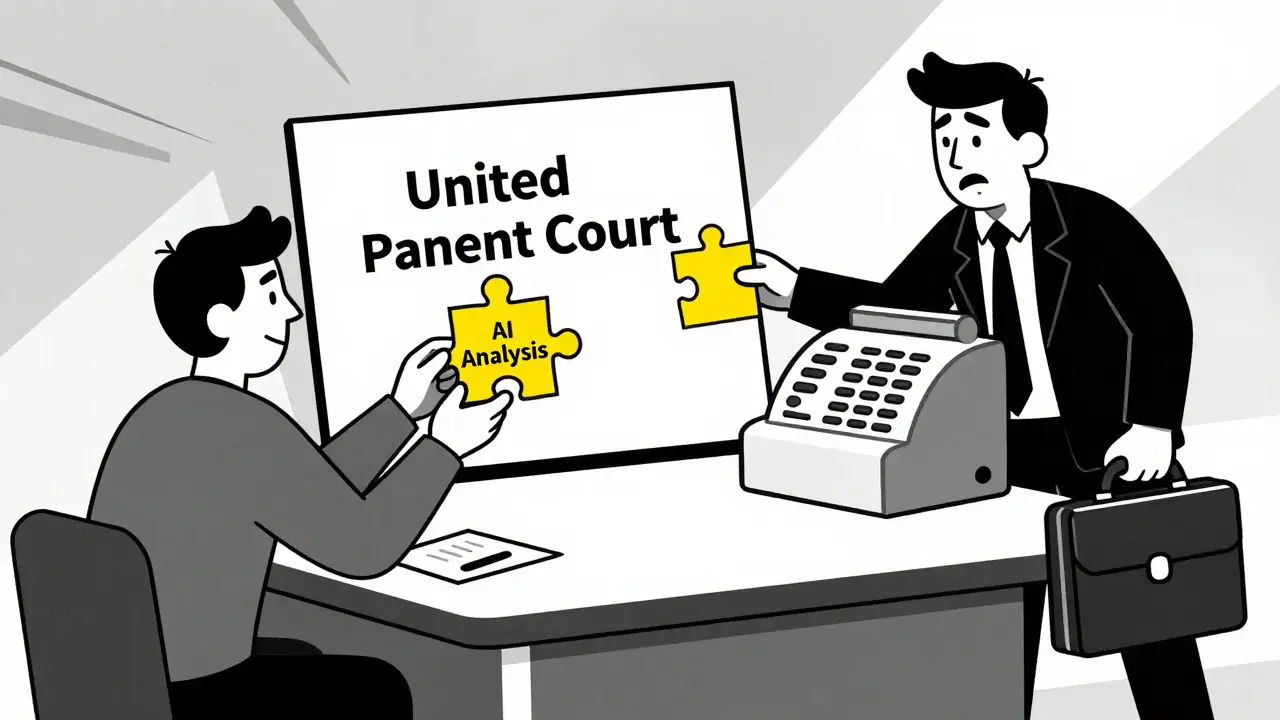
Ten years ago, patent analysis meant teams of lawyers poring over old patents for weeks. Now, AI tools like PatentSight can scan thousands of documents in days. They cut portfolio review time from 3-4 weeks to just 3-5 days. But here’s the catch: AI still misses nearly 19% of relevant prior art. Human experts are still needed to spot the subtle connections - the obscure Japanese patent from 1998 that makes your opponent’s claim look silly.The USPTO’s new Patent Evaluation Express (PEX) program is another game-changer. It gives companies a fast, low-cost validity opinion - at 60% less than a full post-grant review. In just a year, 17% of new settlement talks have used PEX to weaken the other side’s position before even sitting down.
And soon, blockchain may take over royalty payments. IBM and Microsoft are testing smart contracts that automatically adjust payments based on real-time sales data. No more audits. No more disputes over how many units were sold. The system pays itself. Gartner predicts this could cut post-settlement conflicts by 40%.
What’s Next for Patent Settlements?
The biggest challenge ahead isn’t legal - it’s complexity. In industries like AI and quantum computing, a single product can touch hundreds of patents across multiple countries. One smartphone might use tech covered by 500+ patents. Negotiating all of them? That’s not a deal. That’s a full-time job.The Unified Patent Court in Europe, launched in June 2023, is already changing the game. Companies used to settle separately in Germany, France, and the UK. Now, one settlement can cover 17 countries. Cross-border deals jumped 22% in the first six months.
Pharmaceuticals still lead in high-value settlements - 28% of cases over $50 million. But telecom and consumer electronics are catching up. And the companies winning? They’re not the ones with the most patents. They’re the ones with the best negotiators - people who understand tech, law, and human behavior.
There’s no magic formula. But the pattern is clear: the most successful companies don’t fight patents. They manage them. They don’t see settlements as defeat. They see them as strategy.
What You Can Learn From This
If you’re in a company that owns or uses patented tech, here’s what matters:- Don’t wait until you’re sued to think about your patent portfolio. Audit it now.
- Know which patents are strong - and which are weak. Weak ones are liabilities, not assets.
- Build relationships with legal teams who specialize in patent negotiation, not just litigation.
- Practice your settlement strategy before a crisis hits. Run mock negotiations. Test your bottom line.
- Remember: a settlement isn’t about winning. It’s about moving forward.
Patent disputes aren’t going away. But the smartest players aren’t trying to win every battle. They’re trying to win the war - by choosing when to fight, and when to walk away.
What percentage of patent cases settle before trial?
Over 85% of patent disputes settle before trial, according to a 2022 Stanford Law School study of 10,000 cases from 2010 to 2020. Most settlements occur after the Markman hearing but before summary judgment, typically between 6 and 9 months into the legal process.
How much does a patent settlement usually cost?
Settlement values vary widely. For cases involving non-practicing entities (patent trolls), the median is around $1.2 million. For disputes between competitors, the median jumps to $8.7 million. In high-stakes industries like telecom or pharma, settlements can exceed $1 billion, especially when they include cross-licensing or joint R&D.
What’s the difference between mediation and arbitration in patent cases?
Mediation involves a neutral third party helping both sides reach a voluntary agreement. It succeeds in about 65% of patent cases. Arbitration, on the other hand, is binding - the arbitrator makes a final decision that both parties must accept. It resolves 81% of cases but removes the right to appeal. Mediation is flexible; arbitration is final.
Why do some companies use high-low settlement structures?
High-low settlements reduce risk for both sides. The defendant agrees to pay a minimum if the patent is upheld and a maximum if it’s invalidated. This structure works best between rational competitors who want to avoid trial but need certainty. It fails with patent trolls, who don’t care about patent validity - they just want cash.
Can AI replace lawyers in patent negotiations?
No. AI tools like PatentSight can speed up patent analysis and find prior art faster, but they still miss nearly 19% of relevant references. Legal strategy, negotiation tactics, and understanding business context require human judgment. AI supports lawyers - it doesn’t replace them.
What’s a FRAND license, and why does it matter?
FRAND stands for Fair, Reasonable, and Non-Discriminatory. It’s a commitment made by companies that hold standard-essential patents (SEPs) - like those for 4G or Wi-Fi. They agree to license these patents to anyone at reasonable rates. If they refuse or demand excessive fees, they can face antitrust fines. The European Commission fined Qualcomm €242 million in 2018 for violating FRAND terms.
How long does a typical patent settlement take?
Most settlements take 6 to 9 months, from initial talks to signed agreement. Some can wrap up in weeks if both sides are motivated. Others drag on for years, especially if there’s a patent validity challenge or if one party is a non-practicing entity. The timeline depends on complexity, willingness to compromise, and whether external factors like court deadlines apply.



Aurora Daisy
December 23, 2025 AT 21:20So let me get this straight - we’re glorifying corporate surrender as ‘strategy’? Brilliant. Just hand over your money, bow to the patent troll, and call it ‘smart business.’ Meanwhile, real innovators get squeezed out because the system rewards bullies with deep pockets. This isn’t negotiation. It’s extortion dressed in a suit.
Katie Taylor
December 25, 2025 AT 01:29YES. This is exactly why startups die before they even launch. Big players don’t fight patents - they buy them, then use them as weapons. The real win isn’t settling - it’s building a portfolio so strong no one dares come after you. We need patent reform, not more ‘smart’ compromises.
Ademola Madehin
December 25, 2025 AT 10:07bro this is wild… i saw a guy get sued for using a round button on his app. like… what? this system is broken. they’re not protecting innovation - they’re protecting lawyers’ vacations.
Wilton Holliday
December 27, 2025 AT 00:32Love this breakdown. Seriously. Most people think patent battles are about who invented what - but it’s really about who can afford to wait longer. 🙌 And that AI point? Game-changer. Tools like PatentSight are leveling the field for smaller firms. Don’t sleep on tech helping the little guy.
Lu Jelonek
December 28, 2025 AT 17:07High-low settlements are brilliant for rational actors, but they’re useless against trolls. I’ve seen it firsthand - trolls don’t care about validity, they care about settlement pressure. The system is rigged to favor those who can absorb cost, not those who create value.
Pankaj Chaudhary IPS
December 29, 2025 AT 02:07The structural imbalance in patent litigation is a global concern. In India, we see SMEs crushed under the weight of foreign patent assertions - often based on prior art that is culturally or linguistically obscure. AI tools help, but they cannot replace local legal expertise that understands regional innovation ecosystems. We need international cooperation, not just corporate deals.
suhani mathur
December 30, 2025 AT 08:56Of course you’d say settlement is ‘smart.’ You’re not the one getting sued by a shell company in Delaware that owns 3 patents bought for $50k. The real ‘strategy’ is lobbying Congress to fix this mess. Until then, it’s just corporate cowardice with a PowerPoint.
Blow Job
December 31, 2025 AT 10:52Patent trolls are the reason I left Silicon Valley. I built something real. They didn’t build anything - just filed paperwork and waited. The fact that we call this ‘business’ is the saddest thing about modern tech. We’re not innovating. We’re litigating.
Christine Détraz
January 1, 2026 AT 14:44I’ve been in the trenches on both sides - as a startup and later as in-house counsel. The truth? Most companies don’t settle because they’re weak. They settle because the system is broken. The real victory isn’t avoiding trial - it’s preventing the lawsuit from ever happening. Build better IP strategy before you launch.
Bartholomew Henry Allen
January 3, 2026 AT 05:25Settlement is not strategy. It is capitulation. The United States patent system was designed to protect inventors not to enable corporate extortion. When 85 percent of cases settle it is not a sign of efficiency. It is a sign of systemic failure. The law must be reformed. The courts must be empowered. The status quo is unacceptable.
Joseph Manuel
January 3, 2026 AT 12:23Let’s be honest: 90% of patent litigation is about extracting rents, not protecting innovation. The median settlement for trolls is $1.2M? That’s a tax on progress. The fact that companies treat this as a cost of doing business is the real scandal. We’re not fixing patents - we’re normalizing theft.
Isaac Bonillo Alcaina
January 4, 2026 AT 09:41AI misses 19% of prior art? That’s not a flaw - that’s a catastrophe. If your entire settlement strategy hinges on automated tools that miss critical evidence, you’re not managing risk - you’re gambling with your company’s future. And yet, firms still outsource this to software. No wonder so many settlements collapse later.
Lindsey Kidd
January 4, 2026 AT 22:17FRAND licenses are the unsung heroes of tech. 🌍 Without them, we wouldn’t have 4G, Wi-Fi, or Bluetooth. Companies like Qualcomm got slapped with €242M fines for abusing them - and rightly so. Standardization should enable collaboration, not exploitation. Let’s celebrate the ones playing fair.
Usha Sundar
January 6, 2026 AT 09:21Just pay them and move on.
Adarsh Dubey
January 7, 2026 AT 09:57Interesting how the article frames settlement as wisdom - but ignores the fact that the entire system incentivizes the worst behavior. If you’re a troll, sue everyone. If you’re a real company, pay up. That’s not strategy. That’s surrender. The real innovation needed isn’t in AI tools - it’s in legal reform.