
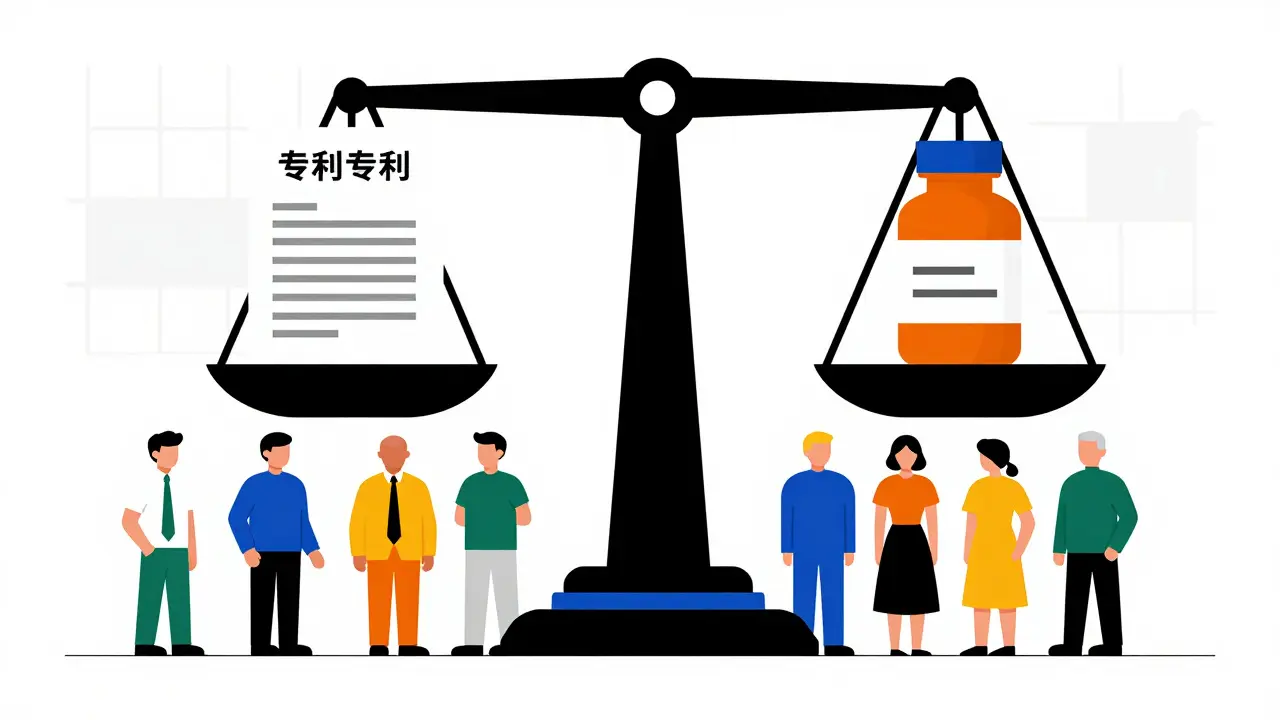
What is compulsory licensing, and why does it matter?
Compulsory licensing lets a government allow someone else to make or use a patented invention without the patent owner’s permission. It doesn’t take away the patent. It just says: in this case, the public interest comes first. This tool is mostly used when people need life-saving medicine, and the price is too high, or when a country can’t get enough of a critical technology during a crisis.
It’s not some secret loophole. It’s written into international law. The TRIPS Agreement, signed by nearly every country in 1994, makes it clear: governments have the right to issue these licenses. The catch? They must pay the patent holder fair compensation. That’s not charity-it’s a legal balance between protecting innovation and saving lives.
When do governments actually use it?
Most of the time, it’s for medicines. Between 2000 and 2020, 95% of all compulsory licenses reported to the World Trade Organization were for drugs. Think cancer treatments, HIV antivirals, or vaccines during a pandemic.
Thailand did it in 2006 for HIV drugs. The price of lopinavir/ritonavir dropped from $1,200 a year to $230. Brazil did the same for efavirenz, cutting the cost from $1.55 per tablet to $0.48. India issued its first compulsory license in 2012 for Nexavar, a kidney cancer drug. Bayer, the patent holder, was selling it for $5,500 a month. After the license, a local company made a generic version for $175. That’s not a small difference-it’s the difference between living and dying.
During the early days of the COVID-19 pandemic, over 40 countries, including Canada, Germany, and Israel, looked into issuing compulsory licenses for vaccines and treatments. Some passed emergency laws to speed up the process. Others didn’t go through with it, but the threat alone pushed drug companies to lower prices voluntarily.
How does it work in the U.S.?
The U.S. has the legal tools-but rarely uses them. There are three main ways:
- Title 28, U.S.C. § 1498: The federal government can use any patented invention for its own purposes-like building military equipment or responding to a health emergency. The patent holder can sue for compensation in the Court of Federal Claims, but can’t stop the use. Between 1945 and 2020, there were only 10 cases, mostly for defense tech.
- Bayh-Dole Act march-in rights: If a drug was developed with taxpayer money (like through NIH grants), the government can force the patent holder to license it if they’re not making it available to the public. The NIH has received 12 requests since 1980. They’ve denied every single one, saying the company is "doing enough."
- Environmental laws: The Clean Air Act lets the government license patented pollution-control tech if it’s needed to meet air quality standards. This has been used a few times, mostly for industrial emissions systems.
The U.S. prefers to negotiate. And usually, it works. Drug companies give discounts to avoid the political fallout of a license being issued. But when they don’t? The law is there.
How does it work elsewhere?
Not every country plays the same way.
In India, the Patents Act lets anyone apply for a compulsory license if the drug isn’t affordable or available in sufficient quantities. Since 2005, they’ve issued 22 licenses-almost all for cancer drugs. The process takes 18 to 24 months. Applicants must prove they tried to get a voluntary license first. But if it’s a public health emergency? That step is skipped.
Germany has the legal power under its Patent Act to issue licenses for public interest, but they’ve never done it. The same goes for the UK and France-laws exist, but political will doesn’t.
Spain changed the rules in 2020. During the pandemic, they removed the requirement to negotiate first. If a health emergency is declared, the government can move fast.
Canada used the export clause of TRIPS in 2012 to send a generic HIV drug to Rwanda. Only one country has ever used that part of the law. It’s complicated, but it works.
What are the downsides?
Opponents say compulsory licensing kills innovation. A 2018 study found countries with active licensing programs saw a 15-20% drop in pharmaceutical R&D investment. The pharmaceutical industry claims each license announcement causes an 8.2% drop in stock prices for affected companies.
There’s also the legal cost. In the U.S., getting compensation under Section 1498 takes an average of 2.7 years. In India, Bayer fought its Nexavar license for eight years before the courts finally upheld it.
And then there’s the problem of capacity. The World Health Organization says 60% of low- and middle-income countries don’t have the legal or technical staff to actually implement a compulsory license-even if the law allows it. They know the tool exists, but they can’t pull the trigger.
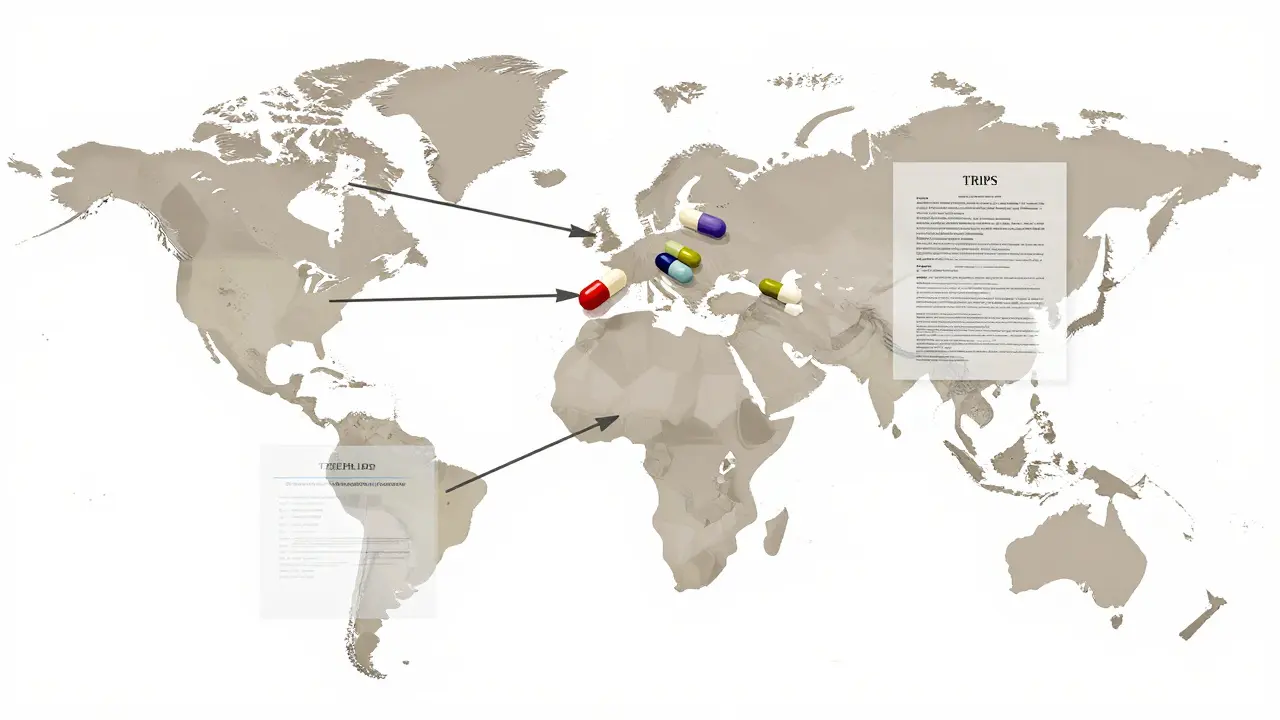
What’s changing now?
Things are shifting. In June 2022, the WTO agreed to a temporary waiver for COVID-19 vaccine patents. It lets developing countries make vaccines without permission until 2027. So far, only 12 facilities in 8 countries are producing under it. The rules are still too slow, too messy.
The European Union is pushing new rules in 2023. If a company doesn’t offer fair licensing terms within 30 days of a request, the government can skip negotiations and issue a license automatically. That’s a big change.
Meanwhile, the World Health Organization is drafting a Pandemic Treaty. One draft article says: during a declared global health emergency, essential medicines and vaccines should be automatically licensed. No waiting. No negotiations. Just access.
Experts predict compulsory licensing will become more targeted. By 2030, 75% of licenses will likely be limited to specific diseases or emergencies-not general price controls.
Who benefits?
Patients do. Generic drugmakers do. Teva Pharmaceutical made $3.2 billion extra between 2015 and 2020 from markets opened by compulsory licenses.
But the biggest winners? The people who couldn’t afford the original drug. In low-income countries, compulsory licensing helped slash the price of first-line HIV drugs by 92% between 2000 and 2020. That’s millions of lives.
It’s not about punishing companies. It’s about making sure patents don’t become barriers to survival. The system isn’t perfect. But when a child dies because a pill costs $10,000, the law has to have a way to say: no more.
Is it really a threat to innovation?
Drug companies argue that if governments can just override patents, why invest billions in new drugs?
But here’s the reality: most new drugs are developed with public money. The NIH spent over $40 billion on medical research in 2023. Many breakthroughs come from universities funded by taxpayers. The patent system was never meant to lock up public knowledge forever.
And here’s another fact: the threat of a compulsory license has led to voluntary price cuts in 90% of HIV drug deals since 2000. Companies lowered prices just to avoid the risk. That’s not a failure of the system-it’s proof it works as a deterrent.
Compulsory licensing isn’t about taking away rights. It’s about reminding everyone: patents serve society. When they stop doing that, society has the right to step in.


Erika Putri Aldana
December 22, 2025 AT 21:27Siobhan K.
December 24, 2025 AT 09:49Michael Ochieng
December 24, 2025 AT 22:54Grace Rehman
December 25, 2025 AT 02:20the system was built on a social contract: you invent something, we give you 20 years to profit, then it becomes public
but now? It's corporate feudalism with lawyers
and we act surprised when people start breaking the rules?
Jerry Peterson
December 27, 2025 AT 00:02Meina Taiwo
December 27, 2025 AT 05:33Brian Furnell
December 29, 2025 AT 01:16Adrian Thompson
December 30, 2025 AT 12:29Dan Adkins
December 30, 2025 AT 22:02Theo Newbold
January 1, 2026 AT 11:23Cara C
January 1, 2026 AT 13:12Southern NH Pagan Pride
January 3, 2026 AT 00:16Jay lawch
January 4, 2026 AT 01:23Christina Weber
January 4, 2026 AT 13:27Orlando Marquez Jr
January 6, 2026 AT 11:05