
Fall Risk Medication Checker
This tool helps identify medications that may increase fall risk for adults over 65. It is NOT medical advice. Always discuss your medications with your healthcare provider.
Check Your Medications
Select medications you take regularly. This tool identifies common medications with higher fall risk for older adults.
Your Fall Risk Assessment
Based on your selected medications, your fall risk level is:
Next Steps:
- Bring all medications (prescription, OTC, supplements) to your next appointment
- Ask your doctor about the STEADI program (STOP, SWITCH, REDUCE)
- Consider non-medication alternatives like CBT for anxiety or insomnia
- Track balance changes and report them to your healthcare provider
Every year, more than 36,000 older adults in the U.S. die from falls. That’s more than car crashes or gun violence. And it’s not just bad luck - many of these falls are tied to the very medicines people take to feel better. If you or someone you care about is over 65 and taking multiple prescriptions, this isn’t just a warning. It’s a reality.
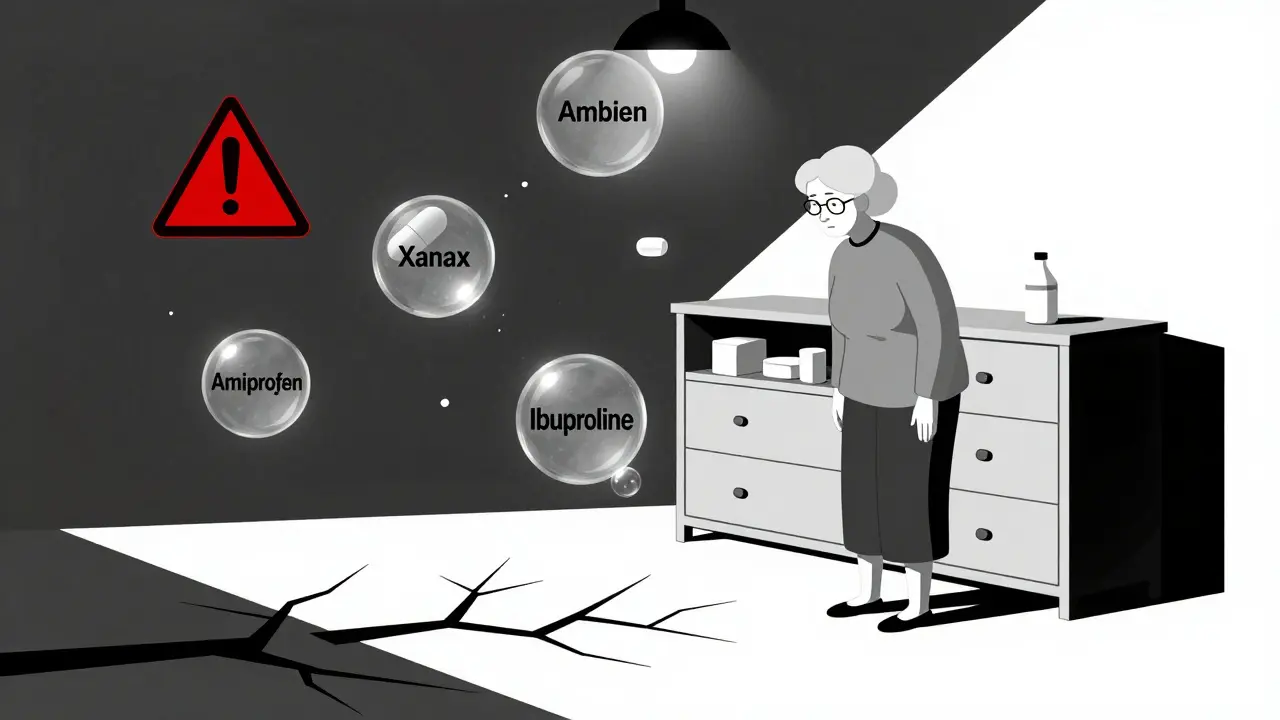
One in three older adults falls at least once a year. Half of those who fall end up with injuries - broken hips, head trauma, deep bruises. Some never walk the same way again. And the biggest hidden culprit? Medications. Not just one, but combinations. The drugs meant to help - for sleep, anxiety, blood pressure, pain - are often the same ones that make you dizzy, slow, or unsteady on your feet.
Which Medications Are Most Dangerous?
The American Geriatrics Society has a list called the Beers Criteria - it’s not a list of bad drugs, but of drugs that are riskier than they need to be for people over 65. Among the top offenders:
- Antidepressants - especially tricyclics (like amitriptyline) and even some SSRIs (like sertraline). These don’t just lift mood - they can dull your reflexes, blur your vision, and drop your blood pressure when you stand up. Studies show they have the strongest link to falls of any drug class.
- Benzodiazepines - drugs like diazepam (Valium), lorazepam (Ativan), and alprazolam (Xanax). These are prescribed for anxiety or insomnia, but they stick around in the body longer as we age. Even a single dose can leave you groggy the next morning. Long-term use? That’s a recipe for repeated falls.
- Sedative-hypnotics - zolpidem (Ambien), eszopiclone (Lunesta), zaleplon (Sonata). These are marketed as “non-addictive sleep aids,” but they can cause sleepwalking, confusion, and loss of balance - sometimes without the person even remembering it happened.
- Opioids - oxycodone, hydrocodone, morphine. Pain relief is important, but high-dose opioids slow reaction time, cause dizziness, and impair judgment. A 2023 JAMA study found high-potency opioids increase fall risk by 80% compared to low-dose versions.
- Muscle relaxants - baclofen, cyclobenzaprine. These are often given for back pain or spasms, but they hit the brain like a sedative. Baclofen alone has been linked to a 70% higher fall risk than other options.
- NSAIDs - ibuprofen, naproxen. You might think these are harmless. But they can mess with blood pressure control, especially when taken daily. A 25% increase in fall risk? That’s not nothing.
- Anticholinergics - oxybutynin, tolterodine, diphenhydramine (Benadryl). These are used for overactive bladder, allergies, or even colds. They cause dry mouth, blurred vision, and brain fog. Many seniors don’t realize their nighttime allergy pill is making them a walking hazard.
- Antihypertensives and diuretics - if your blood pressure drops too fast when you stand up, you’re at risk. This is called orthostatic hypotension. It’s common with blood pressure meds, especially when combined with water pills.
It’s not about avoiding all these drugs. It’s about knowing if they’re still necessary.
Why Do These Drugs Hurt More as We Age?
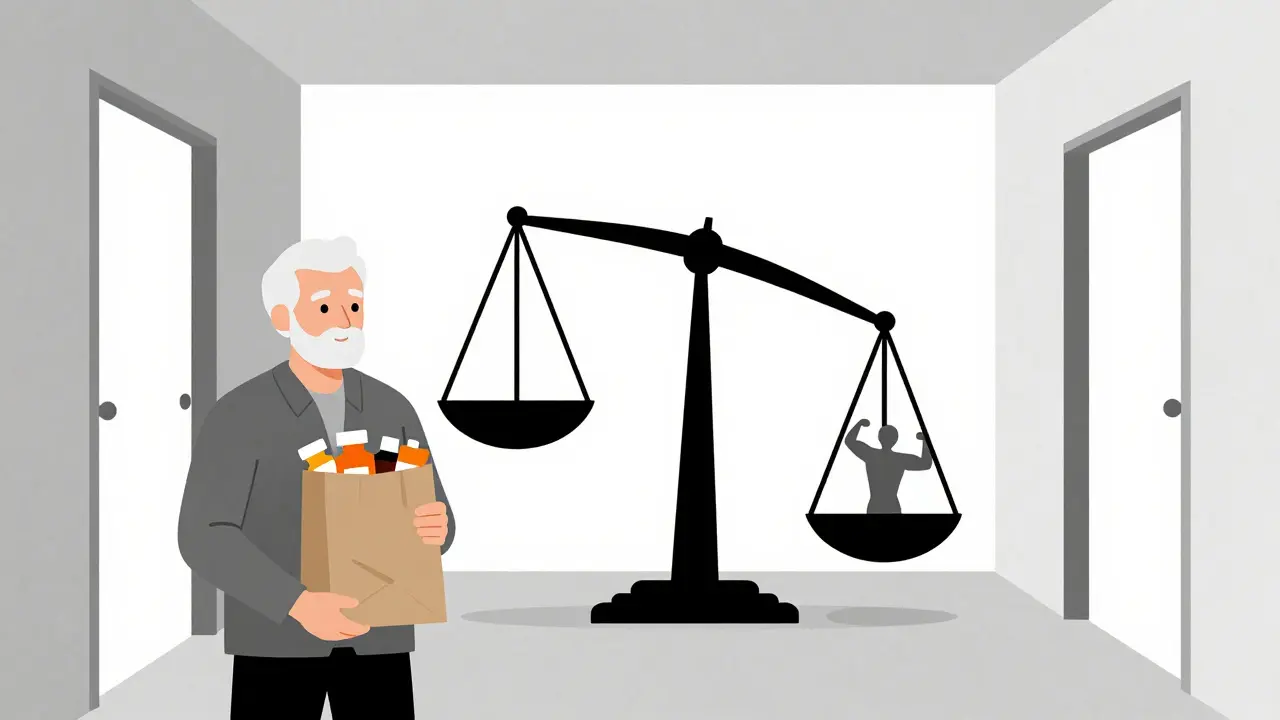
Your body changes after 65. Your liver and kidneys don’t clear drugs the way they used to. That means a pill that was fine at 50 might build up to dangerous levels by 75. Also, your balance system weakens. Your vision dims. Your muscles lose strength. When you add a drug that slows your brain or drops your blood pressure, it’s like adding one more weight to an already tipping scale.
And here’s the quiet truth: most older adults don’t know their meds are risky. A 2023 study found that 63% of seniors taking multiple fall-risk drugs had no idea they were at higher risk. Doctors don’t always explain it. Pharmacies don’t always flag it. And patients? They’re just trying to sleep, manage pain, or stay calm.
What’s Really Going On Behind the Scenes?
Let’s look at real stories.
One woman in her late 70s started taking Ambien for insomnia. Within weeks, she fell three times. The third fall broke her hip. She didn’t connect the dots until her daughter found the medication bottle and read the warning label: “May cause dizziness, drowsiness, impaired coordination.”
Another man, 72, took Xanax daily for anxiety for six months. He started bumping into doorframes, missing steps, and feeling “off.” He didn’t tell his doctor because he thought it was just “getting older.” He only stopped after his physical therapist asked, “Are you on any sleeping pills or anxiety meds?”
The CDC found that 28% of older adults who fell blamed their meds - but only 15% ever talked to their doctor about it. That gap? It’s deadly.
What Can Be Done?
There’s a proven way to cut fall risk - and it doesn’t involve buying new equipment or installing grab bars (though those help too). It’s about reviewing and rethinking the meds.
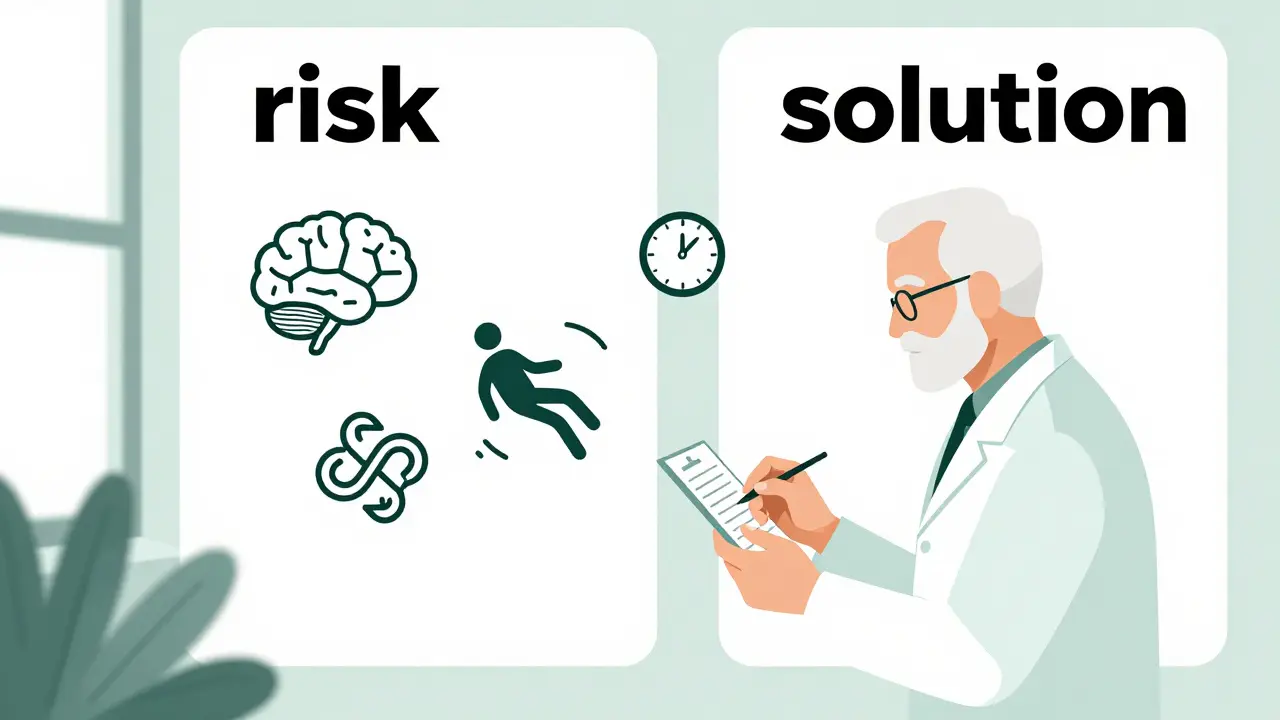
The CDC’s STEADI program - which stands for Stopping Elderly Accidents, Deaths & Injuries - has three simple rules:
- STOP - If a drug isn’t clearly helping, or if it’s been taken for years without review, ask if it can be stopped.
- SWITCH - Can a safer alternative work? For anxiety, cognitive behavioral therapy (CBT) is just as effective as Xanax, with zero fall risk. For insomnia, CBT-I (Cognitive Behavioral Therapy for Insomnia) works for 70-80% of people and doesn’t make you dizzy.
- REDUCE - Lower the dose. Sometimes half a pill is enough. Less drug = less risk.
Pharmacists are key here. A 2023 study showed that when pharmacists lead medication reviews, fall risk drops by 22%. That’s because they spot hidden interactions - like when a blood pressure pill and a painkiller combine to drop your pressure too low.
Try the “brown bag method”: bring every pill, capsule, supplement, and OTC bottle to your next appointment. Include the antihistamine you take for allergies, the melatonin you use for sleep, the herbal tea you drink at night. Your doctor can’t fix what they can’t see.
What About Newer, Safer Options?
Yes, there are newer drugs designed to be safer. Some non-benzodiazepine anxiety treatments have lower fall risk. But they’re expensive - often $450 a month compared to $30 for generic diazepam. Insurance doesn’t always cover them. And even these aren’t risk-free.
The real solution isn’t just switching to a pricier pill. It’s asking: Do I need this at all?
Medicare now tracks how often older adults are prescribed risky drugs. Providers who overprescribe can lose money. That’s pushing clinics to do better. But change moves slowly.
What You Can Do Today
- Ask your doctor: “Is this medicine still necessary? Could it be making me unsteady?”
- Ask your pharmacist: “Do any of these meds interact in a way that could make me fall?”
- Track your balance: If you’ve stumbled recently, even once, write it down. Bring it up at your next visit.
- Don’t take sleep aids or anxiety meds for more than a few weeks unless you’ve had a formal review.
- Know the signs: Dizziness when standing, blurred vision, confusion, feeling “drugged” - these aren’t normal aging. They’re red flags.
Falls aren’t inevitable. They’re preventable. And often, the fix isn’t a new cane or a home modification. It’s simply hitting pause on a pill that’s no longer serving you - or worse, hurting you.
Can over-the-counter drugs cause falls in older adults?
Yes. Common OTC meds like diphenhydramine (Benadryl), sleep aids with antihistamines, and even some cold medicines contain anticholinergic ingredients that cause drowsiness, blurred vision, and confusion. These can be just as risky as prescription drugs. Many seniors don’t realize their nighttime allergy pill or sleep aid is a fall risk.
Are antidepressants really that dangerous for seniors?
Yes. Research from the American Geriatrics Society and multiple studies, including a 2023 Mayo Clinic analysis, show antidepressants - especially tricyclics and even some SSRIs - have the strongest link to falls among all drug classes. They affect balance, cause dizziness, and can lower blood pressure when standing. That doesn’t mean they shouldn’t be used, but they need careful review and monitoring.
How long does it take for a medication to affect fall risk?
It can happen quickly - sometimes within hours or days of starting a new drug. But the bigger danger comes with long-term use. Benzodiazepines and sleep aids can build up in the body over weeks, leading to chronic drowsiness and impaired coordination. Even if you feel fine, your balance may be slowly worsening.
Can stopping a medication suddenly be dangerous?
Yes. Stopping benzodiazepines, antidepressants, or opioids abruptly can cause withdrawal symptoms like anxiety, seizures, or rebound insomnia. Always work with your doctor to taper off slowly - usually over 6 to 12 weeks. Never stop on your own.
What’s the best alternative to benzodiazepines for anxiety or insomnia?
Cognitive Behavioral Therapy (CBT) is the top alternative. For anxiety, CBT reduces symptoms as effectively as Xanax - without drowsiness or fall risk. For insomnia, CBT-I (Cognitive Behavioral Therapy for Insomnia) works for 70-80% of older adults, according to the American Academy of Sleep Medicine. It’s covered by Medicare in many cases and taught through community health programs.
How often should seniors have their medications reviewed?
At least once a year - but ideally every time they see a new doctor or start a new medication. The CDC and American Geriatrics Society recommend annual medication reviews for everyone 65 and older. Bring all pills, supplements, and OTC drugs. Many falls happen because of interactions between old and new meds.

Tom Sanders
March 8, 2026 AT 23:15Bro, I just took my grandpa's meds for a day to see what he's on... woke up feeling like a zombie. No joke. Ambien + blood pressure pill + that Benadryl he takes for allergies? He's basically a walking trip hazard. Why are we still letting doctors prescribe this junk like it's candy?
Morgan Dodgen
March 10, 2026 AT 21:55Classic pharmaceutical industry manipulation 🤡 They don't care if you die, they care if you keep buying. The Beers Criteria? A joke. They're just trying to push newer $$$ drugs. I've seen docs refuse to take a med off a list because 'it's profitable.' The system is rigged. Wake up people. This isn't medicine - it's a revenue stream. #BigPharmaIsEvil
Erica Santos
March 12, 2026 AT 06:51Oh wow, another ‘caregiver’s guide’ that blames the meds and not the fact that we’ve turned aging into a medical condition. People used to just... slow down. Now we’re told to ‘optimize’ every function until we’re on 12 pills and can’t walk. The real problem? We treat 70-year-olds like broken machines that need constant tinkering.
Scott Easterling
March 14, 2026 AT 01:58Wait - so you’re telling me that giving someone a drug to help them sleep... might make them fall? Shocking. Next you’ll say that eating too much sugar causes diabetes. 🤦♂️ This article is just fearmongering wrapped in jargon. My uncle’s on 7 meds and he’s still hiking. Maybe he’s just lucky? Or maybe your ‘risk’ is just bad luck?
Jazminn Jones
March 14, 2026 AT 12:54While the article presents statistically significant data, it fails to address the epistemological limitations of pharmacovigilance in geriatric populations. The Beers Criteria, while empirically grounded, are inherently reductionist. One cannot isolate polypharmacy risk without accounting for socioeconomic determinants, cognitive load, and adherence patterns. Moreover, the implicit assumption that discontinuation equates to safety ignores iatrogenic withdrawal syndromes. A truly holistic approach demands interdisciplinary collaboration - not merely pill reduction.
Philip Mattawashish
March 14, 2026 AT 15:20Everyone's so quick to blame the drugs, but nobody wants to talk about the real issue: lazy doctors and pill-pushing pharmacies. They don't want to have the hard conversation. They'd rather prescribe another pill than tell you to go to therapy, get more sleep, or stop drinking coffee after 2 p.m. And don't even get me started on how insurance refuses to cover CBT-I - because therapy doesn't have a patent. This isn't medicine. It's capitalism with a stethoscope.
George Vou
March 15, 2026 AT 16:03my grandma took benadryl for years and never fell once. this is all fear-mongering. they just want you to stop taking meds so they can sell you ‘natural’ supplements. who’s behind this? big wellness? big anti-pharma? who profits when old people stop taking their meds? hmmmm…
Mantooth Lehto
March 16, 2026 AT 10:25I'm a nurse. I've seen this too many times. One lady on 4 meds fell, broke her hip, went to rehab, came home, and got 3 new meds for ‘complications.’ She died 6 months later. No one ever asked if she still needed the original 4. We treat symptoms like puzzles - not signs. Just stop. Pause. Review. Please.
Stephen Rudd
March 16, 2026 AT 22:29You Americans are obsessed with pills. In Australia, we just tell old people to slow down. No one takes Ambien. No one takes Xanax. We use tea, walks, and silence. You medicate every emotion, every discomfort, every second of discomfort. Then you wonder why you fall. It's not the drug. It's the culture. You've turned aging into a disease that needs fixing.
Katy Shamitz
March 17, 2026 AT 08:51My mom was on 8 meds. We cut 3 after a pharmacist review. She went from barely walking to gardening again. It wasn't magic - just listening. I wish more families knew this was possible. You don’t need a PhD to ask, ‘Is this still helping?’ Just courage. And a brown bag. 🙏
rafeq khlo
March 18, 2026 AT 18:28Author here. Thanks for the comments. Just wanted to say - if you're reading this and you're over 65, take 5 minutes today and look at your pill bottles. Ask one question. That’s all it takes.