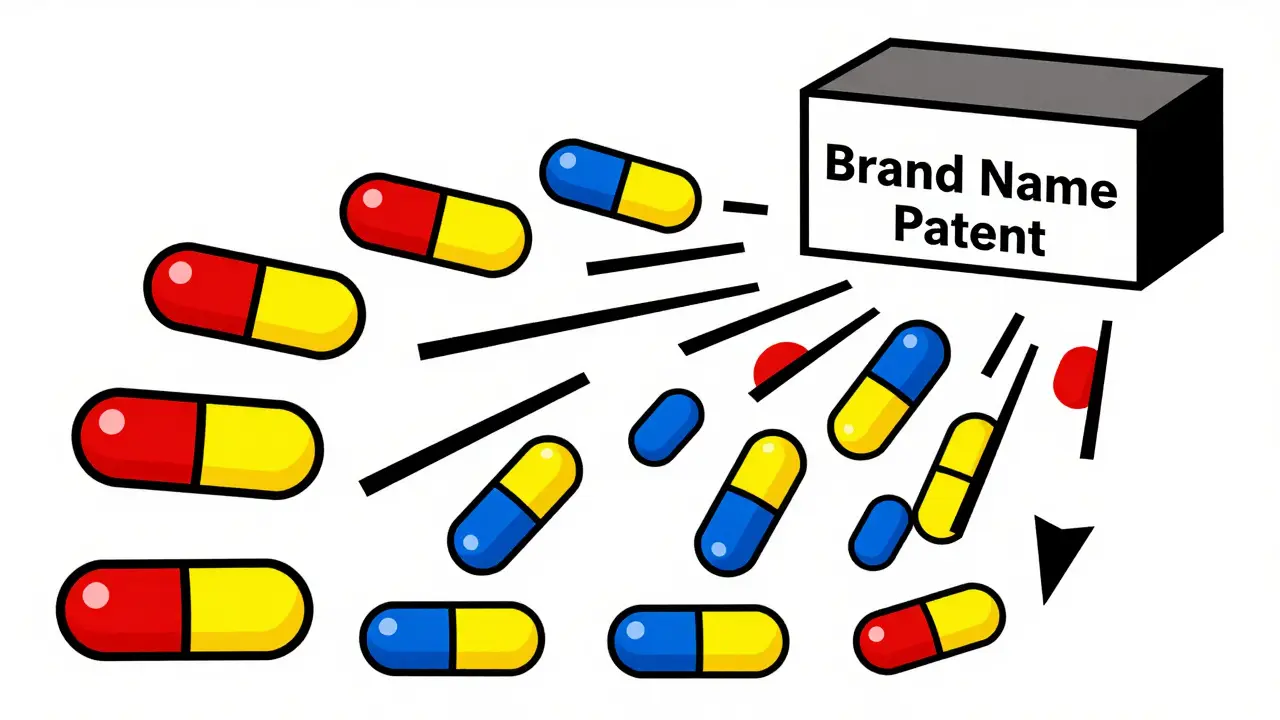
Most people assume that if a government wants to lower the cost of medicine, it simply sets a maximum price. It’s a logical assumption, right? You see price caps on rent or utilities, so why not pills? But when it comes to generic drugs, the playbook is completely different. Instead of direct price controls, governments-especially in the United States-rely on a strategy of aggressive market competition.
This approach isn't an accident; it's the result of decades of policy evolution centered on the Hatch-Waxman Act of 1984. This landmark legislation created the Abbreviated New Drug Application (ANDA) pathway, allowing manufacturers to prove their products were bioequivalent to brand-name drugs without repeating costly clinical trials. The result? A system where prices naturally crash once patents expire. According to the Congressional Budget Office (CBO), generic drugs account for about 90% of prescriptions filled in the U.S., yet they make up only 23% of total drug spending. That massive gap exists because generic prices typically fall 80-85% below their brand-name equivalents almost immediately after entering the market.
The Logic Behind Excluding Generics from Price Negotiations
You might have heard about the Medicare Drug Price Negotiation Program established by the Inflation Reduction Act of 2022. It’s designed to let the federal government negotiate lower prices for high-cost medications. However, there’s a catch: generic drugs are explicitly excluded from this program. Why would policymakers ignore a sector that fills nine out of ten prescriptions?
The answer lies in the nature of the market. The Department of Health and Human Services (HHS) determined that generic drugs already benefit from sufficient market competition. Unlike branded drugs, which often have no alternatives due to patent protection, generics face immediate pressure from multiple manufacturers. A 2022 FDA analysis showed that generic drug prices drop by 75% within six months of entry and by 90% within two years when multiple competitors exist. Extending price negotiations to these already-low-cost items would yield minimal savings. The Stanford Medicine White Paper on Prescription Drug Costs estimated that negotiating generic prices would save only $1.2 billion annually, compared to $9.5 billion from branded drug negotiations. It’s simply not an efficient use of regulatory resources.
Regulatory Speed as a Pricing Tool
If the government isn’t setting prices, what is it doing? It’s focusing on speed. The faster a generic drug gets approved, the sooner it hits the market and drives down costs. This is where the Generic Drug User Fee Amendments (GDUFA) come into play. Reauthorized in 2022 with $750 million in industry fees through 2027, GDUFA aims to slash approval times from an average of 18 months to just 10 months.
The impact has been significant. The FDA’s 2023 Generic Drug Program Report highlighted a 35% increase in generic drug approvals since 2017, with 1,083 generic drugs approved in 2023 alone. By accelerating the path to market, regulators ensure that competitive pressure builds quickly. For standard generics, the FDA achieved 92% compliance with its 10-month review target in 2023. However, challenges remain for "complex generics"-drugs with difficult formulations or delivery mechanisms. Only 38% of these complex applications met the 10-month target, prompting the FDA to create new submission templates to streamline the process further.
| Feature | Branded Drugs | Generic Drugs |
|---|---|---|
| Pricing Mechanism | Negotiation & Rebates | Market Competition |
| Medicare Negotiation Eligibility | Eligible (Single-source) | Ineligible |
| Average Price Drop Post-Entry | N/A (Patent Protected) | 75-90% within 2 years |
| Primary Regulatory Focus | Safety & Efficacy Trials | Bioequivalence & Approval Speed |
| Antitrust Scrutiny | Moderate | High (Pay-for-delay settlements) |
Fighting Anti-Competitive Practices
While competition is the goal, it doesn’t always happen naturally. Brand-name manufacturers sometimes try to block generics from entering the market. One common tactic is "pay-for-delay" agreements, where a brand company pays a generic manufacturer to delay launching their cheaper alternative. These deals keep prices artificially high for patients.
The Federal Trade Commission (FTC) has stepped up its fight against these practices. In 2023 alone, the FTC challenged 37 such settlement agreements. They estimate that restoring generic competition in these cases could save consumers $3.5 billion annually. The FTC also blocked the proposed Teva-Sandoz merger in January 2024, citing concerns that it would reduce competition for 13 specific generic products. This vigilance ensures that the market remains open and that prices stay low through genuine competition rather than collusion.
Why Price Spikes Still Happen
If the system works so well, why do we occasionally hear news stories about generic drug prices skyrocketing? The reality is that while the vast majority of generics are affordable, the market is fragile. When production costs rise or supply chains break, prices can spike. However, these instances are rare. A GAO report from June 2023 found that 97% of generic drug price increases between 2019 and 2022 were below the inflation rate. Compare that to branded drugs, where 46% exceeded inflation during the same period.
When spikes do occur, they’re often isolated. For example, a Reddit user reported their sertraline prescription jumping from $4 to $45. While painful for that individual, the FDA’s 2023 Drug Shortage Report noted this affected only 0.3% of generic drugs. More concerning than price hikes are shortages. The American Society of Health-System Pharmacists (ASHP) reported that 18% of hospital pharmacists experienced shortages of critical generics in May 2024 because prices had fallen so low that manufacturers couldn’t cover production costs. This highlights the delicate balance: too much competition can drive prices below sustainable levels, leading to supply disruptions.
The Role of Rebates and Insurance
Patients rarely pay the full list price for generics. The Medicare Payment Advisory Commission (MedPAC) reported in March 2024 that Part D plans pay generic drugs at an average of 15% below the Average Manufacturer Price (AMP). Additionally, negotiated rebates average 28% for preferred generics. These market mechanisms, driven by pharmacy benefit managers (PBMs) and insurers, further suppress out-of-pocket costs for consumers. A 2024 KFF Consumer Survey found that 76% of respondents paid $10 or less for generic prescriptions through Medicare Part D, resulting in 82% satisfaction with affordability.
Future Outlook: Strengthening Competition
Looking ahead, the focus remains on removing barriers to entry rather than imposing caps. The FDA’s Generic Drug Implementation Plan for 2024-2026 prioritizes complex generics and authorized generics to prevent brands from using "product hopping" to evade competition. Meanwhile, the CMS Interoperability and Prior Authorization Proposed Rule aims to stop insurance plans from adding unnecessary hurdles to generic prescriptions, potentially saving beneficiaries $420 million annually.
The Congressional Budget Office projects that generic drug prices will continue to decline at 3.5% annually through 2030 due to these competitive forces. This trend suggests that the current model-fostering rapid entry and monitoring anti-competitive behavior-is working. Direct price controls are seen as unnecessary and potentially harmful to innovation and supply stability. As long as the regulatory framework supports swift approvals and fair competition, generic drugs will likely remain one of the most cost-effective pillars of healthcare.
Why aren't generic drugs included in Medicare price negotiations?
Generic drugs are excluded because they already benefit from intense market competition. Prices typically drop 80-85% below brand-name equivalents shortly after entry. The Department of Health and Human Services determined that negotiating prices for generics would yield minimal savings compared to branded drugs, making it an inefficient use of resources.
How does the Hatch-Waxman Act affect generic drug prices?
The Hatch-Waxman Act of 1984 created the ANDA pathway, allowing generic manufacturers to gain FDA approval by proving bioequivalence rather than repeating expensive clinical trials. This reduced development costs from billions to millions, enabling more companies to enter the market and driving prices down through competition.
What is a "pay-for-delay" agreement?
A pay-for-delay agreement is a settlement where a brand-name drug manufacturer pays a generic competitor to delay launching their cheaper version. This keeps the brand name off-patent but unchallenged, maintaining higher prices. The FTC actively challenges these agreements to protect consumer savings.
Do generic drug prices ever go up significantly?
Significant price spikes are rare. A 2023 GAO report found that 97% of generic price increases between 2019 and 2022 were below the inflation rate. When spikes do occur, they are usually isolated incidents affecting less than 1% of products, often due to supply chain issues or manufacturing shortages.
How does GDUFA help lower drug costs?
GDUFA (Generic Drug User Fee Amendments) funds the FDA to speed up the review of generic drug applications. By reducing approval times from 18 months to 10 months, generics reach the market faster. Faster entry means quicker competition, which leads to steeper and faster price declines for consumers.