Medication Side Effect Risk Estimator
Your Health Profile
Risk Assessment
Enter your details to see how your medical history influences your risk profile.
You take a pill for your back pain. It works great for a week. Then you wake up with stomach cramps that feel like they’re tearing you apart. You blame the spicy dinner you had last night. But what if the real culprit was the blood thinner you’ve been taking for three years? Or maybe it wasn’t even the combination-it was your liver’s specific way of processing chemicals, a trait you inherited from your parents and never thought twice about.
We often treat medication side effects as random bad luck. One person gets dizzy; another feels fine. But your risk isn’t random. It is written in your medical history, which includes everything from your genetic code to the list of prescriptions you stopped taking five years ago. Understanding this link doesn’t just make you a smarter patient; it can save you from preventable hospital visits.
The Polypharmacy Trap: When More Means Worse
The single biggest factor in your medical history that spikes side effect risk is how many drugs you are currently on. This is called polypharmacy, defined as the concurrent use of multiple medications by a single patient. It sounds clinical, but it’s basically a numbers game where the odds stack against you quickly.
Data from the British Heart Foundation’s 2023 analysis shows a sharp jump in danger as your pill count rises. If you take between five and nine medications, you are almost twice as likely (a 100% increase) to experience an adverse reaction compared to someone taking fewer than five. Jump to ten or more meds, and that risk triples (a 300% increase).
Why does this happen? Each drug interacts with your body’s systems-liver enzymes, kidney filters, gut receptors. Add more drugs, and you create more opportunities for them to bump into each other. The Agency for Healthcare Research and Quality (AHRQ) notes that each additional medication increases your risk of an adverse drug event by roughly 7-10%. It’s not just about the drugs fighting each other; it’s about the sheer load on your body’s processing units.
- 1-4 medications: Baseline risk level.
- 5-9 medications: Risk doubles.
- 10+ medications: Risk triples.
If you have a history of being prescribed multiple treatments for different conditions, you are already in a higher-risk bracket. This isn’t a judgment on your health; it’s a mechanical reality of pharmacology.
Your Genes Are Not Just Background Noise
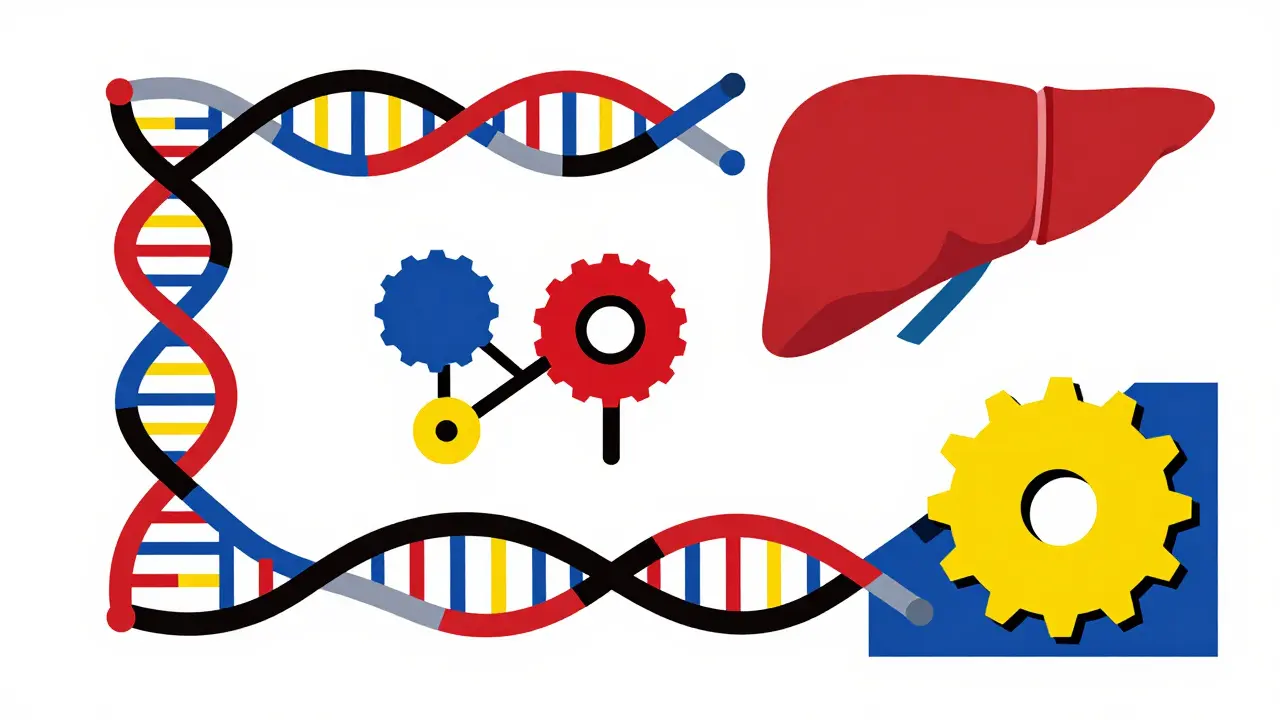
You might think your medical history starts when you were born, but it actually starts with your DNA. This field is known as pharmacogenomics, which studies how genes affect a person's response to drugs. Your liver uses enzymes, specifically the Cytochrome P450 family, to break down most medications. Some people have versions of these enzymes that work at full speed. Others have variants that are sluggish or nearly inactive.
The Merck Manual highlights that genetic variations in these CYP450 enzymes can cause medication levels in your blood to spike by 30% to 500%. Imagine taking a standard dose of antidepressant, but because of your genetics, your body processes it so slowly that you effectively get five times the dose. That’s not a side effect; that’s toxicity waiting to happen.
This explains why “one size fits all” dosing fails so often. While tools like the FDA-cleared YouScript platform can analyze 27 gene-drug interactions to predict these issues, adoption remains low-only 5.7% of US healthcare systems used such analytics in early 2024. Until then, your personal history of reacting poorly to certain drugs might be your body’s way of signaling a genetic mismatch.
Kidneys, Liver, and Age: The Hardware Decline
Your medical history also includes the wear and tear on your organs. Two organs do the heavy lifting for clearing drugs: the kidneys and the liver. If your history includes chronic kidney disease (CKD) or hepatic impairment, your clearance rates drop significantly.
CKD can reduce renal clearance by 50-75%. The American Medical Association notes that patients with CKD require dosage adjustments for 40% of commonly prescribed medications. Yet, a 2021 audit in JAMA Internal Medicine found that doctors overlooked necessary dose adjustments in 45% of prescribing decisions for patients with declining kidney function. If you have a history of high blood pressure or diabetes, your kidneys may already be compromised, making standard doses dangerous.
Age compounds this. The American Geriatrics Society reports that adults over 65 experience 3 to 5 times more adverse drug reactions than younger adults. This isn’t just because older people take more pills. It’s because aging naturally reduces kidney filtration and liver mass. A medication that was safe for you at 40 could be toxic at 70, even if your diagnosis hasn’t changed.
| Factor | Effect on Body | Risk Increase |
|---|---|---|
| Chronic Kidney Disease | Reduces renal clearance by 50-75% | High (requires adjustment for 40% of drugs) |
| Hepatic Impairment | Slows liver metabolism | Moderate-High (requires adjustment for 25% of drugs) |
| Age > 65 | Natural decline in organ function | 3-5x more ADRs than younger adults |
| Polypharmacy (10+ meds) | Increased interaction potential | 300% increased risk of reaction |
The Hidden Danger of Past Reactions
Your past experiences with drugs matter more than you might think. If you had a rash from penicillin ten years ago, that is not just a memory; it is a warning label for your future. A study in BMC Family Practice found that patients with a history of adverse reactions to one drug class have a 30-40% higher likelihood of cross-reactivity with similar medications. For example, those with penicillin allergies face an 8-fold higher risk of reacting to cephalosporins.
But there’s a trickier issue: misattribution. Many patients report side effects that their providers initially miss because they don’t connect them to the medication. On platforms like PatientsLikeMe, 62% of individuals with chronic conditions reported experiencing side effects that were unrecognized as medication-related. Beta-blockers can mask tachycardia during bleeding; corticosteroids can hide pain from ulcers. If your history includes unexplained symptoms after starting a new drug, document it. That pattern is data.
Gender and the Data Gap
Your sex is part of your biological history, and it plays a huge role in side effect risk. Older women experience adverse drug reactions at least 50% more frequently than men. Why? Partly due to body composition differences, but largely because of historical gaps in research.
FDA data shows that women comprised only 22% of participants in cardiovascular drug trials between 2010 and 2020. Most dosing protocols were built on male physiology. When women enter that equation, the same dose often results in higher blood concentrations. If you are a woman with a history of heart or hormonal conditions, be aware that standard guidelines may not account for your specific pharmacokinetics.
How to Protect Yourself: Actionable Steps
Knowing your risk is useless if you don’t act on it. Here is how to use your medical history as a shield rather than a liability.
- Audit Your List Annually: Don’t wait for a crisis. Ask your doctor for a structured medication review. A 2023 Cochrane Review of 14 trials showed that deprescribing unnecessary meds reduces adverse reactions by 22%. Only 18% of eligible patients get this done yearly, so you have to ask for it.
- Track Your Own History: Keep a personal log. Note every drug you’ve taken, the dose, and any side effects-even mild ones. Include OTC supplements. Incomplete histories contribute to 23% of preventable hospital admissions, with the average patient having 3.2 undocumented medication elements per admission.
- Check for Interactions Before Buying: Use reliable databases or apps to check for interactions before adding a new supplement or OTC painkiller. Warfarin and NSAIDs, a common combo for arthritis patients, cause 34,000 emergency room visits annually in the US alone.
- Demand Renal/Liver Checks: If you are over 60 or have diabetes/hypertension, ensure your eGFR (kidney function) and liver enzymes are checked regularly. If your eGFR drops, your doses need to change.
- Report Everything: If you suspect a side effect, report it to your provider and consider logging it with the FDA’s Adverse Event Reporting System (FAERS). Historical drug interactions account for 28% of serious adverse events; your data helps others avoid the same trap.
Your medical history is not just a file in a cabinet. It is a living map of your body’s vulnerabilities. By understanding how polypharmacy, genetics, organ function, and past reactions intersect, you move from being a passive recipient of pills to an active manager of your health. The next time you pick up a prescription, ask yourself: Does my history support this dose?
What is the biggest risk factor for medication side effects?
Polypharmacy, or taking multiple medications simultaneously, is the strongest risk factor. According to the AHRQ, each additional medication increases the risk of an adverse drug event by approximately 7-10%. Taking 10 or more medications can triple your risk of a reaction.
How does age affect medication safety?
Adults over 65 experience 3 to 5 times more adverse drug reactions than younger adults. This is due to natural declines in kidney filtration and liver mass, which slow down the body's ability to clear drugs from the system, leading to higher drug concentrations in the blood.
Can my genetics determine if I will have side effects?
Yes. Genetic variations in liver enzymes (like CYP450) can alter how you metabolize drugs. These variations can cause medication levels to rise by 30-500%, turning a standard dose into a toxic one for some individuals. This field is known as pharmacogenomics.
Why do women experience more side effects than men?
Older women experience adverse reactions at least 50% more frequently than men. This disparity is partly due to physiological differences and partly because women were historically underrepresented in clinical trials (only 22% of cardiovascular trial participants from 2010-2020), leading to dosing protocols based primarily on male physiology.
What should I do if I have a history of drug allergies?
You have a 30-40% higher chance of cross-reactivity with similar drug classes. For example, a penicillin allergy increases the risk of reacting to cephalosporins by 8-fold. Always inform your provider of past reactions, and keep a personal record of any side effects, even mild ones.
How can I reduce my risk of adverse drug reactions?
Request an annual structured medication review to identify unnecessary drugs (deprescribing). Ensure your kidney and liver function are monitored regularly, especially if you are over 60. Keep a detailed personal log of all medications and side effects, and check for interactions before adding new supplements or OTC drugs.