
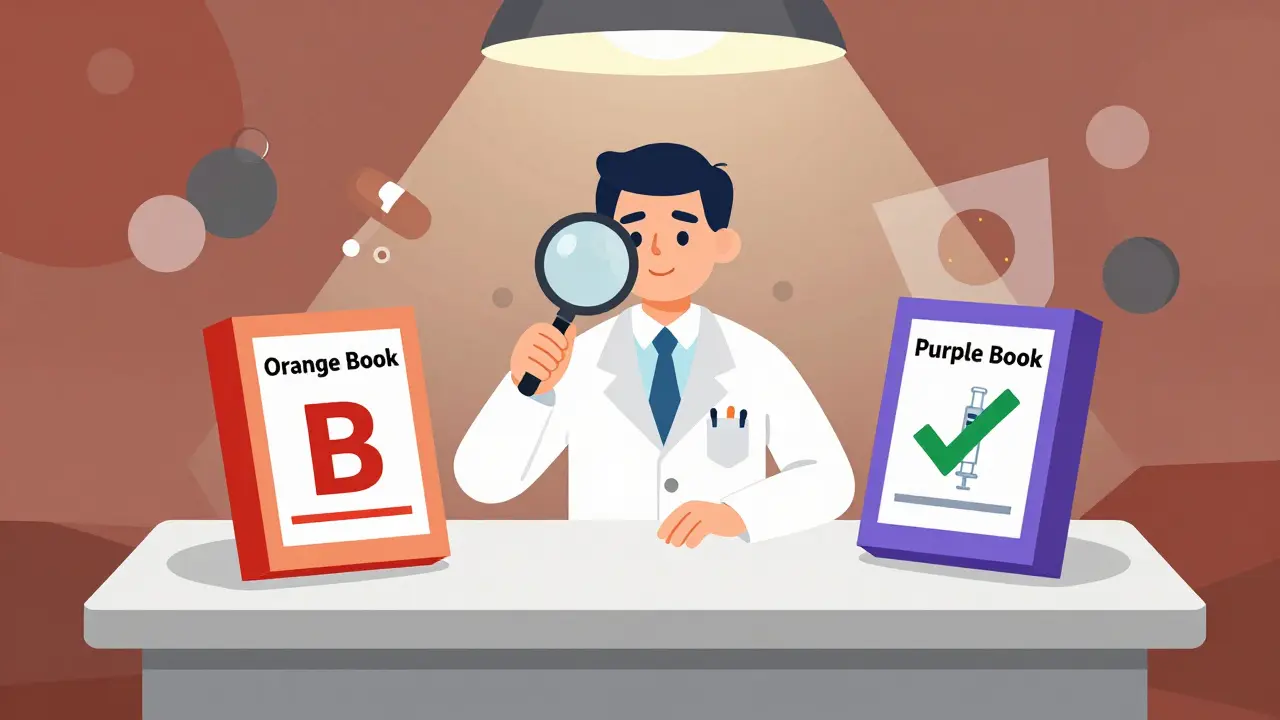
When you're checking if a generic drug is safe to substitute for a brand-name version, or if a new biosimilar is truly equivalent to its reference product, you're not just guessing. You're relying on two official, free tools from the U.S. Food and Drug Administration: the Orange Book and the Purple Book. These aren't just reference guides-they're live safety dashboards used daily by pharmacists, doctors, and drug manufacturers to prevent harmful substitutions and ensure patient safety.
What the Orange Book Actually Tells You About Drug Safety
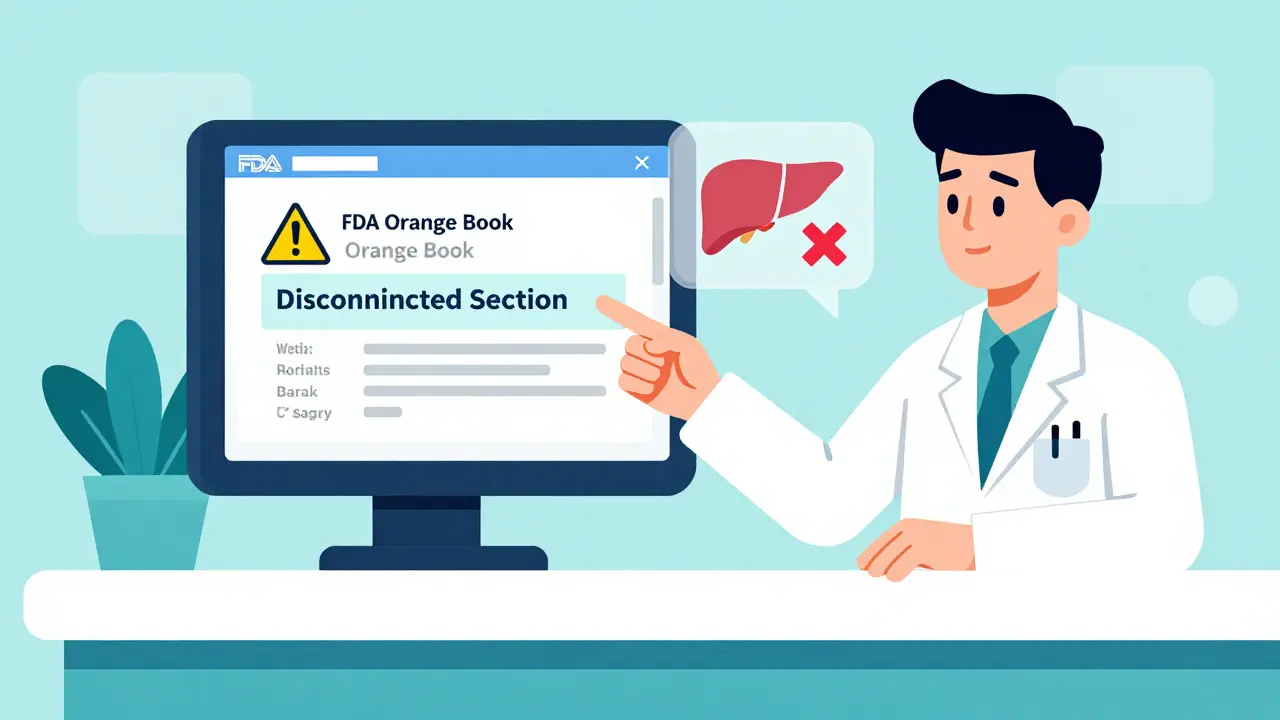
The FDA Orange Book, officially called Approved Drug Products with Therapeutic Equivalence Evaluations, is the go-to source for small-molecule drugs-think pills, capsules, and liquid medications. It’s been around since 1985, and it’s updated every month. As of September 2023, it lists over 20,000 approved drugs, including generics. But here’s what most people miss: it doesn’t just list which generics are equivalent to brand names. It also flags drugs that were pulled from the market for safety reasons. That’s in Section II-the Discontinued Section. If a drug was withdrawn because it caused liver damage, heart rhythm problems, or dangerous interactions, it’s right there, clearly marked with a footnote: "Federal Register determination that product was discontinued or withdrawn for safety or efficacy reasons." As of late 2023, 127 products were listed this way. You can’t miss it if you know where to look. When you search for a drug, look for the "Therapeutic Equivalence Code" next to each product. If it starts with an "A," that means the generic is therapeutically equivalent to the brand-same active ingredient, same dose, same safety profile. If you see a "B," that’s a red flag. It means the FDA doesn’t consider it interchangeable. That’s often because of issues with absorption, stability, or, yes-safety concerns. Pharmacists in hospital systems use this daily. One pharmacist on Reddit shared how they caught a potential error: a generic version of a narrow therapeutic index drug had been withdrawn for safety reasons, but the pharmacy’s system still tried to auto-substitute it. The Orange Book caught it before the patient got the wrong pill.What the Purple Book Reveals About Biological Drug Safety
Now, if you’re dealing with biologics-drugs made from living cells like insulin, Humira, or cancer treatments like Herceptin-you need the Purple Book. Launched in 2014, it’s the FDA’s answer to the growing world of biosimilars. Biosimilars aren’t generics. You can’t copy a living cell the way you copy a chemical pill. So the FDA created a new standard: "biosimilarity." The Purple Book lists every licensed biological product and shows which ones have been approved as biosimilar or interchangeable to a reference product. The key safety question? "Is the risk of switching between the biosimilar and the original product no greater than using the original alone?" The Purple Book doesn’t list side effects like nausea or headaches. Instead, it tells you if the FDA has judged the safety profile to be comparable. If a biosimilar says "Yes" under "Biosimilarity or Interchangeability," it means the manufacturer proved through clinical trials and lab tests that the safety risks are the same. No clinically meaningful differences. Here’s the trick: look for the reference product first. All biosimilars are listed under their original drug. So if you’re checking the safety of a biosimilar to Enbrel, you search for Enbrel-and every biosimilar that’s been approved for it pops up. That lets you compare them side by side. One clinical researcher said this feature alone cut their safety review time in half. But here’s the catch: the Purple Book doesn’t update in real time. If a new safety alert comes out for a reference product in December, the Purple Book might not reflect it until February. That’s why you always cross-check with FDA MedWatch alerts.Key Differences Between Orange and Purple Books for Safety Checks
| Feature | Orange Book | Purple Book |
|---|---|---|
| Products Covered | Small-molecule drugs (pills, liquids) | Biological products (injections, infusions) |
| Safety Data Type | Explicit withdrawals for safety reasons | Biosimilarity assessments (comparative safety) |
| Key Safety Indicator | Discontinued Section + "B" therapeutic codes | "Biosimilarity or Interchangeability" = Yes/No |
| Update Frequency | Monthly | Every 60 days |
| Post-Marketing Updates | Yes, includes emerging safety signals | No, requires separate MedWatch check |
| Search Tool | Searchable database since 2015 | Unified database since 2022 |
The Orange Book is blunt: if a drug was pulled for safety, it’s listed. The Purple Book is more nuanced: it says whether a biosimilar matches the original in safety-not whether the original is safe. That’s why you need both.
How to Actually Use These Tools for Safety Checks
You don’t need to be a regulatory expert to use these. Here’s how to do it in practice.Using the Orange Book
- Go to FDA’s Orange Book website.
- Search by drug name, active ingredient, or applicant.
- Look at the "Therapeutic Equivalence Code." Avoid any with a "B." Only use "A" codes for substitutions.
- Scroll down to the "Discontinued Section." Filter by "Reason for Discontinuation" → select "Safety." If your drug is there, don’t use it.
- Check the "Reference Listed Drug" column. If the brand was withdrawn for safety, the generic likely is too.
Pro tip: If you’re dealing with a drug that has a narrow therapeutic index-like warfarin, lithium, or digoxin-double-check the therapeutic code. Even an "A" code doesn’t always mean it’s safe to switch in every patient. Some hospitals require extra review for these.
Using the Purple Book
- Go to FDA’s Purple Book website.
- Search for the reference product (e.g., "adalimumab").
- Look under the "Biosimilarity or Interchangeability" column. Only products marked "Yes" have met FDA safety comparability standards.
- Click on the biosimilar name to see its approval date and exclusivity status.
- Check the "Reference Product Exclusivity" column. If exclusivity expired, the biosimilar has had more time to collect real-world safety data.
Don’t assume "interchangeable" means safer. It just means the FDA has approved it for automatic substitution at the pharmacy level without a doctor’s note. Safety still depends on the patient’s condition and history.
What These Books Don’t Tell You (And What to Do Instead)
Neither the Orange Book nor the Purple Book tells you about side effects, allergic reactions, or rare adverse events. That’s not their job. For that, you need the FDA’s Adverse Event Reporting System (FAERS). It’s a public database of over 17 million reports from doctors, patients, and manufacturers. If you see a drug flagged in the Orange Book as withdrawn for safety, go to FAERS and search for that drug. Look for patterns: multiple reports of liver failure? That’s not a coincidence. Same with the Purple Book-if a biosimilar was just approved, check FAERS for any early signals of immune reactions. Also, don’t forget FDA Safety Communications. These are alerts issued when new risks emerge-like a biosimilar linked to increased infection rates in elderly patients. These updates come out weekly and aren’t automatically added to the Purple Book.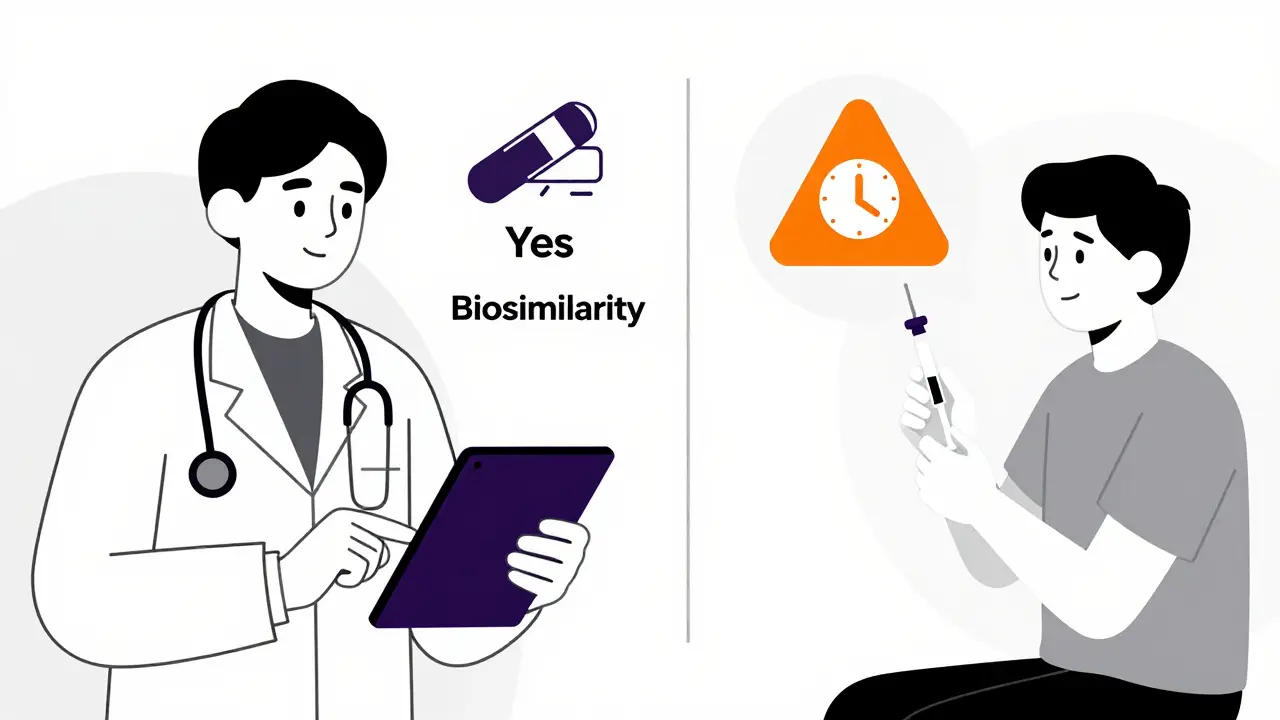
Real-World Use Cases and Common Mistakes
A 2022 survey by the National Community Pharmacists Association found that 37% of pharmacists struggled to interpret therapeutic equivalence codes for complex drugs. That’s a problem. A "B" code might mean the generic isn’t absorbed the same way. That’s not just a difference-it’s a safety risk. One hospital pharmacy team in Ohio caught a dangerous pattern: multiple patients on a generic version of a blood thinner had unexplained bleeding. They checked the Orange Book and found the generic had a "B" code, but the system was still auto-substituting it. They changed the protocol. No more bleeding cases. On the biologics side, a clinic in Texas switched five patients to a new biosimilar because it was cheaper. They didn’t check the Purple Book. One patient had a severe infusion reaction. Later, they found the biosimilar had only been approved 45 days prior-and the reference product had just been flagged in a MedWatch alert for immune-related complications. The Purple Book hadn’t updated yet. The lesson? Use the books as your first line of defense-but never your only one.Where These Tools Are Heading
The FDA is making big changes. In 2023, they added "Safety Signal" flags to the Orange Book-highlighting drugs that show early signs of trouble before they’re officially pulled. That’s a game-changer. The Purple Book is getting faster updates. The 2023 FDA budget included $5.2 million to improve how safety data is presented. By 2025, they plan to use AI to scan FAERS reports and auto-flag safety issues in both books. But here’s the reality: these tools are only as good as the people using them. If you’re a pharmacist, doctor, or patient advocate, you owe it to yourself to learn them. They’re free. They’re official. And they save lives.Can I use the Orange Book to check if a generic drug is safe to substitute?
Yes. Look for the therapeutic equivalence code. Only "A" codes mean the generic is considered safe and effective for substitution. Avoid "B" codes. Also check the Discontinued Section-if the drug was pulled for safety, don’t use it.
Does the Purple Book list side effects for biosimilars?
No. The Purple Book only tells you whether a biosimilar has been approved as comparable in safety and effectiveness to its reference product. For specific side effects, you must check the product’s prescribing information or the FDA’s FAERS database.
How often are the Orange and Purple Books updated?
The Orange Book is updated monthly. The Purple Book is updated every 60 days. Neither reflects real-time safety alerts-always cross-check with FDA MedWatch for urgent updates.
Are all biosimilars in the Purple Book interchangeable?
No. The Purple Book distinguishes between "biosimilar" and "interchangeable." Only products marked "Interchangeable" can be substituted at the pharmacy without a doctor’s permission. Both are safe, but interchangeability requires extra testing.
What should I do if I find a drug flagged in the Orange Book as withdrawn for safety?
Do not use or dispense that drug. Contact your pharmacy’s compliance officer or medical director immediately. Report the finding to the FDA’s MedWatch program. Even if the drug is still in stock, it’s no longer legally available for sale in the U.S. due to safety risks.



rajaneesh s rajan
January 28, 2026 AT 14:03Frank Declemij
January 29, 2026 AT 18:02Eli In
January 31, 2026 AT 01:23Megan Brooks
February 1, 2026 AT 19:01Ryan Pagan
February 3, 2026 AT 07:58Paul Adler
February 3, 2026 AT 08:34Kristie Horst
February 5, 2026 AT 00:30Andy Steenberge
February 6, 2026 AT 20:45Pawan Kumar
February 8, 2026 AT 09:30DHARMAN CHELLANI
February 8, 2026 AT 22:32Keith Oliver
February 10, 2026 AT 20:28Kacey Yates
February 12, 2026 AT 15:19ryan Sifontes
February 13, 2026 AT 13:58Laura Arnal
February 15, 2026 AT 07:41Jasneet Minhas
February 16, 2026 AT 04:14