
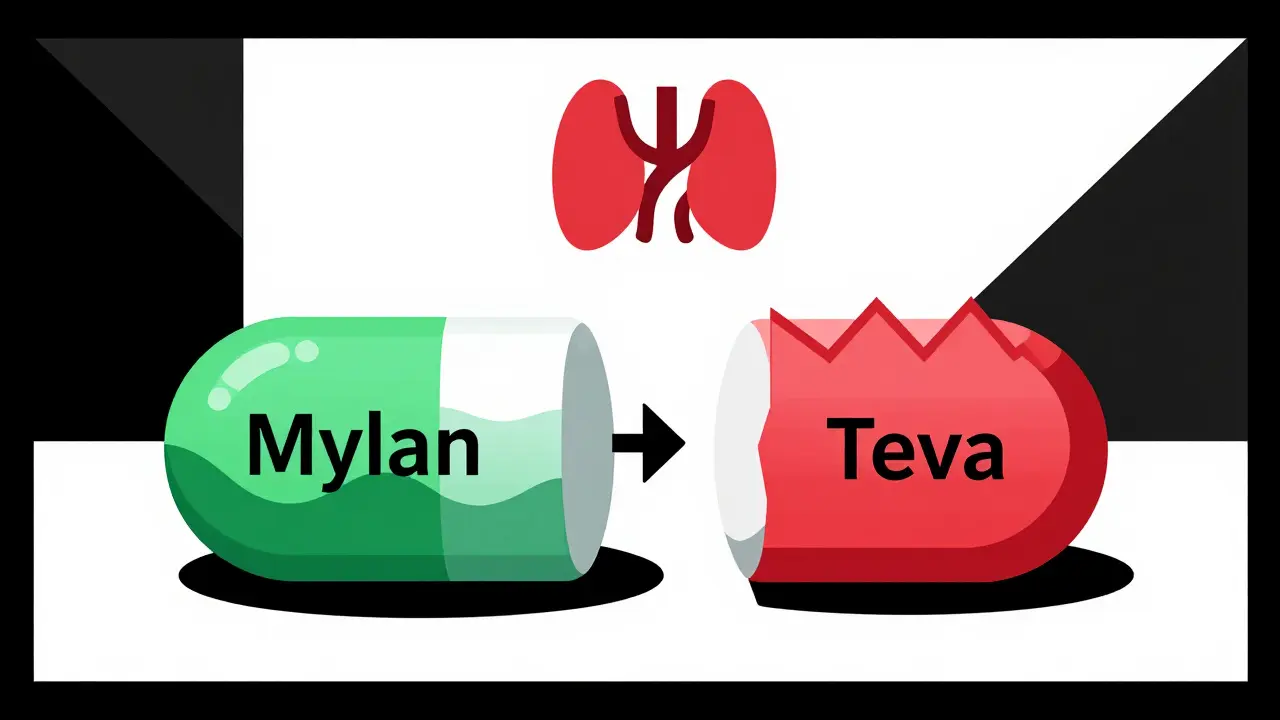
Switching from one generic levothyroxine to another sounds simple-same drug, same dose, same pill. But for millions of people on thyroid replacement therapy, it’s not that easy. You might feel fine one month, then suddenly tired, gaining weight, or having heart palpitations after your pharmacy fills your prescription with a different brand. Why? Because levothyroxine is a narrow therapeutic index (NTI) drug. Even tiny changes in blood levels can throw your thyroid hormone balance off. And while regulators say generics are interchangeable, real patients and some doctors still worry.
What makes levothyroxine different from other generics?
Most generic drugs are safe to swap. Take ibuprofen: switching from store brand to CVS brand won’t change how you feel. But levothyroxine? It’s not like that. Your body needs a very precise amount of thyroid hormone. Too little, and you’re sluggish, cold, and gaining weight. Too much, and you’re anxious, losing weight, or getting heart rhythm problems. The difference between a safe dose and a dangerous one is small-sometimes just 12.5 mcg.
Levothyroxine sodium (C15H11I4NNaO4) has a molecular weight of 798.86 g/mol. It’s sold in doses from 25 mcg to 300 mcg. The most common ones? 75 mcg and 100 mcg. That’s what most people take. But even if two generics have the same dose, the fillers, dyes, or binders inside the pill can vary between manufacturers. These aren’t active ingredients-but they can affect how your body absorbs the hormone. For some people, that’s enough to change their TSH levels.
What does TSH tell you?
TSH-thyroid-stimulating hormone-is the gold standard for checking if your levothyroxine dose is right. Your pituitary gland releases TSH to tell your thyroid to make more hormone. When you’re on levothyroxine, your thyroid isn’t working, so your body relies on the pill. If your TSH is too high (over 4.0 mIU/L), you’re likely under-treated. Too low (under 0.4 mIU/L), and you’re over-treated. For most adults, the target is 0.4-4.0 mIU/L. Older adults? Sometimes up to 6.0 is okay. But if you’ve had thyroid cancer, your doctor might aim for below 0.1.
That’s why TSH testing matters. It’s not about how you feel-it’s about the number. Two people can feel fine with a TSH of 5.0, but if their cancer history requires 0.5, they’re at risk. That’s why monitoring isn’t just routine-it’s life-saving for some.
Regulators say: Switch freely. Doctors say: Watch out.
The FDA says approved generics are interchangeable. Their rules require bioequivalence: the new pill must deliver 80-125% of the original drug’s absorption. That’s the standard for most drugs. But levothyroxine is an NTI drug. Experts have argued for tighter limits-90-111%-since 2014. The FDA never adopted that. So technically, two generics can differ by up to 25% in absorption and still be called “equivalent.”
Meanwhile, the American Thyroid Association (ATA) used to say: Don’t switch unless necessary. If you do, test TSH in six weeks. That was their 2014 guideline. But in 2022, a huge FDA-backed study of over 15,000 patients found no meaningful difference in TSH levels between people who switched generics and those who didn’t. The average TSH? 2.7 mIU/L in both groups. No significant change. That study changed everything.
Now, the FDA updated its labeling in January 2024: “For most patients, switching between different levothyroxine products does not require additional TSH monitoring beyond routine follow-up.” That’s a big shift. But not everyone agrees.
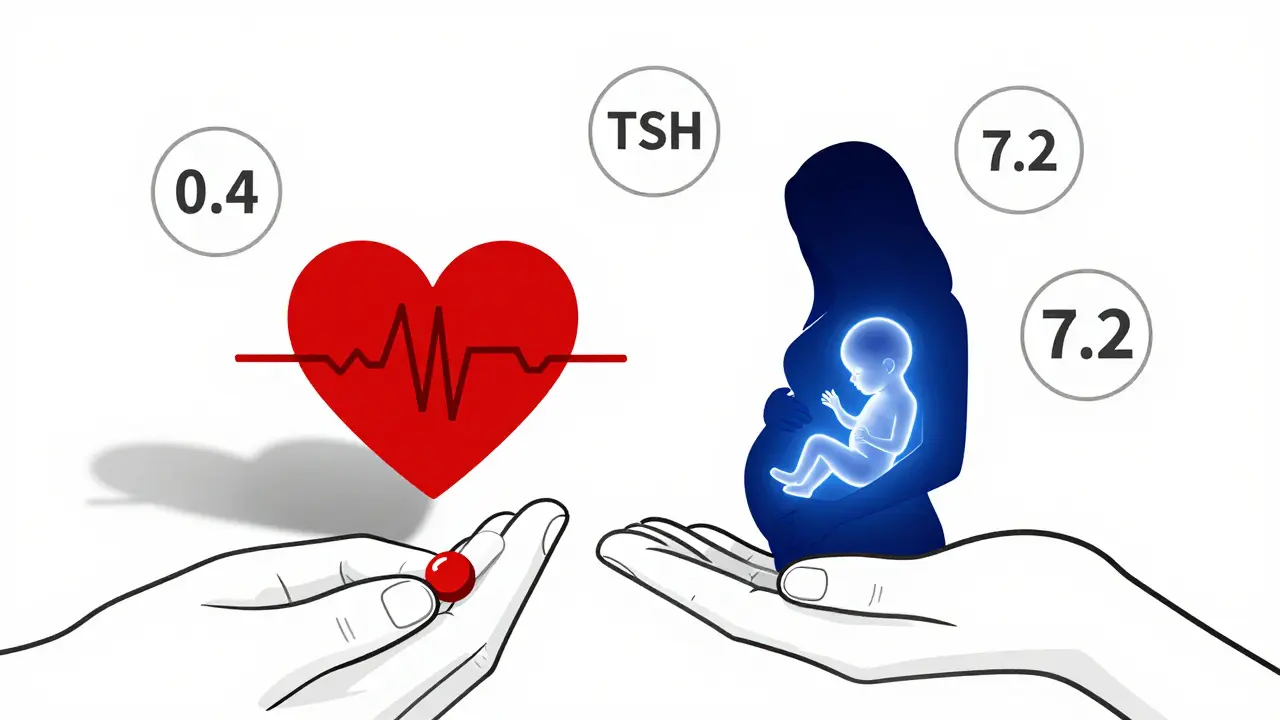
Who really needs to check TSH after switching?
Not everyone. But some people are more sensitive. Here’s who should get tested:
- Thyroid cancer survivors-They need tight control. TSH must stay low to prevent recurrence. A jump from 0.3 to 1.5 could mean trouble.
- Pregnant women-Thyroid hormone is critical for fetal brain development. Even small drops in hormone levels can matter. TSH should be checked every 4-6 weeks during pregnancy, regardless of switch.
- People with heart disease-Too much thyroid hormone can trigger atrial fibrillation. If you have a history of arrhythmia, don’t risk it.
- Those with past TSH instability-If your levels bounced around before, you’re more likely to react to a new formula.
- Patients on high doses (>100 mcg)-A 10% absorption difference means 10 mcg extra or less. That’s a big deal at higher doses.
For everyone else? Routine TSH checks every 6-12 months are enough. You don’t need an extra test just because your pill looks different.
What do patients actually experience?
Real people aren’t just numbers. In the UK, the MHRA collected over 1,200 reports of symptoms after switching levothyroxine brands. Fatigue? 327 cases. Palpitations? 289. Weight changes? 215. One Reddit user wrote: “Switched from Mylan to Teva. My TSH went from 1.8 to 7.2 in 8 weeks. I had to up my dose.” Another said: “Switched three times in two years. No change. My doctor says I’m in the 70% who don’t care.”
A 2021 survey by Paloma Health found 18.7% of patients noticed symptoms after switching. Only 6.2% needed a dose change. That means most people are fine. But 1 in 5 isn’t nothing. And if you’re one of them, it’s a huge deal.
Some people react to excipients-fillers like lactose, corn starch, or dyes. If you’re allergic to one, you might get bloating, rashes, or gut issues. That’s not a thyroid problem-it’s an allergy. But it’s easy to mistake for “the medicine isn’t working.”

What do guidelines say now?
Here’s the current state of play:
- USA (FDA & AACE): Routine TSH testing after generic switches is no longer needed for most patients. Only test if you have symptoms or fall into a high-risk group.
- UK (NHS & CHM): If you feel worse after switching, test TSH. If symptoms persist, stick with one brand. They don’t ban switching-they just say: listen to your body.
- Europe (EMA): Still recommends checking TSH 6-8 weeks after any switch. More cautious than the U.S.
- Veterans Health Administration: Still requires TSH testing within 60 days of any switch. Policy hasn’t caught up with the science yet.
The ATA is updating its guidelines in late 2024. Expect a major shift toward the FDA’s position. But until then, your doctor might still follow the old advice.
What should you do if you switch?
Here’s a simple plan:
- Don’t panic. Most people don’t notice a difference.
- Check your pill. Look at the name on the bottle. If it’s different from last time, note it.
- Watch for symptoms. Fatigue, weight gain, brain fog, rapid heartbeat, or anxiety? Track them.
- Wait 6-8 weeks. TSH takes time to stabilize after a change. Don’t test too early.
- Get tested if: You’re in a high-risk group, symptoms appear, or your last TSH was borderline.
- Ask for your brand. If you feel worse and testing shows a problem, ask your doctor to prescribe a specific brand. Insurance may cover it if you document symptoms.
Pharmacies can’t always give you the same brand. But if you’ve had a bad reaction before, your doctor can write “Dispense as Written” or “Brand Necessary” on the prescription. It’s legal. It’s not uncommon.
The big picture: Cost vs. control
Levothyroxine generics save billions. In 2023, 89% of prescriptions were generic. A 100 mcg dose costs $4.37 for generic versus $45.72 for Synthroid. That’s a 90% savings. If we stopped switching, we’d pay more. A lot more.
But for the 8-12% of patients who are sensitive-those with DIO2 gene variants, low thyroid reserve, or excipient sensitivities-consistency matters. We don’t yet have a cheap, routine genetic test to find them. So for now, we rely on symptoms and TSH.
The goal isn’t to stop generics. It’s to make sure the right people get the right care. Most people can switch safely. A few need attention. The system should be smart enough to tell the difference.




Rosalee Vanness
January 13, 2026 AT 21:27Okay, so I switched from Mylan to Teva last year and my TSH went from 1.9 to 6.7 in six weeks. I thought I was just getting older, or stressed from work-turns out my body was screaming for the old pill. I begged my doctor to let me stick with Mylan, and after two months of paperwork and insurance battles, they finally approved it. Now I feel like myself again: not zombie-mode, not panic-mode, just… human. I know most people don’t notice a difference, but for those of us who do? It’s not a ‘mild inconvenience.’ It’s a whole damn life reset.
And honestly? If the FDA says ‘it’s fine,’ then why do so many of us still feel like guinea pigs? I’m not anti-generic-I just want consistency. My thyroid isn’t a commodity to be swapped like laundry detergent.
Also, side note: the new Teva pill had this weird chalky aftertaste. I thought I was going crazy. Turns out, it was the filler. Lactose. I’m mildly lactose intolerant. So yeah. That’s a thing.
Don’t tell me ‘it’s the same dose.’ The dose is the same. The delivery system? Not even close. And if your body is fine with the change? Great. But don’t invalidate the ones who aren’t.
PS: My endo now keeps a handwritten list of which brand I’m on. She calls it ‘The Rosalee Protocol.’ I’m weirdly proud of that.
PPS: If you’re reading this and you switched and feel off? Don’t wait six months. Test now. Your pituitary gland doesn’t care about insurance policies.
Lance Nickie
January 14, 2026 AT 15:41nah most people fine. stop being dramatic.
John Tran
January 15, 2026 AT 07:09So… here’s the thing. Levothyroxine isn’t just a drug. It’s a metaphysical contract between your cells and the universe. Every molecule of T4 is a whispered prayer to your mitochondria. When you switch brands, you’re not just changing fillers-you’re breaking a sacred covenant with your own biology.
I mean, think about it: your thyroid doesn’t have a voice. It’s a silent, trembling monk in the cave of your neck, chanting TSH mantras. And then-BAM!-some corporate chemist in New Jersey swaps out cornstarch for microcrystalline cellulose and suddenly your soul is out of sync.
It’s not science. It’s alchemy. And the FDA? They’re the alchemists who think turning lead into gold is ‘close enough.’
I’ve switched four times. Each time, my dreams got weirder. Last time, I dreamed I was a thermostat in a house where no one believed in climate control. I woke up sweating. My TSH was 5.9.
So yeah. Test. Wait. Cry. Repeat. The system is broken. But at least my pills are cheap.
Also, I think the dye in Mylan gives me existential dread. Just saying.
Trevor Davis
January 16, 2026 AT 03:48Hey, I just wanted to say I really appreciate how thorough this post is. As someone who’s been on levothyroxine for 14 years, I’ve seen every twist and turn this drug can throw at you. I used to panic every time my pharmacy switched brands-until I started keeping a little journal: pill color, shape, TSH, how I felt. Turns out, I’m one of the 12% who are sensitive. I’ve got the same brand now for three years straight. My doctor calls me ‘the exception that proves the rule.’
But here’s the thing-I’m not mad. I get why generics exist. I just wish the system was smarter. Like, why can’t pharmacies just flag ‘patient sensitive’ in the system? Why do we have to beg? Why do we have to prove we’re not ‘overreacting’?
And props to the UK NHS for actually listening to patients. We need more of that. Not just data, but *stories*. Because behind every TSH number is a person who just wants to feel normal again.
Lethabo Phalafala
January 18, 2026 AT 01:12As a South African woman who’s had to fight for thyroid meds in a country where even basic meds are rationed, I can’t believe how privileged this conversation is.
We don’t get to choose brands here. We get what the hospital has. If it’s generic? Good. If it’s the same generic for six months straight? Miracle.
I switched from one local generic to another last year. My TSH went from 3.1 to 8.4. I was so tired I couldn’t carry my groceries. My kids thought I was dying. I had to walk 7km to the clinic to beg for a blood test.
So yes-TSH matters. Yes-switches can wreck you. But here’s the real issue: in places like mine, you don’t get to *choose* to test. You get to *hope* someone remembers to order the test.
Stop arguing about 10% absorption differences. Start fighting for access. Because if you can’t even get your meds, the brand doesn’t matter.
And yes-I’m still on the same generic. And yes-I still feel like a ghost sometimes. But I’m alive. And that’s something.
Milla Masliy
January 19, 2026 AT 11:08I’m a nurse in a rural clinic and I see this every week. One woman came in crying because her pill changed color and she started having panic attacks. She swore it was the new brand. We checked her TSH-6.8. She’d been on the same generic for two years. Switched last month. No symptoms before.
We switched her back. TSH dropped to 2.1 in 6 weeks. She cried again-but this time from relief.
So yeah. Most people are fine. But ‘most’ doesn’t mean ‘all.’ And in healthcare, we can’t afford to ignore the ‘all.’
Also, I love that this post mentions excipients. So many providers don’t even know what those are. Lactose, dyes, gluten-these aren’t just ‘fillers.’ They’re triggers. And if someone’s got a sensitivity, it’s not ‘all in their head.’ It’s biology.
Just… listen. Test. Don’t assume. And for the love of God, don’t tell someone they’re ‘overreacting’ because their pill looks different.
Priyanka Kumari
January 19, 2026 AT 16:35As someone from India who’s been on levothyroxine for 11 years, I want to say: this is one of the most balanced, human takes I’ve ever read. In my country, generics are the only option-and we don’t even have TSH tests in small towns. I had to travel 200km for my first test after switching brands.
But here’s what I’ve learned: consistency beats perfection. I’ve been on the same generic for 7 years now. My doctor knows my name, my pill, my TSH history. That’s the real magic-not the brand, but the relationship.
Also, I’ve noticed something: people who feel worse after switching are often the ones who’ve been stable for years. Their bodies are like finely tuned instruments. A tiny change? It rings off-key.
So yes-test if you feel off. But also, ask your doctor to document your brand. Keep a photo of the pill. Write down the date. You’re not being paranoid. You’re being smart.
And to the FDA: maybe stop pretending all bodies are the same. We’re not robots. We’re humans with fragile, beautiful biology.
Avneet Singh
January 20, 2026 AT 02:09Look, the entire debate is a classic case of medical reductionism. Levothyroxine isn’t just a hormone-it’s a biomolecular interface between endocrine regulation and pharmaceutical industrial capitalism. The FDA’s 80-125% bioequivalence window is a neoliberal farce designed to maximize shareholder value while pathologizing patient autonomy.
Furthermore, the notion that ‘most people don’t notice’ is statistically valid but epistemologically bankrupt. The 12% who do are not outliers-they are the canaries in the coal mine. Their physiological variance exposes the structural fragility of the entire generic substitution paradigm.
And let’s not forget: the DIO2 polymorphism, which modulates T4-to-T3 conversion, is significantly prevalent in South Asian populations. Yet no pharmacogenomic screening is mandated. Why? Because it’s expensive. And capitalism hates precision.
So yes, test TSH. But also demand genomic profiling. Demand brand fidelity. Demand dignity.
Otherwise, we’re just optimizing for cost, not care.
Adam Vella
January 21, 2026 AT 10:48There is a fundamental flaw in the argument that ‘most patients are unaffected.’ This is an ecological fallacy. Aggregate data does not invalidate individual experience. The mean TSH of 2.7 mIU/L across 15,000 patients does not mean that no individual deviated by more than 2 mIU/L. In fact, the standard deviation was not reported in the FDA study, which is a critical omission.
Moreover, the concept of ‘bioequivalence’ is a regulatory fiction. It is based on Cmax and AUC metrics derived from healthy volunteers-not patients with thyroid dysfunction, cardiac comorbidities, or malabsorption syndromes.
And while cost savings are laudable, they should not be achieved at the expense of clinical vigilance. The Veterans Health Administration’s policy is not ‘outdated’-it is prudent.
Let us not confuse statistical significance with clinical significance. A difference of 0.5 mIU/L may be ‘non-significant’ in a p-value, but it is profoundly significant to a woman trying to conceive or a man with atrial fibrillation.
Science demands nuance. Policy demands courage. And patients deserve both.
Nelly Oruko
January 21, 2026 AT 11:15my tsh went from 2.1 to 5.9 after a switch. i didnt say anything. i thought i was just tired. then i saw a reddit post like this. i tested. i switched back. i cried. i felt like a person again.
thats it. thats all.
vishnu priyanka
January 23, 2026 AT 03:59Been on levothyroxine since 2018. Switched brands like five times. Once, my pill turned from white to pink. I thought I was hallucinating. Turns out, the dye changed. I didn’t feel anything different. But I took a pic of the pill anyway. Just in case.
My doctor laughs when I say, ‘Hey, this one looks different.’ He says, ‘Vishnu, if you’re not dead, you’re fine.’
But I keep the pics. And I check my TSH every six months. Not because I’m paranoid. Because I’m smart.
Also, I once ate a whole bag of chips because I felt ‘off.’ Turns out, my TSH was 6.3. Not the chips. The pill.
So yeah. Pay attention. Your body talks. You just gotta listen.
mike swinchoski
January 24, 2026 AT 22:36you’re all just weak. if you can’t handle a different pill, you shouldn’t be on meds. just take the damn thing and stop whining. everyone else does.
Rosalee Vanness
January 25, 2026 AT 01:22Wow. So someone actually said ‘you’re weak’ to a post about thyroid hormone instability and life-threatening TSH shifts. That’s not ignorance. That’s cruelty wrapped in toxic masculinity.
Let me guess-you’ve never had a chronic illness, never had to explain to your boss why you’re crying in the bathroom because your body betrayed you, never had to beg for a prescription because your insurance won’t cover the brand that doesn’t turn you into a zombie.
I’ve been on this drug for 17 years. I’ve had three heart palpitation ER visits because of a pill change. I’ve missed birthdays because I was too exhausted to get out of bed. I’ve cried in parking lots because I couldn’t remember if I took my pill.
And you think I’m ‘weak’ for wanting to feel like a human being?
Go get a thyroid test. Then come back and talk to me.
Until then? Shut up.