
When a norovirus outbreak hits a hospital or nursing home, things move fast. One person gets sick. Then two. Then ten. Within hours, the whole unit is on alert. Vomiting, diarrhea, fever - it’s not just uncomfortable, it’s dangerous. Especially for older adults, babies, or anyone with a weak immune system. The virus doesn’t care if you’re a nurse, a patient, or a visitor. It spreads like wildfire. And the worst part? You can’t stop it with hand sanitizer.
Why Norovirus Is So Hard to Stop
Norovirus isn’t just another stomach bug. It’s a precision machine for spreading illness. You only need 18 virus particles to infect someone. That’s less than a grain of salt. An infected person can shed up to 10 billion virus particles in a single gram of stool. That’s like dumping a whole bottle of glitter into a room - and then everyone touches the same doorknob.
It survives on surfaces for up to 12 days. It laughs at cold temperatures. It shrugs off heat up to 140°F. You can freeze it, boil it, wipe it down - and it still hangs around. That’s why outbreaks keep happening even in clean places. And here’s the kicker: 30% of people who carry the virus show no symptoms at all. They feel fine. They go to work. They hug their grandkids. And they spread it without knowing.
How It Spreads - And Where It Hits Hardest
Norovirus doesn’t need fancy conditions. It thrives where people are close: nursing homes, hospitals, schools, cruise ships, even restaurants. The CDC breaks down how it moves:
- Person-to-person contact - 62% of outbreaks. This is the biggest driver. Coughing, sneezing, touching, changing diapers - all spread it.
- Contaminated food - 23%. Ready-to-eat foods like salads, sandwiches, and shellfish are common culprits. If a food worker is sick - even if they washed their hands - the virus can get in.
- Surfaces - 10%. Door handles, bed rails, call buttons, toilets. If someone vomits and you don’t clean it right, the virus lingers.
- Water - 5%. Mostly in outbreaks linked to wells or public water systems.
Winter is peak season. In long-term care facilities, 68% of outbreaks happen between November and March. That’s when staffing is thin, windows are closed, and people are packed in tight. It’s a perfect storm.
Handwashing Isn’t Optional - It’s Your First Line of Defense
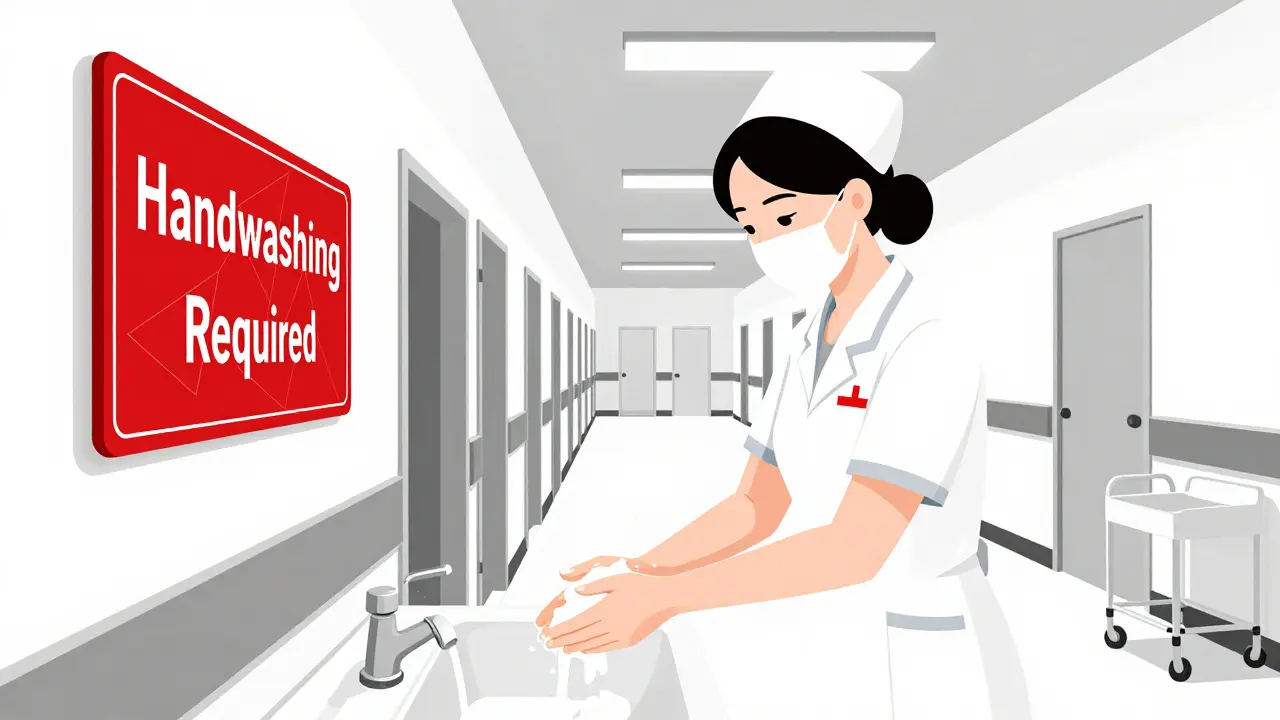
You’ve heard it a thousand times: wash your hands. But here’s the truth most people miss: alcohol-based hand sanitizers don’t kill norovirus. They help with other germs. But not this one. The virus has a tough outer shell that alcohol just slides off.
The CDC says: soap and water. Not just any wash. You need at least 20 seconds. That’s singing "Happy Birthday" twice. You have to scrub under nails, between fingers, around thumbs. And you have to do it at key moments:
- After using the bathroom
- After changing diapers
- Before preparing or eating food
- After cleaning up vomit or diarrhea
And don’t skip drying. Wet hands spread germs faster. Use paper towels. Not air dryers. Those blow virus particles into the air.
During outbreaks, hospitals put handwashing stations right outside affected rooms. Why? Because stress and workload make people cut corners. You can’t rely on people to remember. You have to make it impossible to forget.
Cleaning Isn’t Just Wiping - It’s Disinfecting Like a Pro
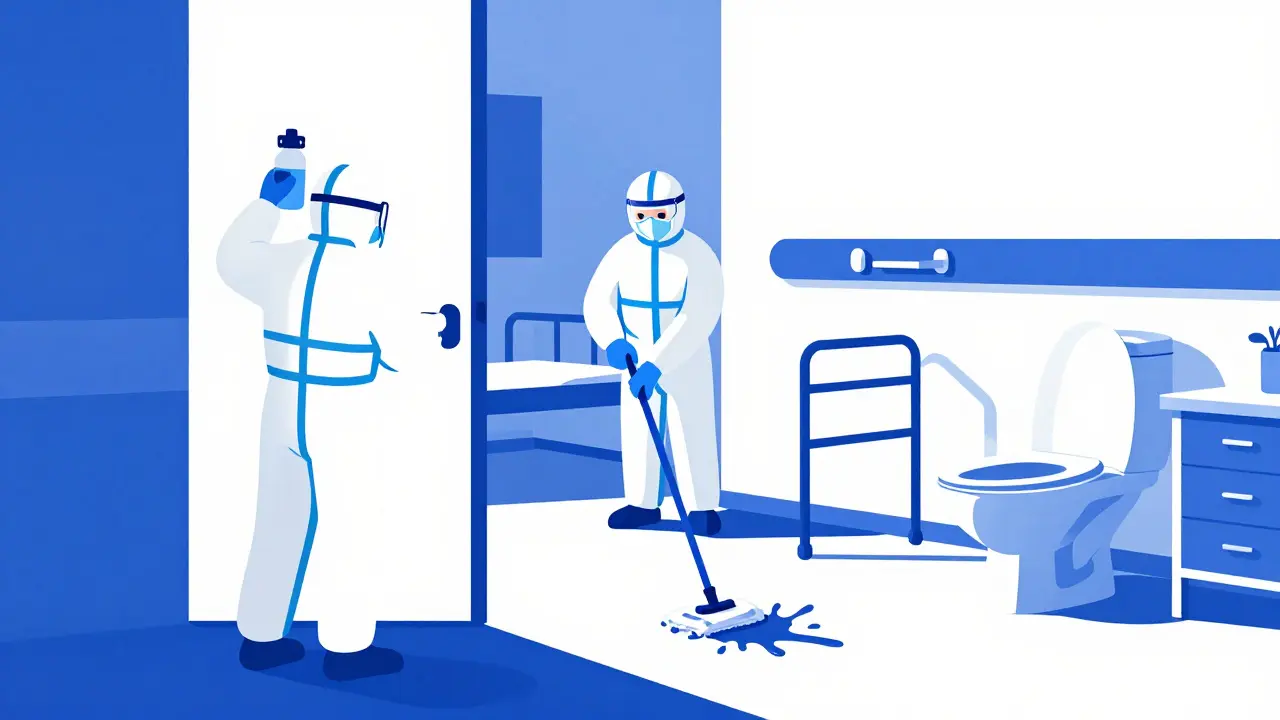
Regular cleaning? Useless. You need bleach. Specifically, a chlorine bleach solution with 1,000 to 5,000 parts per million (ppm). That’s 5 to 25 tablespoons of household bleach per gallon of water. It’s harsh. It smells bad. But it’s the only thing that kills norovirus on surfaces.
Focus on high-touch areas:
- Door handles
- Toilet flushers and seats
- Bed rails and call buttons
- Light switches
- Remote controls
- Stair handrails
And don’t forget the bathroom. Vomit on the floor? You need to clean it up with gloves, a mask, and a disposable mop. Then disinfect the mop head. Then throw it away. Don’t reuse it. Don’t try to save money. One mistake can restart the outbreak.
Some facilities now use hydrogen peroxide vapor machines after an outbreak. These fog the whole room and kill 99.9% of the virus. It’s expensive, but for high-risk areas like ICUs or dialysis units, it’s worth it.
Isolation and Cohorting - Keeping the Sick Apart
When someone shows symptoms - vomiting, diarrhea - they need to be isolated immediately. Not tomorrow. Not when you have time. Right now.
The CDC recommends:
- Single rooms for symptomatic patients. Always.
- If single rooms aren’t available, group sick patients together. Don’t mix them with healthy ones.
- Designate one nurse or aide to care for them - minimize staff movement between units.
- Cancel group activities. No dining halls. No TV rooms. No bingo.
And here’s something new: don’t move asymptomatic people. You might think, "Let’s get them out of there." But 30% of them are already infected. Moving them just spreads it to a new area.
Isolation lasts at least 48 hours after symptoms stop. Some patients - especially those with weak immune systems - can keep shedding virus for weeks. So if someone’s still vomiting three days later? Keep them isolated. Don’t assume they’re "just feeling better."
Hydration: The Real Battle Against Norovirus
People think norovirus kills because of the virus. It doesn’t. It kills because of dehydration.
When you’re vomiting and having diarrhea, you lose fluids fast. Especially kids and older adults. Their bodies don’t hold water well. Their thirst signal fades. They don’t feel thirsty - even when they’re dangerously dehydrated.
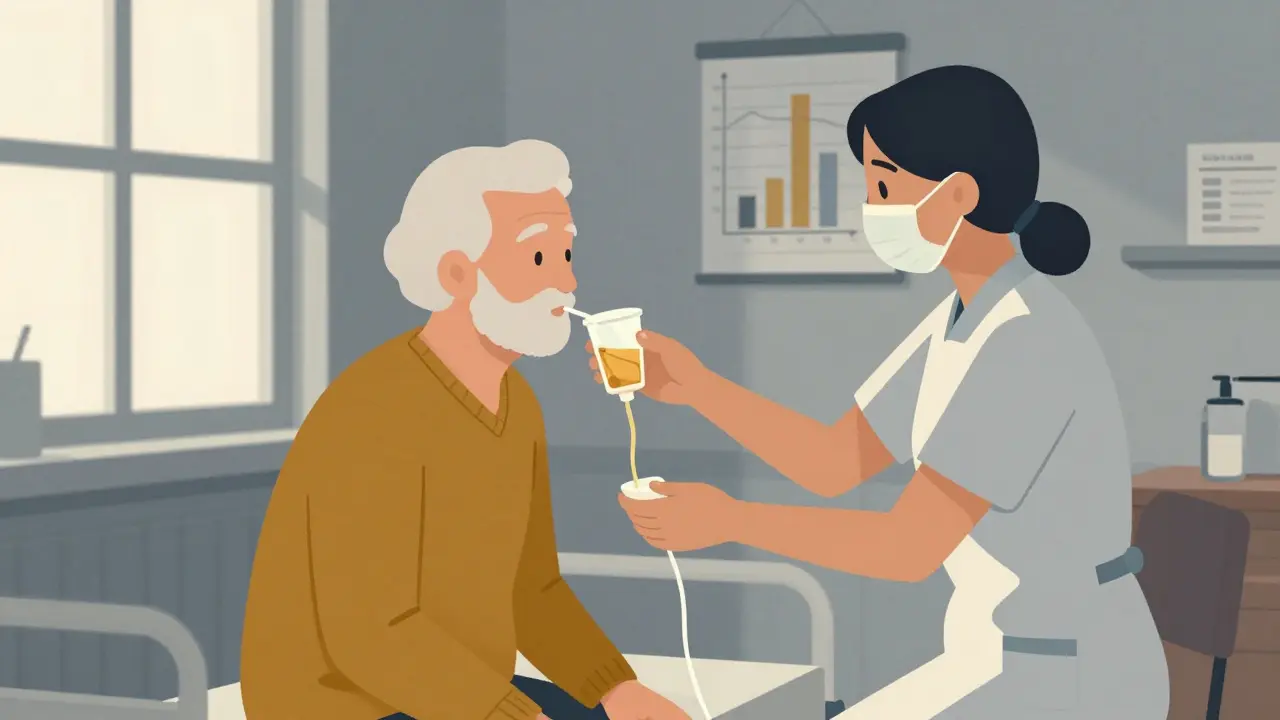
Oral rehydration solution (ORS) is the gold standard. It’s not Gatorade. It’s not soda. It’s a precise mix of salt, sugar, and potassium. The WHO formula: 50-90 mmol/L sodium, 75-100 mmol/L glucose, 20-25 mmol/L potassium. You can buy it over the counter. Or make it at home: 1 liter of clean water, 6 teaspoons sugar, half a teaspoon salt.
Give small sips often. Every 10-15 minutes. Even if they’re still throwing up. The body can absorb fluid even while vomiting. Don’t wait for them to ask. Don’t wait for them to feel better.
For severe cases - dry mouth, no urine for 8 hours, dizziness, confusion - you need IV fluids. Normal saline or lactated Ringer’s. Give 20 mL per kg of body weight in 15-30 minutes. That’s about 1.5 liters for a 150-pound adult.
Monitor elderly patients every 4-6 hours. Check urine output. Skin turgor. Mental state. A confused elderly person might not be "just tired." They might be slipping into dehydration-induced delirium.
Food Workers and Visitors - The Hidden Spreaders
Food handlers are a major source. If someone works in a kitchen and gets sick, they can contaminate food before they even feel sick. That’s why the CDC says: exclude food workers for 48-72 hours after symptoms stop. In hospitals and nursing homes, go with 72 hours. No exceptions.
Visitors? They’re not just guests. They’re vectors. During outbreaks, restrict visitors. Only allow essential ones. And make them wash their hands before entering. Give them a quick briefing: "If you’re feeling off, don’t come. If you’ve had diarrhea in the last 48 hours, don’t come. If you’re unsure, stay home."
Facilities that train visitors see 35% fewer secondary infections. That’s not a small number. That’s life-saving.
What’s Next? Vaccines and Better Tools
There’s hope on the horizon. Takeda’s norovirus vaccine showed 46.7% effectiveness in a major trial in 2022. It’s not perfect - but it’s a start. FDA approval could come as early as 2025.
Meanwhile, real-time reporting systems are changing the game. Wisconsin’s system cut outbreak response time from 72 hours to 24. That means faster isolation, faster cleaning, fewer people sick.
But until vaccines arrive, the old rules still work: soap, bleach, isolation, hydration. No shortcuts. No magic sprays. Just consistent, careful action.
Can you get norovirus more than once?
Yes. There are many strains of norovirus, and immunity after infection is short-lived - usually just a few months. So you can catch it again next season. That’s why hygiene matters more than ever.
Does bleach destroy norovirus on clothes?
Yes, but only if used correctly. Wash contaminated clothing in hot water (at least 140°F) with chlorine bleach. If you can’t use bleach, use the hottest water setting and dry on high heat for at least 28 minutes. Never mix bleach with ammonia or vinegar - it creates toxic gas.
Is norovirus airborne?
Not exactly. But when someone vomits, tiny droplets can become airborne and land on surfaces or be inhaled. That’s why you need masks and ventilation during cleanup. The virus isn’t spread like the flu - but it can travel through the air in bursts.
How long should a patient stay home after symptoms stop?
At least 48 hours. For food workers or people in healthcare, 72 hours. Some people, especially those with weakened immune systems, can shed the virus for weeks. If you’re unsure, stay home longer. Better safe than spreading it.
Can pets get norovirus and spread it to people?
No. Norovirus is specific to humans. Pets can’t catch it or pass it to you. But they can carry the virus on their fur if someone vomits near them. So wash your hands after petting them if you’ve been around someone sick.
Final Thought: It’s Not About Perfection - It’s About Consistency
Norovirus outbreaks aren’t caused by one mistake. They’re caused by a chain of small ones: skipped handwashing, delayed cleaning, ignored symptoms, rushed disinfecting. You don’t need a perfect system. You need a reliable one. One that works even when you’re tired. Even when you’re short-staffed. Even when you’ve had three outbreaks this month.
Do the basics. Every time. Soap. Water. Bleach. Isolation. Hydration. Repeat. That’s how you stop it.



Aisling Maguire
February 28, 2026 AT 23:04Man, I worked in a nursing home in Dublin last winter and this post hit HARD. We had a norovirus outbreak that wiped out half the staff. Hand sanitizer? Useless. We had to scrub floors with bleach so strong it burned our noses. One nurse kept saying, "I just washed my hands!" and I was like, sis, you need to scrub under your nails like you’re trying to dig out a gold bar. And yeah, the asymptomatic carriers? Total ghosts. One guy came in to visit his wife, looked fine, hugged her, and two days later she was puking into a bucket. We didn’t even know he’d been sick until he texted us from home. Wild.
Vikas Meshram
March 2, 2026 AT 11:55Incorrect. Alcohol based sanitizers DO have some efficacy against norovirus if they contain at least 60% ethanol and are applied for a full 30 seconds with proper friction. The CDC’s stance is outdated. Recent 2023 studies from the Journal of Hospital Infection show that ethanol-based formulations with added surfactants reduce viral load by 89%. Also, air dryers are not inherently dangerous-they only pose risk if the room is poorly ventilated. Your fearmongering about bleach is excessive. Sodium hypochlorite at 500 ppm is sufficient for routine disinfection. Overuse leads to environmental toxicity and respiratory harm. This is not 2012 anymore.
Miranda Anderson
March 3, 2026 AT 18:06I’ve been a nurse for 18 years and I’ve seen every kind of outbreak imaginable. Norovirus is the silent assassin because it doesn’t announce itself. People think, "Oh, I’m just a little queasy," and they show up to work. But here’s the thing that no one talks about-the real tragedy isn’t the vomiting or the diarrhea. It’s the loneliness. An elderly person in isolation, too weak to sit up, too scared to call for help because they know the staff is overwhelmed. You can disinfect a room, but you can’t disinfect the fear. We need more than bleach. We need more hands. More time. More humanity. And yes, I still wash my hands for 20 seconds. Every. Single. Time. Even when I’m tired. Even when I’m angry. Even when I’m crying. Because someone’s life depends on it.
Gigi Valdez
March 5, 2026 AT 14:03The clinical guidelines presented here are accurate and align with current CDC protocols. Emphasis on soap and water over alcohol-based sanitizers is well-supported by virological data. The 18-particle infectious dose underscores the necessity of stringent environmental controls. I would only add that while bleach remains the gold standard for surface decontamination, newer EPA-registered sporicidal agents such as peracetic acid-based disinfectants offer comparable efficacy with reduced corrosive risk. Further, staff training should include video demonstrations of proper handwashing technique-kinesthetic learning improves compliance by 42% according to a 2021 meta-analysis. Hydration protocols are appropriately detailed. Well-structured, evidence-based piece.
Angel Wolfe
March 7, 2026 AT 02:02They don’t want you to know this but the real reason norovirus spreads so fast is because the CDC and WHO are pushing a vaccine agenda. They want you to believe soap and bleach works so you keep paying for their "training programs" and "disinfectant subscriptions". Meanwhile, the real solution? Open windows. Fresh air. Let the virus out. But they ban windows in hospitals because it’s too expensive to install proper HVAC systems. And don’t get me started on the bleach-they’re poisoning our water supply. I saw a video from a hospital in Ohio where they were dumping bleach into the drains. That’s not cleaning. That’s chemical warfare. And the asymptomatic carriers? They’re not spreading it. They’re being targeted. Why? Because they’re the ones who won’t take the vaccine. This is all about control. Wake up.
Eimear Gilroy
March 8, 2026 AT 15:39Wait-so if someone vomits and you clean it with bleach, but then use the same mop without disinfecting the mop head, you’re just spreading it around? That’s wild. I never thought about that. Also, 30% asymptomatic? So someone could be perfectly fine and still be a walking virus bomb? That’s terrifying. I’m going to start washing my hands like my life depends on it. Which, honestly, it kinda does. Also, can you make ORS with honey instead of sugar? Or is that a myth? Asking for a friend who’s vegan and also mildly paranoid.
Charity Hanson
March 10, 2026 AT 09:01Y’all need to stop being scared and start being SMART. I work in a clinic in Lagos and we don’t have bleach in stock half the time. But guess what? We still stop outbreaks. How? We use hot water. We use soap. We use community volunteers to remind people to wash their hands. We use music. We sing "Happy Birthday" twice while washing. Kids love it. Grandmas laugh. And guess what? Infection rates dropped 60%. You don’t need fancy machines. You need people who care. And you need to treat people like humans, not hazards. Hydration? Yes. But also love. Tell someone you see them. Tell them you’re there. That’s medicine too.
Brandon Vasquez
March 11, 2026 AT 03:25Good summary. The emphasis on hydration is critical. I’ve seen too many elderly patients admitted with kidney failure because they didn’t drink anything after vomiting. They thought it was "just a stomach bug." The ORS recipe is spot on. Simple. Effective. Accessible. One thing I’d add: monitor urine color. Dark yellow = danger. Pale yellow = okay. No urine in 12 hours = get help. Also, don’t underestimate the power of a quiet presence. Sometimes just sitting with someone who’s scared helps more than any IV.
Jimmy Quilty
March 12, 2026 AT 09:11So let me get this straight-you’re telling me that a single grain of salt-sized amount of poop can infect a whole hospital? And they can’t even kill it with heat? That’s insane. And the part about asymptomatic carriers? That’s like a zombie apocalypse but with diarrhea. I think the government knows this and they’re hiding it. Why else would they ban public bathrooms during winter? And why are they pushing hydrogen peroxide fog machines? Those are military-grade. Are they trying to sterilize the population? I’m telling you, if you see a nurse wearing a full hazmat suit to clean a toilet… run. This isn’t healthcare. It’s a cover-up.
Byron Duvall
March 13, 2026 AT 05:44Ugh this post is so long I didn’t even read it. Just tell me if I can use Lysol. Thanks.