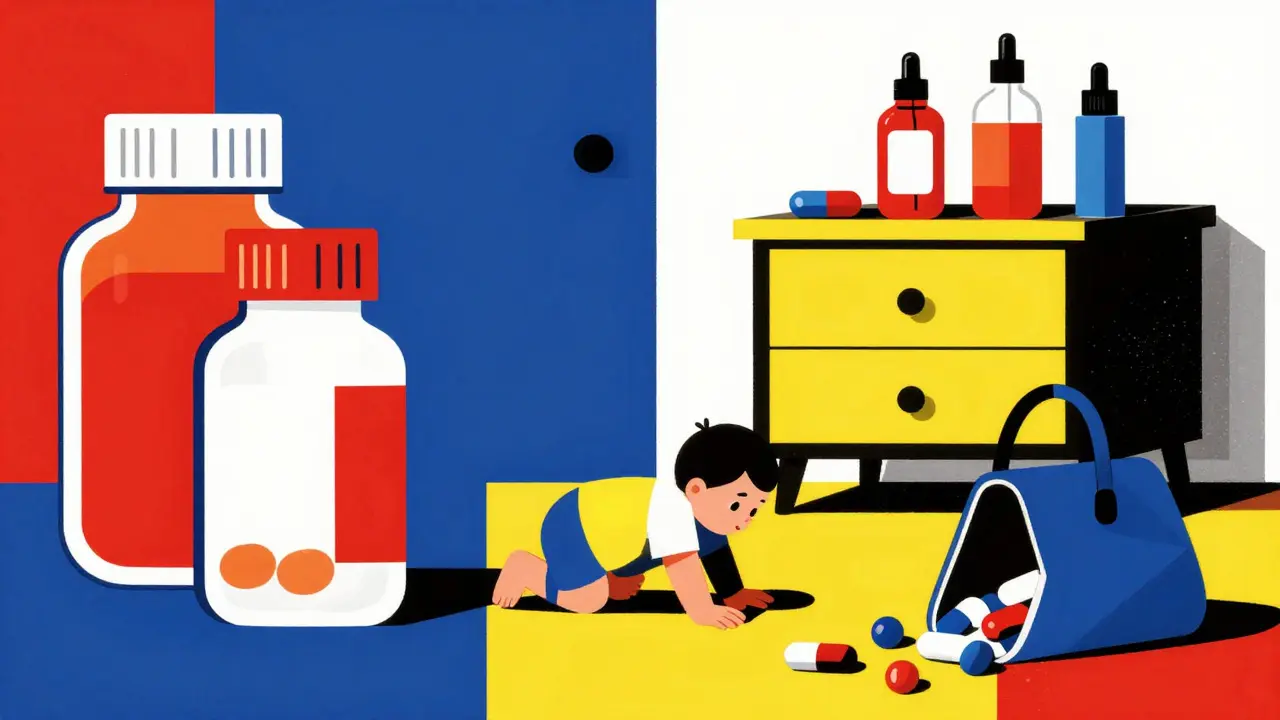
You think you’re safe because the medicine cabinet is high up. But accidental medication poisoning doesn’t care about your shelf height. In fact, more than 90 percent of these incidents happen right inside the home, often while a parent is standing just feet away. It’s a terrifying statistic that hits close to home for many families.
If you have kids under five, you are in the highest-risk demographic. Data from the Children’s Safety Network shows that nine out of ten poisoning deaths in children are linked to drugs. That’s not a rare edge case; it’s the main driver of risk. So, how do we stop this? It’s not just about locking doors. It’s about understanding how toddlers see the world, where they hide their treasures, and why "child-resistant" is a marketing term, not a guarantee.
Why Your Current Storage Might Be Failing You
Let’s get one thing straight: child-resistant containers are not childproof. The American Academy of Pediatrics (AAP) warns that persistent toddlers can defeat most standard caps within minutes. If you rely solely on the cap, you’re gambling with your child’s safety.
Think like a detective. Get down on your hands and knees. Crawl around your living room, kitchen, and bathroom. What do you see? At eye level, you’ll find things adults ignore: loose pills on the nightstand, vitamins in an open drawer, or a handbag left on the floor. NYU Langone Health’s 2023 guidelines highlight that children use toilets and countertops as stepping stones. If it’s reachable by climbing, it’s fair game.
Here is a critical rule: Never store medications in purses, bags, or coat pockets within reach. Nationwide Children’s Hospital reports that 30 percent of exposures come from visitors’ belongings. Grandparents visiting with their own heart meds in a bedside table? That’s a hazard zone. Households with visiting grandparents see a 35 percent higher incidence of medication exposure. Secure those bags immediately when guests arrive.
The High-Risk Culprits in Your Home
Not all medicines pose the same immediate threat. Some are dangerous in tiny doses. Others are dangerous because they look like candy. According to Nationwide Children’s Hospital, acetaminophen (Tylenol), ibuprofen (Motrin, Advil), and aspirin top the list of commonly ingested OTC drugs. They are everywhere, easy to grab, and often taste sweet enough for a kid to want more.
But there’s a newer, quieter danger: liquid nicotine. Found in e-cigarettes and vape refills, this substance is lethal in minuscule amounts. The AAP notes that as little as 0.5 mL-less than a drop from an eyedropper-can be fatal to a toddler. These bottles are small, colorful, and often left on coffee tables. Treat them like poison, because they effectively are.
| Item Type | Primary Risk Factor | Safety Action |
|---|---|---|
| Acetaminophen/Ibuprofen | Sweet taste, common availability, overdose leads to liver/kidney damage | Store in locked cabinets; never call it "candy" |
| Liquid Nicotine/Vape Juice | Extreme toxicity (0.5mL fatal), small size, appealing colors | Keep in locked container away from play areas |
| Prescription Pills | High potency, varied shapes/sizes, adult dosages too high for kids | Use original containers; keep out of sight entirely |
| Iron Supplements | Highly toxic in overdose, looks like red candy | Strictly locked storage; count pills daily |
Dosing Errors: The Kitchen Spoon Trap
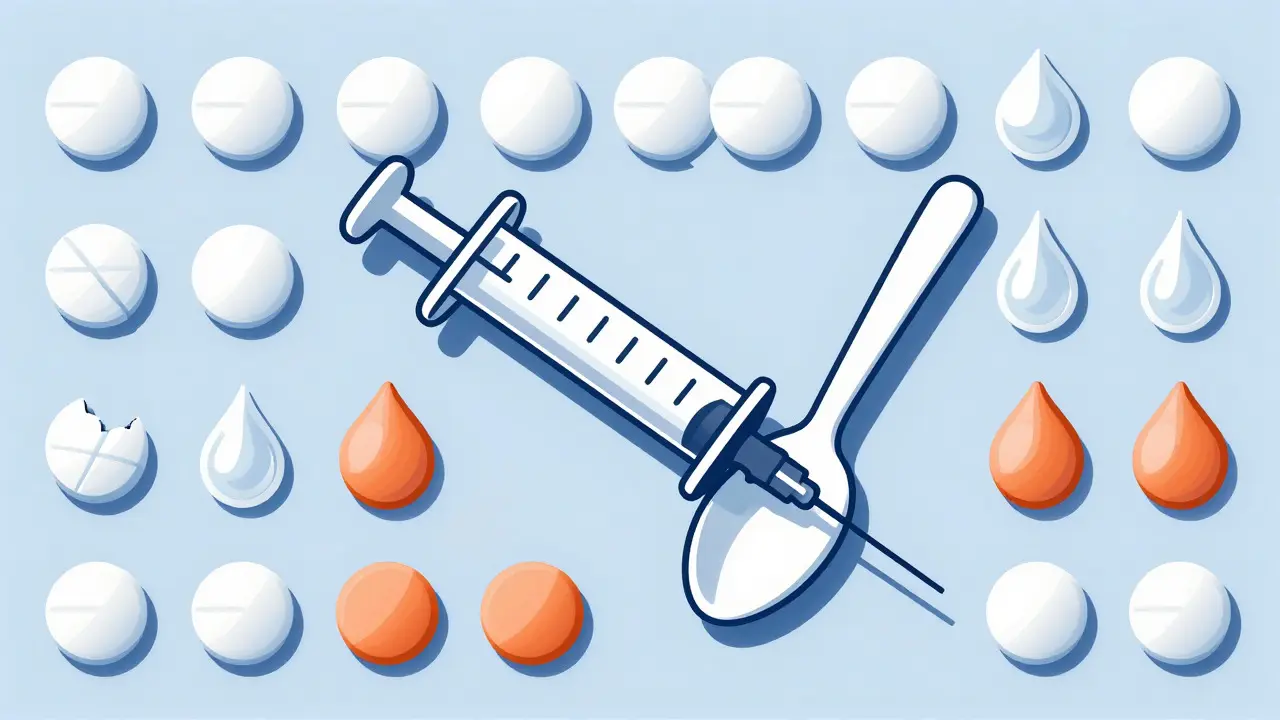
Poison Control data reveals a shocking stat: 68 percent of dosing mistakes stem from errors, not just ingestion. And here’s the kicker-42 percent of incorrect dosing incidents happen because parents used kitchen spoons instead of proper measuring devices.
Your teaspoon isn’t actually a teaspoon. Household cutlery varies wildly in volume, sometimes by 20 to 40 percent. Giving a child 5 mL of medicine using a heaped tablespoon could mean giving them double or triple the intended dose. This is especially dangerous with concentrated infant drops versus standard suspensions.
Always use the device that came with the medicine. If you lost it, buy a medical-grade syringe or cup from the pharmacy. Markings should be in milliliters (mL), not teaspoons. Precision saves lives. Also, never refer to medicine as "candy." The AAP found that doing so increases the likelihood of a child self-administering by 3.2 times. Call it what it is: medicine.
Timing and Developmental Milestones
You might assume nights are the most dangerous time. Wrong. Poison Control’s 2023 breakdown shows that 58 percent of medication poisonings occur between 12 PM and 6 PM. Why? Because that’s when parents are active, distracted, and likely taking their own meds or preparing meals. UCSF Benioff Children’s Hospital notes that 40 percent of incidents happen when a parent is actively using a product and gets distracted. Don’t leave the bottle open while you answer the door.
Children develop fast. Nemours KidsHealth points out that kids as young as 18 months can climb furniture. By age two, they are problem-solving their way into drawers. You need to anticipate milestones 3 to 6 months in advance. If your toddler is starting to pull themselves up now, they will be climbing onto counters soon. Move hazards up and lock them before the behavior starts, not after.
Emergency Response: Act Fast, Not Panic
If you suspect ingestion, time is everything. Immediate consultation within 5 minutes improves outcomes by 89 percent compared to waiting. Do not wait for symptoms to appear. Many poisons take hours to show effects, but internal damage may already be occurring.
Post the Poison Help number visibly in your home. Studies show visible postings reduce response time by 47 percent. In the UK, you would call NHS 111 or go to A&E, but knowing the general principle of immediate professional triage is key. Keep your local emergency numbers saved in your phone and written on the fridge.
Have a plan. Know where your child’s weight is recorded. Dosage calculations depend heavily on weight. If you don’t know their current weight, guess conservatively lower rather than higher. And keep CPR training fresh. While rare, severe cases may require life-saving interventions before help arrives.
Building a Safer Home Environment
Prevention is a system, not a single action. Start with a full audit. Use magnetic locks or automatic latches on all cabinets containing chemicals or meds. Ensure latches engage automatically when closed. Manual latches can be forgotten.
Consider community resources. Nationwide Children’s Hospital highlights programs providing free medication lock boxes, which reduced access incidents by 41 percent. Check if your local pharmacy offers similar services. Smart medication containers are emerging, too, with pilot programs showing a 63 percent reduction in unsupervised access. If budget allows, tech-assisted safety is becoming a viable option.
Finally, educate older siblings. The Rural Health Information Hub’s toolkit mentions school programs reducing misuse by 28 percent. Teach your 7-year-old that medicine is for grown-ups or sick people only, and never to share it. Peer pressure and curiosity drive many accidental ingestions in multi-child households.
Are child-resistant caps really safe?
No, they are not childproof. The American Academy of Pediatrics warns that persistent children can defeat most child-resistant caps within minutes. They are a deterrent, not a barrier. Always store medications in locked cabinets or containers, regardless of the cap type.
What is the most dangerous medication for toddlers?
While acetaminophen and ibuprofen are the most commonly ingested, liquid nicotine is extremely dangerous due to its high toxicity. As little as 0.5 mL can be fatal to a toddler. Iron supplements are also highly toxic in overdose. Always treat all medications as potential hazards.
Can I give my child medicine with juice?
It depends on the specific medication, but generally, mixing medicine with food can lead to incomplete dosing if the child doesn't finish the meal. More importantly, calling it "candy" or hiding it in treats increases the risk of self-administration later. Consult your pharmacist about compatibility, but prioritize accurate measurement over taste masking if possible.
How long does it take for symptoms to appear after poisoning?
Symptoms can appear within minutes or take several hours, depending on the substance. Do not wait for symptoms to decide whether to seek help. Immediate consultation with a poison control center or emergency service within 5 minutes of exposure significantly improves outcomes.
Where should I store medications if I don't have a locked cabinet?
Use a portable lock box or a plastic bin with a padlock. Store it on a high shelf that requires a step stool to reach, ensuring the child cannot climb nearby furniture to access it. Avoid storing meds in bathrooms where humidity can degrade them, unless the container is sealed and locked.